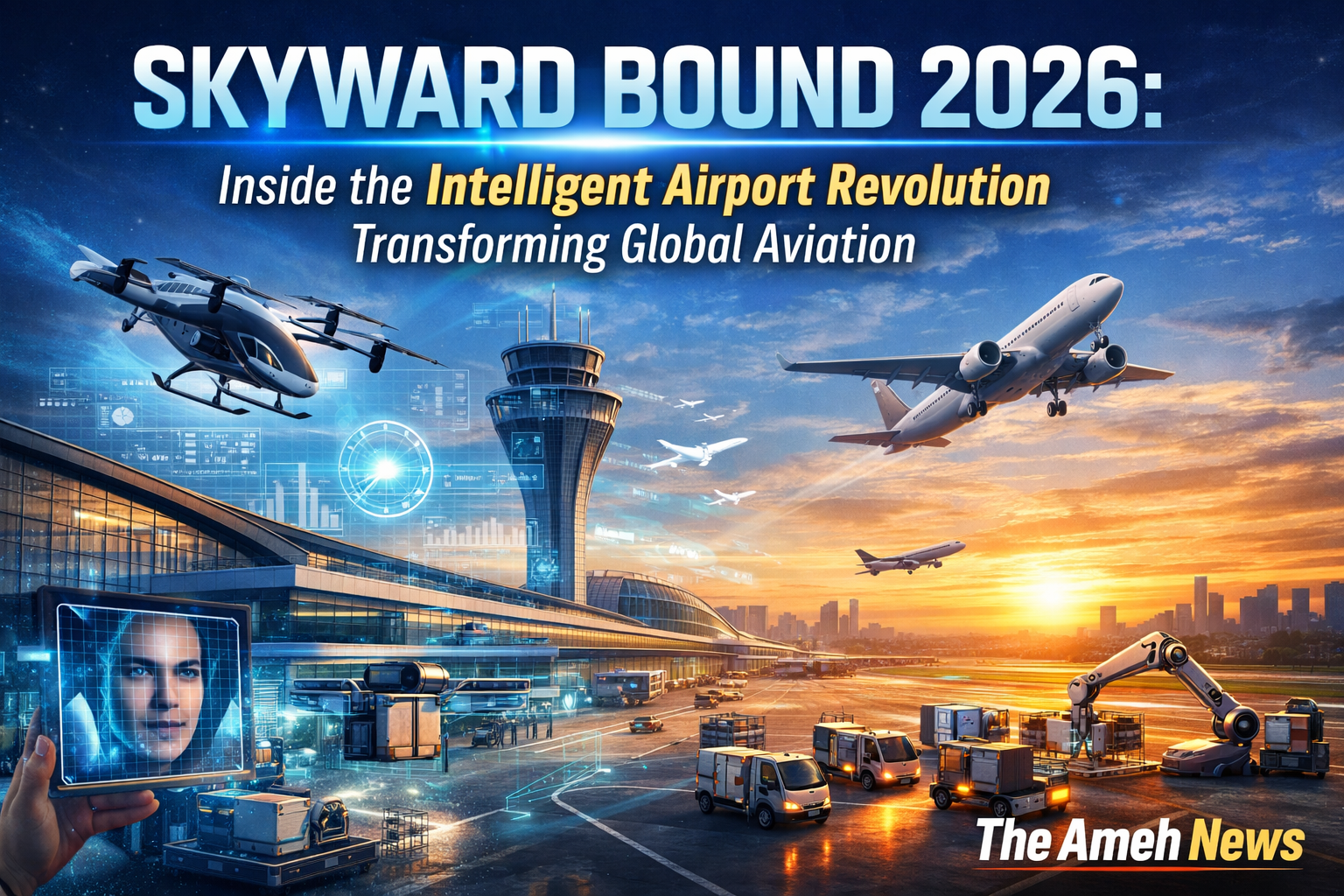
 The global aviation industry is undergoing one of the most profound transformations in its history. In 2026, airports are no longer defined solely by runways and terminals; they are evolving into intelligent infrastructure ecosystems powered by artificial intelligence, digital identity systems, and integrated logistics networks.
What is emerging is a new aviation economy—one that blends technology, sustainability, and data-driven efficiency into a unified operational model. And according to economic experts, the implications go far beyond aviation.
From Transit Hubs to Economic Power Platforms
Traditionally, airports served as gateways—facilitating the movement of passengers and cargo. Today, that model is rapidly changing. Industry analysis from FlightGlobal shows that airports are becoming multi-dimensional infrastructure platforms integrating energy systems, smart logistics, and digital connectivity.
This evolution is positioning airports as critical drivers of economic growth, trade facilitation, and regional development.
Reacting to this shift, economist Celestine Ukpong noted that the transformation of airports into intelligent ecosystems signals “a redefinition of infrastructure itself.”
“Airports are no longer just transport facilities; they are becoming economic command centres. The countries that understand this early will control not just mobility, but trade efficiency and investment flows,” Ukpong said.
Artificial Intelligence and the New Operational Intelligence
The backbone of this transformation is Artificial Intelligence (AI), which has evolved from a support function into a core decision-making system. Discussions at global forums like the FTE APEX Asia Expo point to the rise of “agentic AI”—systems capable of predicting, adapting, and executing operational decisions autonomously.
From rerouting flights around volatile weather conditions to proactively identifying aircraft maintenance needs, AI is reshaping operational efficiency.
A notable example is Delta Air Lines, where AI-driven maintenance has reduced unscheduled downtime by 35%.
Ukpong believes this signals a broader economic shift:
“AI in aviation is not just about efficiency—it is about cost compression and productivity expansion. Lower downtime means higher asset utilisation, and that translates directly into stronger revenue performance for airlines and airports.”
With the global AI aviation market projected to exceed $170 billion by 2033, the financial stakes are enormous.
Digital Identity and the Future of Passenger Experience
Passenger processing is also being revolutionised. According to SITA, nearly half of airports globally are set to deploy biometric identity systems by the end of 2026.
The International Civil Aviation Organisation is advancing the Digital Travel Credential (DTC), which could eliminate the need for physical travel documents.
Ukpong emphasised the economic implications of this shift:
“Time is an economic resource. Reducing passenger processing time improves throughput, increases airport capacity without physical expansion, and ultimately boosts revenue generation.”
Air Cargo, E-Commerce and the Digital Supply Chain
The growth of e-commerce is reshaping cargo operations. With approximately 20% of global air cargo tied to online retail, airports are increasingly adopting blockchain, predictive analytics, and real-time tracking systems.
These technologies enhance transparency, efficiency, and trust across supply chains. However, they also introduce new risks.
“As aviation becomes more digitised, cybersecurity becomes a macroeconomic issue,” Ukpong warned. “A breach in cargo systems can disrupt trade flows and erode investor confidence.”
Advanced Air Mobility and a New Transport Layer
Aviation’s future is also expanding beyond traditional aircraft. Companies like Archer Aviation, in collaboration with Nvidia, are developing electric vertical takeoff and landing (eVTOL) aircraft designed for urban mobility.
These innovations could introduce an entirely new layer of transportation—linking cities, airports, and remote areas with unprecedented efficiency.
Ukpong sees this as a potential economic game-changer:
“Advanced Air Mobility could unlock new urban economies, reduce congestion costs, and create entirely new value chains around aerial logistics.”
Air Traffic Modernisation and Infrastructure Investment
To support growing demand and emerging technologies, governments are investing heavily in air traffic management systems. In the United States, contracts awarded to RTX Corporation and Indra Sistemas are driving a $12.5 billion overhaul of ageing infrastructure.
These upgrades are expected to reduce congestion, improve safety, and enable integration with autonomous aviation systems.
Ukpong highlighted the broader economic significance:
“Infrastructure modernisation is not a cost—it is an investment multiplier. Efficient air traffic systems reduce delays, lower fuel consumption, and enhance overall economic productivity.”
Sustainability Moves from Policy to Performance
Sustainability is now embedded in aviation strategy. The International Air Transport Association projects a $4.5 billion investment in Sustainable Aviation Fuel (SAF) in 2026.
However, cost and supply challenges remain key obstacles, even as regulatory pressures intensify globally.
Ukpong noted:
“Sustainability is no longer optional—it is a competitive variable. Airlines and airports that fail to adapt will face regulatory penalties, higher operating costs, and declining investor interest.”
Workforce Transformation Through Immersive Technology
The aviation workforce is also being reshaped by immersive technologies such as VR, AR, and XR. These tools enable realistic training simulations, improving safety and operational readiness.
From pilots to ground staff, the next generation of aviation professionals is being trained in digital environments that mirror real-world complexities.
The Intelligent Airport and the Future Economy
According to International Airport Review, airports that successfully integrate aviation, energy, logistics, and digital systems will emerge as critical infrastructure platforms in the global economy.
For Ukpong, the implications are clear:
“The future of aviation is not just about flying—it is about building integrated economic ecosystems. Intelligent airports will determine how efficiently nations connect to global trade and investment networks.”
As 2026 unfolds, aviation is no longer just an industry—it is an evolving ecosystem at the intersection of technology, sustainability, and global commerce.
From AI-driven operations and biometric travel to advanced air mobility and green fuels, the transformation is both deep and irreversible.
And as Celestine Ukpong’s analysis underscores, the stakes extend far beyond airports:
“This is not just an aviation story—it is an economic transformation story. The countries that get it right will define the future of global connectivity.”
The global aviation sector is undergoing a major transformation in 2026 as airports evolve into intelligent infrastructure platforms powered by AI, digital identity, and sustainable technologies. Economist Celestine Ukpong highlights the far-reaching economic implications of this shift, from increased efficiency and trade expansion to the emergence of new mobility ecosystems.
Explore how AI, digital identity, and emerging technologies are transforming airports into intelligent economic hubs in 2026, with expert insights from economist Celestine Ukpong on global aviation’s future.
Discover more from Ameh News
Subscribe to get the latest posts sent to your email.