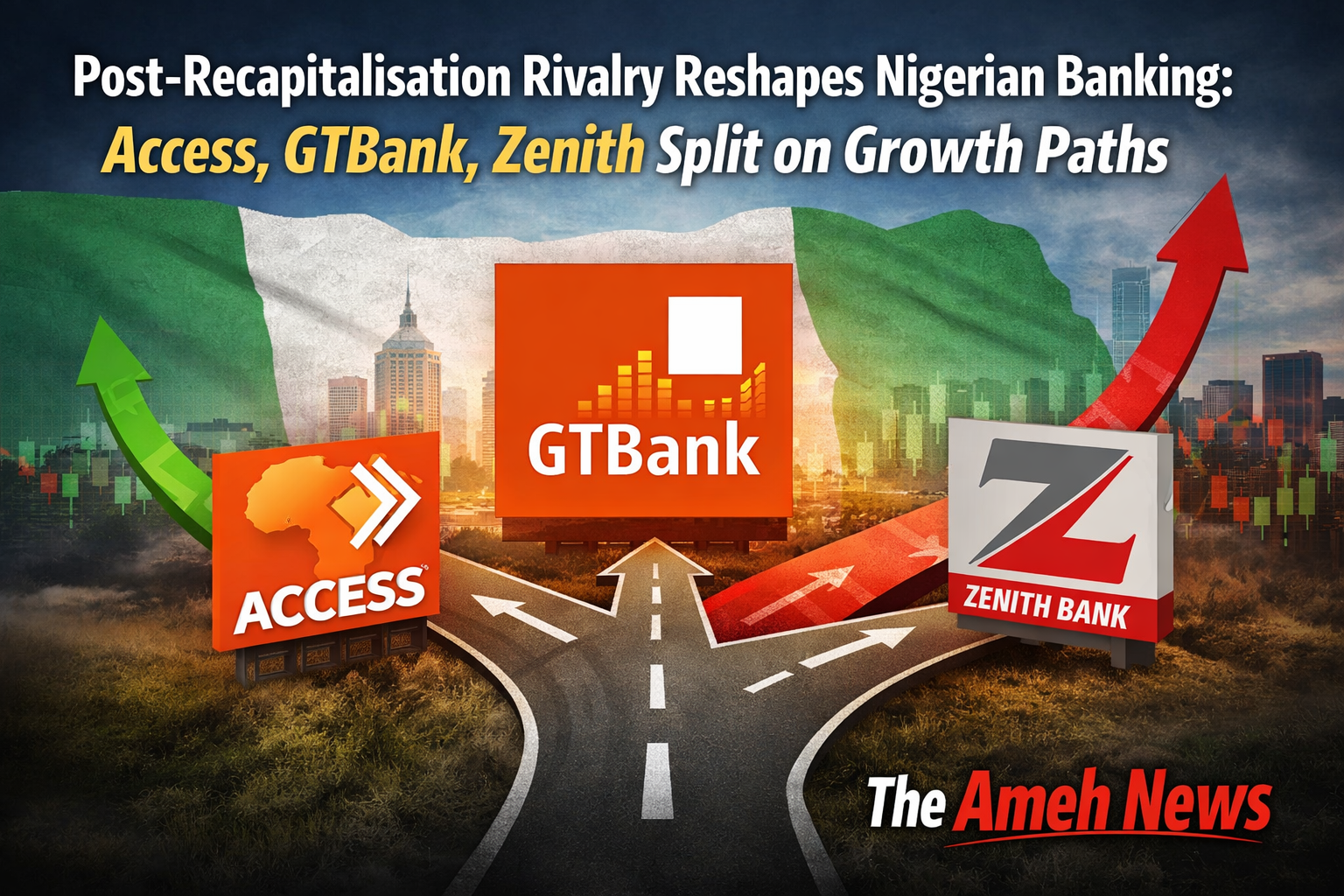
 Nigeria’s banking industry has entered a defining new phase following the Central Bank of Nigeria’s recapitalisation directive, which is forcing financial institutions to strengthen capital buffers, improve resilience, and reposition for regional and global competitiveness.
Among the Tier-1 banks, Guaranty Trust Bank (GTBank), Zenith Bank, and Access Bank are emerging as the most closely watched players—not only because of their size and influence, but because of the sharply different strategies they are adopting in the post-recapitalisation era.
While all three lenders are technically moving in the same regulatory direction, their strategic interpretations of “growth” and “strength” are increasingly divergent, setting the stage for a more complex and competitive banking landscape.
A Regulatory Reset That Changed the Competitive Logic
The recapitalisation framework introduced by the Central Bank of Nigeria is widely seen as a structural reset of the financial system. Beyond compliance, it is forcing banks to rethink their business models—how they raise capital, deploy credit, manage risk, and expand across borders.
Instead of uniform responses, the industry is now witnessing a strategic split: efficiency-led banking, stability-led banking, and expansion-led banking.
GTBank: Discipline, Digital Efficiency and Profit Quality
GTBank has positioned itself as a disciplined, efficiency-driven institution in the post-recapitalisation era. Rather than aggressively expanding its balance sheet, the bank is prioritising profitability, digital strength, and operational efficiency.
Its post-recapitalisation focus includes:
Maintaining lean cost structures and strong cost-to-income discipline
Deepening digital banking dominance and customer self-service channels
Prioritising high-quality earnings over aggressive loan expansion
Preserving its premium brand positioning in retail and corporate segments
Industry analysts note that GTBank’s approach reflects a belief that future banking leadership will be defined less by asset size and more by return on equity, technology efficiency, and customer experience.
In essence, GTBank is betting on “smart scale” rather than “large scale.”
Zenith Bank: Stability, Institutional Strength and Corporate Dominance
Zenith Bank continues to reinforce its long-standing reputation as one of Nigeria’s most stable and well-capitalised financial institutions.
In the post-recapitalisation environment, Zenith’s strategy remains anchored on conservative growth and strong fundamentals.
Key priorities include:
Strengthening Tier-1 capital through sustained profitability and retained earnings
Expanding dominance in corporate, oil & gas, and public sector banking
Maintaining strict credit risk controls and high asset quality
Growing international presence, particularly in key financial hubs
Zenith’s model reflects continuity rather than disruption. It is not dramatically changing direction; instead, it is scaling its proven strengths—corporate banking leadership, liquidity management, and risk discipline.
Access Bank: Aggressive Expansion and Continental Ambition
Access Bank has adopted the most aggressive post-recapitalisation posture among the trio, leaning heavily into expansion, acquisitions, and pan-African integration.
Its strategy reflects a bold ambition to become a dominant financial institution across Africa and selected global markets.
Core post-recapitalisation drivers include:
Cross-border acquisitions and strategic mergers across Africa
Expansion into retail banking and financial inclusion markets
Diversification of revenue streams beyond traditional lending
Strengthening presence in payments, trade finance, and digital ecosystems
Access Bank’s model is high-growth and high-complexity. It prioritises market capture and geographic reach, even as it navigates the operational challenges of integrating multiple subsidiaries across different regulatory environments.
Three Banks, Three Strategic Identities
The recapitalisation exercise has not only strengthened Nigeria’s banking system—it has clarified its internal hierarchy of strategy:
GTBank: Efficiency-led, technology-driven, profitability-focused
Zenith Bank: Stability-led, corporate-focused, risk-disciplined
Access Bank: Expansion-led, acquisition-driven, pan-African
Rather than converging, the banks are diverging into clearly defined strategic identities.
Sector Implications: A More Complex Banking Future
Analysts suggest that this divergence may ultimately strengthen Nigeria’s financial system by creating multiple layers of competitiveness.
However, it also introduces new uncertainties:
Can efficiency consistently outperform scale in a capital-heavy industry?
Will aggressive expansion dilute returns over time?
How will regulatory capital pressure influence future mergers and consolidations?
What is clear is that Nigeria’s banking landscape is no longer defined by similar strategies competing on the same terms. It is now a multi-speed ecosystem shaped by distinct financial philosophies.
The post-recapitalisation era has begun—not as a uniform upgrade, but as a strategic divergence.
Nigeria’s post-recapitalisation banking landscape is evolving as GTBank focuses on efficiency, Zenith Bank strengthens stability, and Access Bank accelerates expansion across Africa, redefining competition in the financial sector.
Discover more from Ameh News
Subscribe to get the latest posts sent to your email.