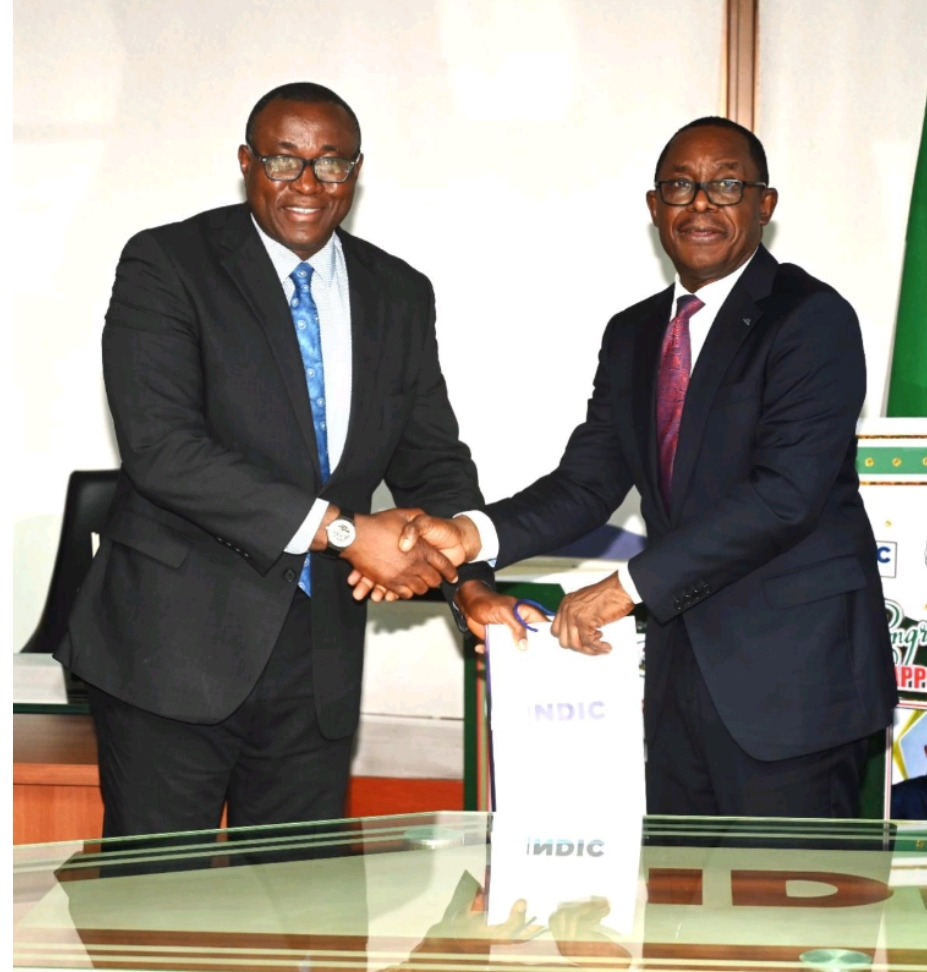
….Leadership Under Pressure as NDIC–Wema Bank ₦125bn Case Returns to Spotlight
 The new Managing Director/Chief Executive Officer of the Nigeria Deposit Insurance Corporation (Nigeria Deposit Insurance Corporation), Mr Sunday Oludare Thompson, is facing what industry observers describe as his first major “acid test” following his assumption of office, as the long-running ₦125 billion Banana Island asset dispute with Wema Bank intensifies.
The case, centred on high-value properties located within Banana Island, has re-emerged as one of the most consequential legacy banking recovery battles in Nigeria’s financial system, drawing renewed scrutiny from regulators, legal analysts, and the investment community.
A Legacy Case Resurfaces with New Leadership at the Helm
Mr Thompson, who officially resumed office on July 25, 2025, inherits a complex institutional mandate: the recovery and resolution of assets tied to defunct banking operations, alongside the protection of depositor interests and maintenance of financial system stability.
The ₦125 billion dispute, alongside a related ₦401 million contested payment, originates from liquidation processes involving a now-defunct financial institution whose licence was revoked by the Central Bank of Nigeria (CBN) during earlier banking sector reforms.
While the NDIC continues to assert its statutory role as liquidator and asset recovery authority, Wema Bank has consistently maintained that its current operations are distinct from historical transactions being questioned in court.
Legal proceedings remain ongoing, with both parties contesting valuation, ownership rights, and the legitimacy of certain asset transfers tied to the Banana Island properties.
Banana Island at the Centre of Financial Controversy
The disputed assets are located in Banana Island, one of Nigeria’s most exclusive real estate corridors, where property valuations rank among the highest in Lagos and across West Africa.
Because of its strategic location and premium asset profile, the estate has become symbolic of broader questions surrounding transparency, asset tracing, and post-liquidation accountability in Nigeria’s banking sector.
Financial analysts note that disputes involving such high-value real estate often extend beyond legal technicalities, becoming reputational tests for institutions involved.
Acid Test for NDIC Leadership
For Mr Thompson, the timing of the case adds weight to early expectations surrounding his leadership. Analysts suggest his handling of the dispute will be closely watched as a measure of:
Institutional firmness in asset recovery
Legal strategy coordination
Stakeholder confidence management
Continuity in long-running liquidation frameworks
An economist, noted that such legacy disputes often define public perception of financial regulators:
“Cases like this are not just about money recovery—they are about how seriously institutions are taken in enforcing financial accountability over time.”
Governance and Reputation Pressure on Wema Bank
For Wema Bank, the dispute arrives at a sensitive period marked by leadership transition and strategic restructuring in Nigeria’s increasingly digital banking environment.
With Mr Sunday Oludare Thompson now at the helm, the bank faces the dual challenge of sustaining operational growth while managing reputational risk linked to legacy litigation.
Financial governance experts say such disputes, even when historical in origin, can influence investor sentiment, regulatory perception, and market confidence if prolonged.
Legal and Sector-Wide Implications
Beyond the two institutions, the case reflects broader systemic issues in Nigeria’s financial sector, including:
Long-tail effects of bank liquidations
Asset registry and documentation gaps
Complexities in the valuation of legacy properties
Slow resolution timelines for recovery cases
A PR strategist and corporate governance commentator, observed that:
“The reputational dimension of financial disputes now matters as much as the legal outcome. Institutions are judged by how they manage uncertainty in real time.”
Outlook: A Defining Early Test
As proceedings continue, attention is increasingly shifting toward how effectively the NDIC under Sunday Oludare Thompson will prosecute or resolve one of its most high-profile recovery cases in recent years.
For observers, the outcome may not only shape perceptions of his early tenure but also reinforce how Nigeria’s financial system handles legacy disputes tied to defunct institutions.
For now, the ₦125 billion Banana Island case remains both a courtroom battle and a governance test—one that could define institutional credibility on both sides of the dispute.
Discover more from Ameh News
Subscribe to get the latest posts sent to your email.