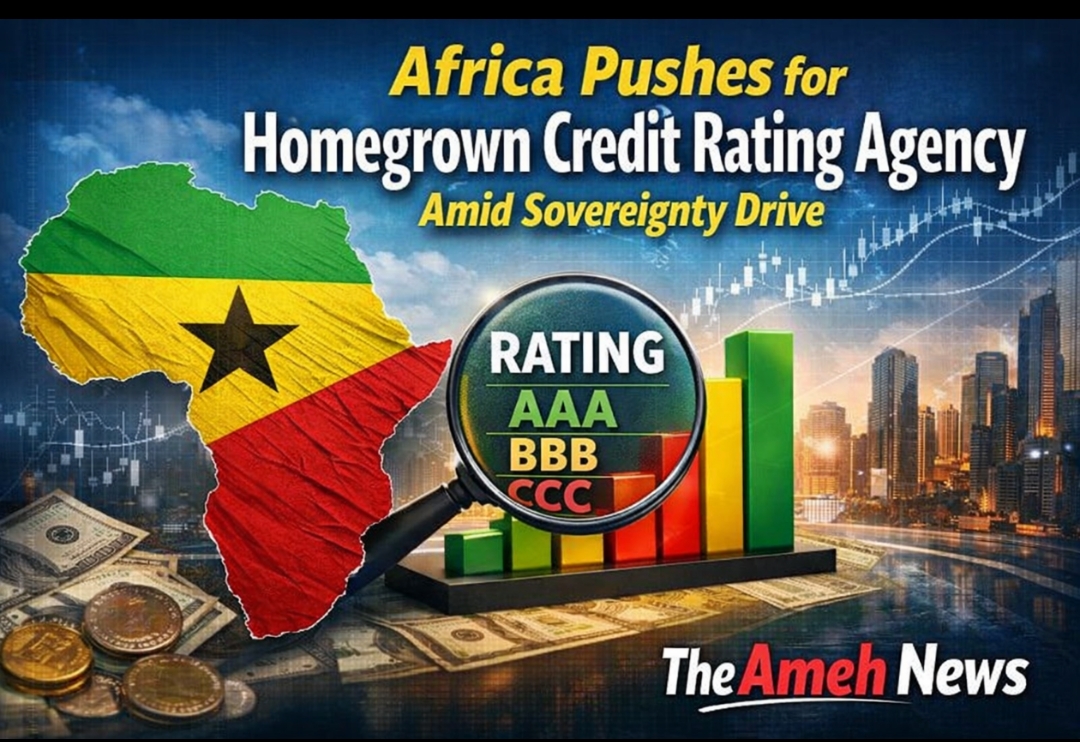
 The growing campaign for an African-owned credit rating agency has gained renewed momentum as economists, financial analysts, and policy experts intensify calls for the continent to reclaim control of its financial narrative amid mounting global economic uncertainties.
The debate, which has lingered for years within Africa’s financial and policy ecosystem, is now evolving into a broader conversation about economic sovereignty, investor confidence, debt sustainability, and the future of Africa’s position within the global credit market.
Across African economies, concerns have persisted over the influence of foreign credit rating agencies whose sovereign assessments often determine borrowing costs, investor sentiment, and access to international capital markets.
Critics argue that several African nations have repeatedly faced what they describe as disproportionately harsh downgrades and risk assessments that fail to adequately reflect local economic realities, reform efforts, growth potential, and structural resilience.
The development has reignited discussions among policymakers and financial experts on the urgent need for Africa to establish a credible indigenous rating institution capable of delivering context-driven assessments rooted in continental realities while maintaining international standards.
Historical Concerns Over Africa’s Global Credit Perception
For decades, dominant international credit rating agencies have played a powerful role in shaping how African economies are perceived globally.
Their ratings influence sovereign debt pricing, foreign direct investment inflows, banking sector confidence, and broader economic outlooks.
However, many African financial experts argue that the methodologies often applied to the continent do not sufficiently capture the unique dynamics of African economies, including the strength of the informal sector, demographic expansion, regional trade integration, natural resource potential, and emerging digital economies.
Economic observers note that even temporary downgrades can trigger severe ripple effects, including rising debt-servicing costs, weaker currencies, declining investor confidence, and constrained fiscal flexibility.
These recurring concerns have fueled continental conversations led by institutions such as the African Union and the African Peer Review Mechanism on building stronger African-led financial institutions.
Why Africa Wants Its Own Credit Rating Agency
Analysts say the call for an African-owned rating institution goes beyond economics and enters the realm of strategic continental independence.
Supporters argue that Africa must begin to develop institutions capable of assessing risks, opportunities, and economic resilience from an African perspective rather than relying almost entirely on external interpretations.
They maintain that such an institution could complement existing global agencies by introducing deeper regional understanding, local market intelligence, and more balanced risk analysis.
The initiative is also being linked to broader continental integration efforts under the African Continental Free Trade Area, which seeks to strengthen intra-African trade, regional value chains, and economic cooperation.
Financial experts believe a continent-wide rating institution could help strengthen domestic capital markets, encourage regional investments, and improve access to long-term infrastructure financing.
Forecasting Emerges as the Core of Modern Credit Ratings
Industry stakeholders say forecasting has become one of the most critical pillars of the modern credit rating business as economies become increasingly exposed to geopolitical tensions, inflation shocks, exchange-rate volatility, climate risks, and debt pressures.
Read Also This: https://amehnews.com/wp-admin/post.php?post=36333&action=edit
Modern rating systems now rely heavily on predictive analysis, economic modelling, data analytics, and forward-looking intelligence to evaluate future financial risks.
Experts argue that Africa’s economic environment requires more localised forecasting models capable of understanding regional peculiarities such as commodity dependence, informal economic activity, demographic expansion, energy transitions, and infrastructure deficits.
The growing role of technology, artificial intelligence, and big data in global finance is also transforming how rating agencies assess sovereign and corporate risks.
Observers believe Africa’s rapidly expanding fintech ecosystem and digital economy could eventually provide indigenous rating institutions with alternative datasets capable of improving the quality and accuracy of credit assessments.
Economist Celestine Ukpong Speaks to The Ameh News
Speaking in reaction to questions from The Ameh News, economist and investment analyst Celestine Ukpong described the push for an African-owned credit rating agency as both “timely and strategically necessary” for the continent’s long-term financial independence.
According to Ukpong, Africa can no longer afford to remain solely dependent on external institutions to define its economic risk profile, especially at a time when many African economies are pursuing reforms, industrial expansion, and regional integration.
He noted that while international agencies have established global credibility over decades, African economies often suffer from generalised risk perceptions that do not fully reflect local economic strengths and recovery capacities.
“Africa must begin to build institutions that understand Africa beyond textbook macroeconomic indicators. The continent’s economic realities are unique, and any serious rating framework must incorporate local context, demographic potential, informal market strength, and long-term developmental indicators,” Ukpong said.
He added that the future of the credit rating industry would increasingly depend on forecasting accuracy rather than traditional backwards-looking assessments.
“The global financial industry is moving rapidly toward predictive intelligence. Rating agencies are no longer just reporting present realities; they are forecasting future vulnerabilities and opportunities. That is where Africa must invest heavily — in data science, predictive analytics, artificial intelligence, and economic intelligence systems,” he stated.
Ukpong further warned that credibility would remain the single most important factor in determining whether an African-owned agency gains international acceptance.
According to him, any institution perceived as politically compromised or lacking methodological transparency would struggle to attract global investor confidence.
“An African-owned rating agency must not become a political institution. It must be independent, technically strong, transparent, and globally competitive. Investors respect credibility, not geography,” he stressed.
The economist also argued that Africa’s growing population, expanding consumer markets, digital transformation, and natural resource base position the continent as one of the world’s most important future investment destinations.
However, he emphasised that achieving sustainable growth would require stronger financial governance, policy consistency, and improved economic forecasting frameworks.
A Defining Moment for Africa’s Financial Architecture
As global economic uncertainties continue to reshape investment flows and sovereign financing conditions, many experts believe Africa stands at a defining moment in its financial evolution.
The push for an indigenous credit rating agency is increasingly being viewed as part of a broader continental strategy aimed at strengthening Africa’s voice within the global financial system.
Industry stakeholders insist that the success of such an institution will ultimately depend on its ability to uphold transparency, independence, analytical rigour, technological innovation, and forecasting excellence.
For many observers, the debate is no longer simply about credit ratings. It is about who gets to define Africa’s economic future in an increasingly competitive and data-driven global economy.
Africa’s growing push for an indigenous credit rating agency has reignited debates on financial sovereignty, forecasting, investor confidence, and Africa’s place in the global credit market, as economist Celestine Ukpong speaks to The Ameh News.
Economist Celestine Ukpong reacts to The Ameh News on the urgent need for an African-owned credit rating agency, the importance of forecasting, and Africa’s quest for financial sovereignty in the evolving global credit market.
Discover more from Ameh News
Subscribe to get the latest posts sent to your email.