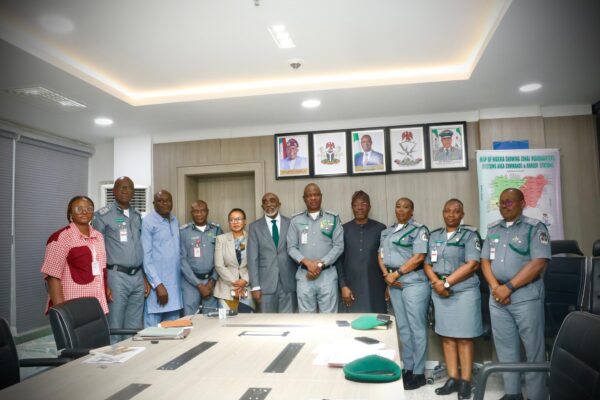
 The Nigeria Customs Service (NCS) and the National Sugar Development Council (NSDC) have reaffirmed their commitment to deepening institutional collaboration aimed at fast-tracking Nigeria’s long-standing goal of achieving self-sufficiency in sugar production.
The renewed partnership was strengthened during a strategic engagement in Abuja, where both agencies agreed to tighten coordination around trade monitoring, data sharing, and policy enforcement under the framework of the Nigeria Sugar Master Plan (NSMP), which targets reduced import dependence and expanded local production capacity.
At the meeting, Comptroller-General of Customs, Adewale Adeniyi, emphasised that the Customs Service plays a critical role in safeguarding Nigeria’s industrialisation agenda, noting that effective border management and import tracking remain essential to protecting local producers and ensuring policy success.
He stressed that Customs is fully committed to supporting the sugar sector through enhanced compliance monitoring, improved intelligence sharing, and closer operational coordination with the Sugar Council. According to him, such collaboration is necessary to close enforcement gaps that often undermine domestic production incentives and distort the market.
Adeniyi also highlighted the importance of structured engagement between both institutions, proposing the designation of focal officers and the establishment of a joint working framework to ensure continuous communication, periodic review meetings, and real-time resolution of operational challenges.
On his part, the Executive Secretary of the National Sugar Development Council, Kamar Bakrin, described Customs as a “strategic partner” in achieving Nigeria’s sugar transformation agenda. He noted that the success of the Sugar Master Plan depends heavily on effective border regulation, accurate import data, and strong enforcement mechanisms to support local investors.
Bakrin further explained that the partnership has already begun producing tangible outcomes, including immediate steps toward joint implementation, improved coordination systems, and renewed confidence among stakeholders in the sugar value chain.
He added that the engagement demonstrated a shared understanding of the importance of the sugar sector not only for food security, but also for industrial growth, job creation, and rural economic development.
Nigeria has long relied on sugar imports to meet domestic demand, but policymakers say the strengthened collaboration between Customs and the Sugar Council marks another step toward reversing that trend and building a more self-reliant and competitive local industry.
Nigeria Customs Service and the National Sugar Development Council strengthen collaboration to boost local sugar production, enhance import monitoring, and accelerate Nigeria’s drive toward self-sufficiency under the Sugar Master Plan.
Discover more from Ameh News
Subscribe to get the latest posts sent to your email.