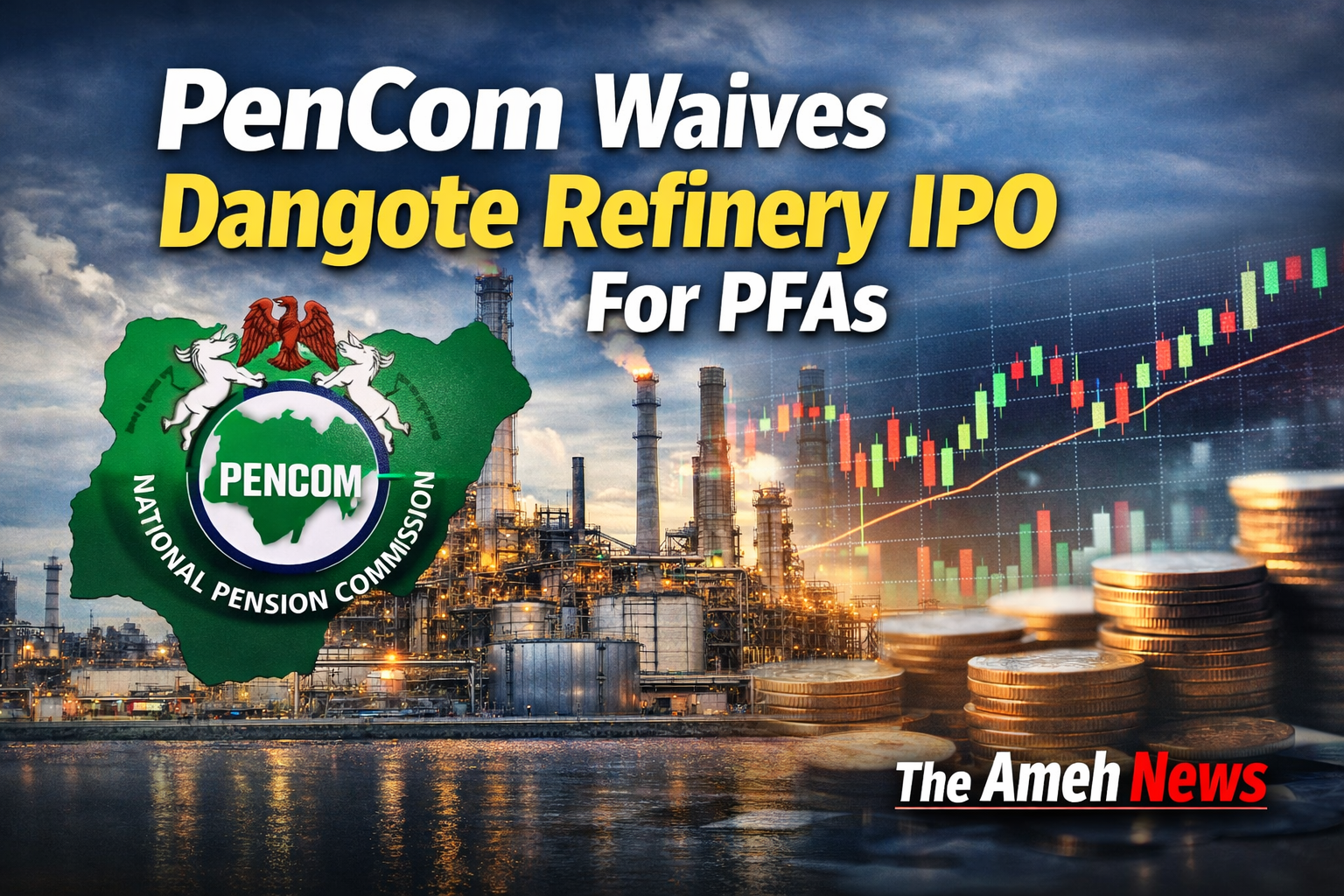
 Nigeria’s pension regulator, the National Pension Commission (PenCom), has come under renewed scrutiny after granting a rare regulatory waiver allowing Pension Fund Administrators (PFAs) to invest in the highly anticipated Initial Public Offering (IPO) of the Dangote Refinery—a move that temporarily suspends core investment safeguards designed to protect workers’ retirement savings.
The decision, contained in a circular dated May 13, 2026, effectively exempts the IPO from key eligibility requirements under Nigeria’s Revised Regulation on Investment of Pension Fund Assets, including profitability history, operating track record, and dividend payment history.
According to multiple verified reports from the National Pension Commission, the waiver was described as a “one-off, exceptional and strictly case-specific” intervention, justified by the strategic importance of the refinery to Nigeria’s economy. �
Punch Newspapers +1
A Flashback: Why Nigeria Built Strict Pension Investment Rules
Nigeria’s pension system was rebuilt after years of instability that left millions of retirees unpaid under the old defined-benefit structure.
The introduction of the Contributory Pension Scheme (CPS) was designed to eliminate political interference and protect workers’ savings through strict risk-based investment rules.
Under these rules, PFAs are generally required to invest pension assets only in companies that have demonstrated:
At least 3 years of profitability within 5 years
A history of dividend payments or bonus shares
Strong governance and transparent financial reporting
These safeguards were intended to ensure that pension funds—now worth over ₦20 trillion to ₦30 trillion depending on reporting period estimates—remain stable, conservative, and insulated from speculative or politically driven investments.
For years, PenCom was widely praised for maintaining one of Africa’s most cautious and structured pension regulatory frameworks.
The Exception: Why Dangote Refinery Changed the Equation
The waiver was issued ahead of the expected IPO of the Dangote Petroleum Refinery & Petrochemicals, a flagship industrial project owned by billionaire industrialist Aliko Dangote through Dangote Industries Limited.
The refinery—reportedly the largest single-train refinery in the world with a capacity of about 650,000 barrels per day—has been positioned as a transformational asset for Nigeria’s energy independence.
Reuters and other financial outlets report that PenCom justified the waiver on the grounds of:
The refinery’s strategic national importance
Its role in reducing fuel imports and conserving foreign exchange
The “strong fundamentals” of its parent company
The long-term investment horizon is suitable for pension assets �
MarketScreener
The IPO itself is expected to be one of the largest in Nigeria’s history, with market estimates placing valuation expectations in the multi-billion-dollar range.
What Changed: A Temporary Relaxation of Core Rules
Ordinarily, pension funds are restricted from investing in companies without a proven profitability and dividend history.
However, PenCom’s circular temporarily suspends those requirements for this specific IPO—effectively opening the door for pension participation in a high-growth but untested equity offering.
Regulators insist on the waiver:
Does not apply to future IPOs
Does not weaken overall pension safeguards
Must still comply with the internal risk management frameworks of PFAs �
investdata.com.ng
Still, analysts say the move represents one of the most significant departures from Nigeria’s pension investment orthodoxy in over a decade.
Why It Matters: The Stakes for Ordinary Contributors
Nigeria’s pension contributors—public servants, private-sector workers, and retirees—collectively own the capital now being considered for exposure to the refinery IPO.
This raises three key implications:
1. Exposure to Higher-Risk Equity
Unlike government bonds, IPO investments carry market volatility risk, especially for newly listed mega-projects without a long trading history.
2. Potential for Higher Long-Term Returns
Supporters argue that early participation in infrastructure-linked IPOs could boost pension returns over time if the refinery performs strongly.
3. Concentration Risk Concerns
Critics warn that channelling significant pension exposure into a single large national project could increase systemic risk if performance falls short of expectations.
Expert and Market Concerns
Financial analysts say the decision highlights a recurring tension in Nigeria’s economic policy:
The need to mobilise domestic capital for industrial growth
Versus the responsibility to preserve pension safety and stability
Some market observers argue that pension funds globally invest in infrastructure and energy assets—but usually under strict diversification limits and long-term risk modelling.
Others caution that Nigeria’s capital market structure still carries governance and transparency risks that make such exceptions sensitive.
A Reflection: Growth Ambition vs. Institutional Discipline
At its core, the PenCom waiver reflects Nigeria’s broader economic crossroads.
On one hand, policymakers are eager to use domestic pension capital to fund transformative projects like the Dangote Refinery, reducing dependence on foreign financing.
On the other hand, Nigeria’s pension reforms were built precisely to prevent exceptions, political pressure, and regulatory flexibility from eroding contributor trust.
The key question now is not just whether the refinery succeeds—but whether regulatory consistency can be maintained in future investment decisions.
A Defining Moment for Nigeria’s Pension System
The PenCom decision may ultimately be remembered as either:
A bold step toward unlocking long-term domestic capital for industrial growth
Or a cautionary example of regulatory flexibility in a sensitive financial system
What is certain is that millions of Nigerian workers—many of whom may never directly invest in stocks—now have a stake in one of the country’s most ambitious industrial projects through their retirement savings.
Nigeria’s PenCom has granted a rare waiver allowing pension funds to invest in the Dangote Refinery IPO, sparking debate over pension safety, regulatory consistency, and investment risk.
Discover more from Ameh News
Subscribe to get the latest posts sent to your email.