……Nigeria’s Pension Paradox: ₦30.94 Trillion Asset Surge, ₦758 Billion Liability Clearance, and a Historic Growth Cycle (July 2024–April 2026)
 Nigeria’s pension industry continues to reflect what analysts describe as the “pension paradox”—a system that is simultaneously achieving record-breaking asset growth while still confronting structural inclusion gaps and legacy obligations.
According to the multiple sources, between July 2024 and April 2026, the Contributory Pension Scheme (CPS) moved through one of its most expansionary phases in history, even as reforms under the National Pension Commission (PENCOM) attempted to deepen coverage and clear outstanding liabilities.
The Full Growth Picture (July 2024 – April 2026)
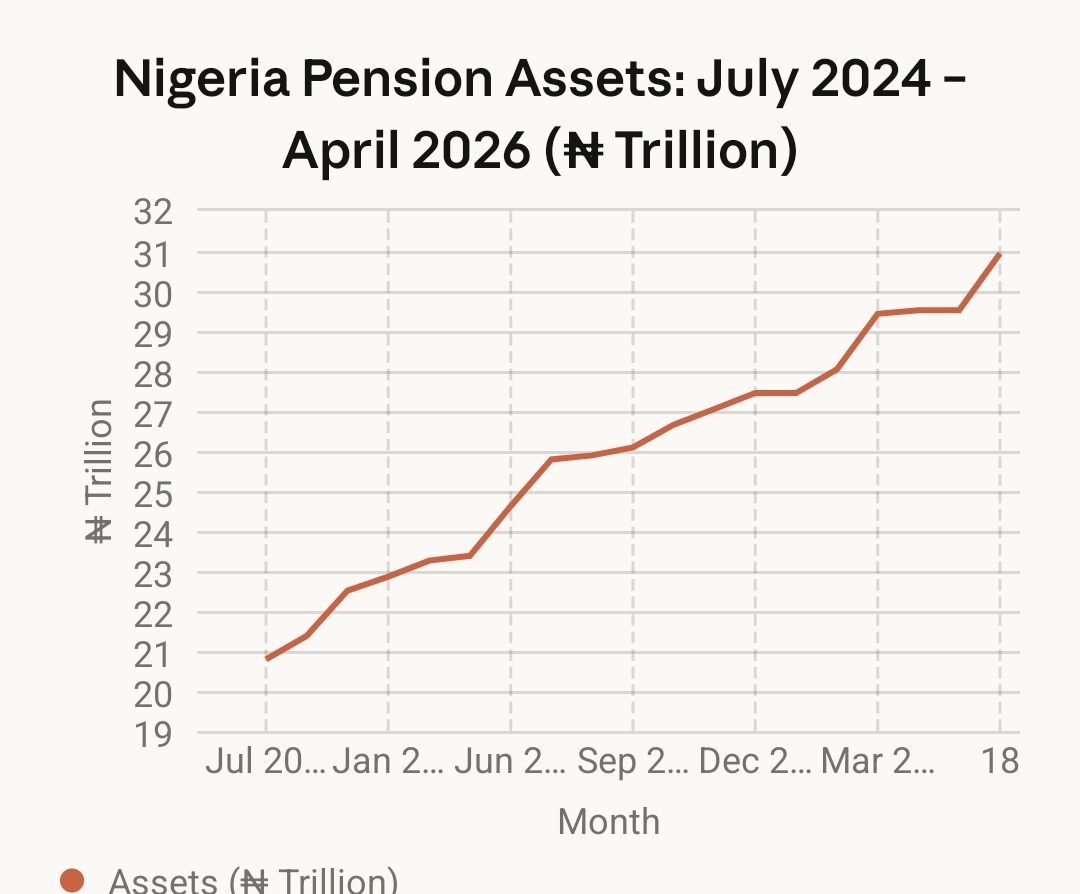
Pension fund assets stood at ₦20.79 trillion in July 2024, and rose steadily to ₦30.94 trillion by April 2026, representing a total expansion of about:
₦10.15 trillion increase
+48.8% growth in less than two years
 Key Milestones
Period Assets Growth
Jul 2024. ₦20.79tn. Baseline
Dec 2024. ₦22.51tn. +8.3%
Dec 2025. ₦27.45tn. +32.0%
Apr 2026. ₦30.94tn. +48.8%
Annual and Short-Term Performance Signals
Full-year 2025: Assets rose by 22%, increasing from ₦22.51tn to ₦27.45tn, adding about ₦4.94tn in 12 months
Year-to-date 2026 (Jan–Apr): Additional 13.8% growth
April 2026 alone: Recorded an extraordinary ₦1.42 trillion increase, widely reported as the largest monthly gain in Nigeria’s pension industry history
What Is Driving the Expansion?
Analysts attribute the strong growth cycle to three core drivers:
Sustained pension contributions from the formal sector
Strong investment income across multiple asset classes
Improved compliance enforcement across employers and institutions
A major structural feature of the portfolio remains the dominance of Federal Government securities, which account for about 56% of total pension assets, providing stability and predictable yields.
At the same time, equity market exposure also contributed significantly, as Pension Fund Administrators (PFAs) benefited from strong performance in the Nigerian stock market over the period.
₦758 Billion Bond Intervention: Clearing Legacy Liabilities
A defining policy intervention during this period was the ₦758 billion Federal Government bond approved by President Bola Tinubu in February 2026.
According to official reports, the bond was fully cashed and disbursed, with proceeds deployed to clear outstanding pension liabilities accumulated over previous years.
This settlement helped:
Reduce legacy arrears owed to retirees
Improve liquidity within the pension payment system
Restore confidence among pensioners and stakeholders
The intervention is widely viewed as a critical stabilisation mechanism that strengthened the credibility of the pension framework.
Reform Leadership and Institutional Reset
Under the leadership of Ms. Omolola Oloworaran, Director-General of PENCOM, Nigeria’s pension system has entered a reform-driven phase marked by both expansion and restructuring.
Key outcomes during her tenure include:
Rapid asset growth from ₦20.79 trillion (July 2024) to ₦30.94 trillion (April 2026)
Execution of the ₦758 billion bond-backed liability clearance
Acceleration of inclusion reforms targeting the informal sector
Strengthening of governance, transparency, and risk controls across the industry
These developments are increasingly being described by industry observers as part of a broader institutional reset of Nigeria’s pension architecture.
Expanding the System Beyond the Formal Sector
Despite strong financial performance, the system’s core challenge remains inclusion.
Nigeria’s informal sector—estimated at about 80% of the workforce—remains largely under-penetrated by pension coverage. In response, PENCOM has intensified reforms around the Micro Pension Scheme, now repositioned as a more flexible Personal Pension Plan.
The new strategy relies heavily on:
Fintech-enabled onboarding systems
Mobile-first pension contributions
Agent networks and “super agents”
Simplified digital registration models
The objective is to make pension participation as seamless as everyday financial transactions.
Infrastructure Investment and Strategic Trade-offs
An economist Celestine Ukpong told The Ameh News that another defining feature of the pension expansion era is the increased allocation of assets into infrastructure and private equity investments, aimed at supporting national development priorities.
He added that while this strategy enhances long-term economic impact and domestic capital formation, it also raises policy debates around:
Liquidity management
Inflation risk exposure
Long-term return stability for contributors
The Continuing Pension Paradox
Speaking with The Ameh News on the development, a stakeholder said despite the historic asset expansion to ₦30.94 trillion, Nigeria’s pension system continues to reflect its structural contradiction:
Added that ttrong financial accumulation and investment growth at the top
Persistent exclusion of large segments of informal workers at the base
Even with improved liquidity following the ₦758 billion bond-backed settlement, the long-term sustainability of the system depends on how effectively it expands coverage beyond the formal economy.
A Defining Phase in Nigeria’s Pension History
Taken together, the period between July 2024 and April 2026 represents one of the most dynamic growth cycles in Nigeria’s pension history:
₦10.15 trillion added in under two years
48.8% total asset growth
Largest recorded monthly gain of ₦1.42 trillion
Full settlement of major legacy liabilities via ₦758 billion FG bond
According to the report, under PENCOM’s current leadership, this period is increasingly being framed as a transformative chapter—one that combined aggressive asset growth, structural reforms, and debt resolution.
However, the ultimate measure of success will depend on whether Nigeria can resolve its central pension paradox: transforming a rapidly growing financial pool into a truly inclusive retirement system that reflects the full structure of its economy.
Discover more from Ameh News
Subscribe to get the latest posts sent to your email.