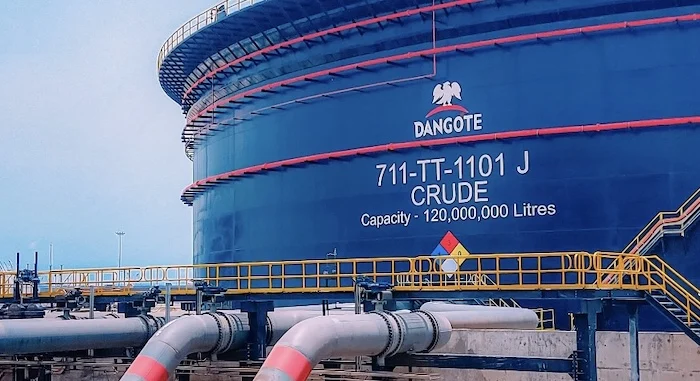
 The Management of Dangote Petroleum Refinery has firmly rejected allegations circulating in public discourse suggesting that Premium Motor Spirit (PMS) refined at its facility is being exported to Lomé and later re-imported into Nigeria.
In a strongly worded statement released on Monday, the refinery described the claims as “misleading, unfounded, and inconsistent with verifiable trade data, commercial logic, and operational realities.”
The company said it ordinarily avoids engaging with unsubstantiated allegations but was compelled to respond in order to correct public misinformation and reinforce transparency around its operations.
‘No Evidence, No Commercial Logic’ Behind Allegations
The refinery stressed that there is no factual or commercial basis for the claims, noting that all available trade data and contractual frameworks contradict the narrative being circulated.
According to management, the core objective of the refinery is to strengthen Nigeria’s domestic fuel supply chain, reduce dependence on imported refined products, and stabilise local availability of petroleum products across the country.
It added that any arrangement that allows imported fuel to compete with locally refined products would directly undermine this mandate.
“Such claims are not supported by any verifiable data or operational reality,” the statement said.
The company further disclosed that all sales contracts, tender agreements, and distribution arrangements explicitly prohibit the resale or re-importation of its petroleum products back into Nigeria once exported.
High Logistics Costs Make Scheme ‘Economically Unworkable’
A key pillar of the refinery’s rebuttal centered on the economics of the alleged practice.
Management explained that the logistics involved in transporting petroleum products from Nigeria to Lomé and back into Nigeria would impose significant additional costs, making such a scheme commercially irrational.
The refinery estimated that transportation alone would cost between US$82 and US$90 per metric ton, excluding further expenses such as storage, insurance, financing, port handling, and distribution fees.
It stressed that no rational market operator would absorb such costs only to reintroduce the same product into the domestic market at a competitive disadvantage.
“Dangote Refinery does not offer export discounts capable of offsetting these costs or creating arbitrage opportunities between export and domestic markets,” it said.
Industry analysts note that in global petroleum trade, profit margins are typically tight, and such multi-leg trade routes would eliminate any economic incentive for re-importation.
Strict Product Traceability and Compliance Systems
The refinery also highlighted what it described as a robust end-to-end traceability system designed to monitor every stage of product movement.
This includes detailed records of lifting points, vessel nominations, shipping documentation, counterparties involved, and final declared destinations.
According to the statement, these controls ensure full visibility across the supply chain and are consistent with international best practices in petroleum trading and compliance.
Management insisted that the idea of uncontrolled re-importation is incompatible with its operational safeguards.
“Any suggestion that the refinery facilitates or tolerates re-importation is inconsistent with its contractual safeguards and established compliance systems,” it stated.
Strategic Role in Nigeria’s Energy Security
Reaffirming its broader national role, the company said its operations are anchored on reducing Nigeria’s dependence on imported petroleum products and strengthening local refining capacity.
The refinery emphasized that enabling re-importation would be counterproductive to national economic goals, including:
Pressure on Nigeria’s foreign exchange reserves
Weakening of domestic refining incentives
Reduced competitiveness of local industrial investment
Undermining energy self-sufficiency efforts
It stressed that its long-term vision is aligned with Nigeria’s industrialisation agenda and broader African energy security goals.
Allegations ‘Entirely Unfounded’
The statement concluded with a categorical denial of the allegations, describing them as “entirely unfounded” and unsupported by any strategic, operational, or economic evidence.
“There is no commercial logic, no contractual allowance, and no operational pathway that supports the claim that Dangote Refinery exports PMS for re-importation into Nigeria,” the company said.
It reaffirmed its commitment to transparency, compliance, and accountability across its operations.
The statement also reiterated the position of Dangote Industries Limited as a group focused on advancing Africa’s industrial development through strategic investments in energy, manufacturing, and infrastructure.
More information about the group is available at its official website: dangote.com
Industry Context
The clarification comes amid heightened scrutiny of petroleum supply chains in West Africa, where concerns around product diversion, arbitrage trading, and cross-border fuel movement have periodically surfaced.
However, experts in the downstream petroleum sector argue that large-scale structured re-importation schemes would face significant logistical, regulatory, and financial barriers, particularly in tightly monitored supply chains involving major refineries.
Dangote Refinery denies claims of PMS export and re-importation into Nigeria, citing trade data, strict contracts, traceability systems and high logistics costs.
Discover more from Ameh News
Subscribe to get the latest posts sent to your email.