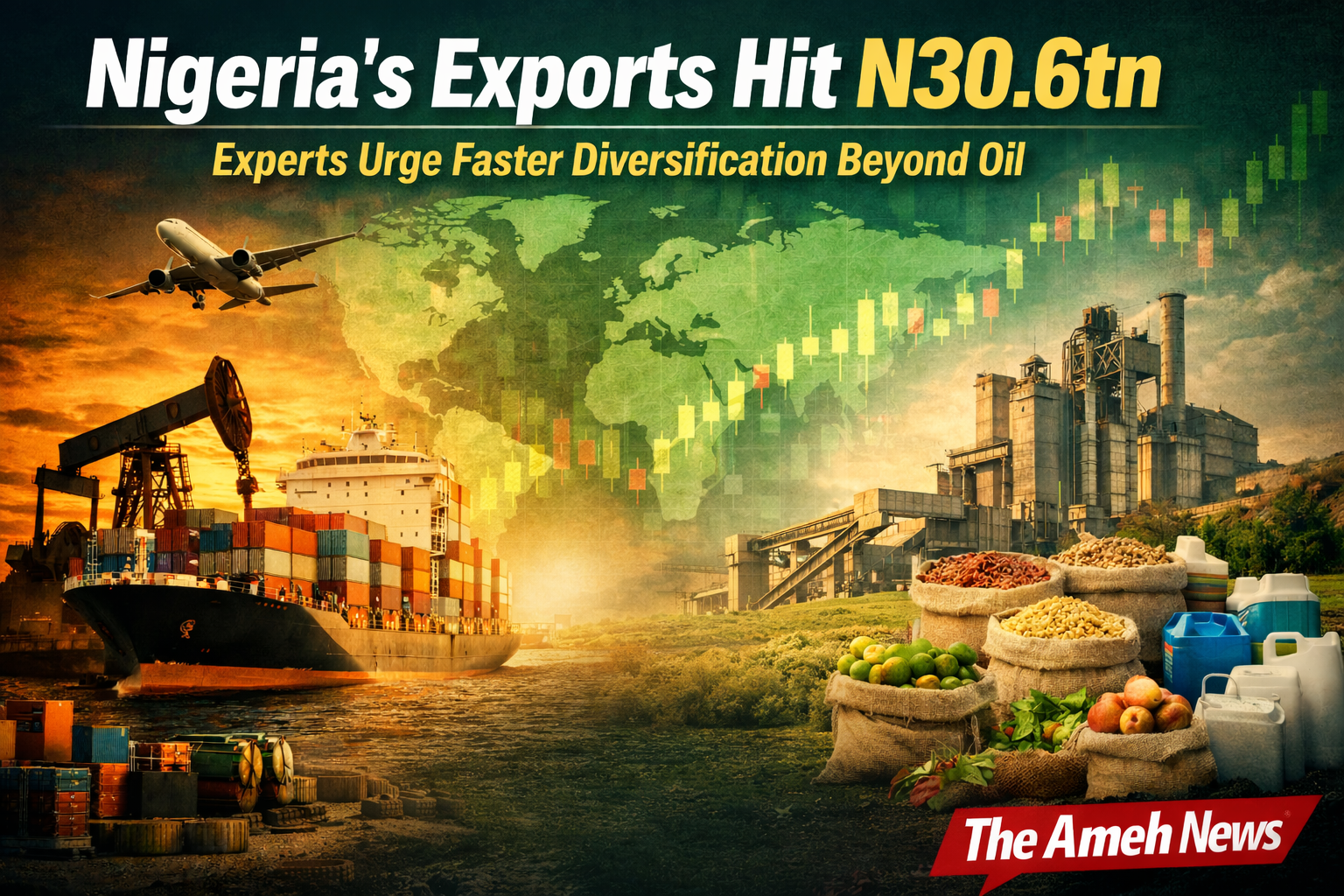
 Nigeria’s export sector is demonstrating renewed strength, with the country recording exports worth more than N30.6 trillion ($19.1 billion) between June 2025 and January 2026, according to trade-flow data compiled by the United Nations international trade statistics database, UN Comtrade.
The latest figures reveal that the United States remains Nigeria’s largest export destination, while India continues to increase its purchases of Nigerian products. At the same time, trade with African countries has surged under the African Continental Free Trade Area (AfCFTA), signaling a new phase in Nigeria’s economic integration with the continent.
The data showed that Nigeria exported an average of N3.78 trillion ($2.36 billion) worth of goods monthly during the eight-month period, reflecting sustained global demand for Nigerian commodities and manufactured products.
American importers purchased Nigerian goods worth N7.95 trillion ($4.97 billion), accounting for approximately 26 per cent of total exports. The United States imported more than twice the value of goods purchased by Nigeria’s second-largest export destination, India.
Exports to the U.S. peaked at N1.47 trillion in June 2025 before moderating to N609.6 billion in December. However, demand rebounded significantly in January 2026, when imports climbed to N962.4 billion.
India maintained its position as Nigeria’s second-largest export market, importing goods valued at N3.42 trillion ($2.14 billion) during the period, largely driven by strong energy demand and growing commercial ties between both countries.
AfCFTA Driving Stronger Regional Trade
The country’s trade performance was equally impressive within Africa.
According to the African Trade Report 2026 released by Afreximbank, Nigeria’s trade with other African nations rose from $7.47 billion in 2024 to $9.02 billion in 2025, representing a 21 per cent increase.
The report attributed the growth to Nigeria’s increasing participation in regional commerce and efforts to leverage opportunities created by AfCFTA, which seeks to eliminate trade barriers and deepen economic integration across Africa.
While crude oil remains the dominant export product, Nigeria is increasingly exporting chemicals, plastics, rubber products, processed agricultural goods, food products, fertiliser, urea and cement to regional markets.
The diversification trend is being viewed as a positive development for Africa’s largest economy as policymakers seek to reduce dependence on oil revenues and create more sustainable export earnings.
Export Growth Must Translate Into Industrial Development
Reacting to questions from The Ameh News on the significance of the latest export figures, economist, Celestine Ukpong, described the N30.6 trillion export performance as a positive indicator of Nigeria’s competitiveness in global markets.
According to him, the figures demonstrate that Nigeria remains a strategic supplier of critical commodities to major economies despite global economic headwinds.
“Any economy that consistently expands its export footprint is creating opportunities for foreign exchange inflows, industrial expansion and employment generation. The figures show that demand for Nigerian products remains strong in both developed and emerging markets,” he said.
However, Ukpong warned that the sustainability of the export boom would depend on the country’s ability to increase value addition.
“It is encouraging that non-oil exports such as fertiliser, agro-processed products, chemicals and manufactured goods are gaining traction. But Nigeria must move faster in processing raw materials locally. Exporting finished and semi-finished products generates significantly more value than exporting raw commodities.”
He noted that AfCFTA presents one of the biggest economic opportunities available to Nigeria in decades.
“With a market exceeding 1.4 billion people, AfCFTA can become a game changer. Nigerian businesses must position themselves to dominate regional value chains. The challenge now is improving infrastructure, reducing logistics costs and enhancing competitiveness.”
Trade Growth Must Reflect in Fiscal Stability
For Peter Adebayo FCA, the impressive export numbers should be viewed beyond trade statistics and assessed through their impact on public finances, exchange rate stability and private sector growth.
Responding to The Ameh News, Adebayo said the growth in exports offers encouraging signs for Nigeria’s external reserves and foreign exchange position.
“When exports increase, foreign exchange earnings improve, pressure on the naira can reduce and government revenue may strengthen. These are important indicators for investors and policymakers,” he stated.
The chartered accountant, however, stressed that Nigeria must avoid excessive dependence on crude oil exports despite the strong figures.
“The reality is that oil still accounts for the majority of export earnings. That leaves the economy vulnerable to external shocks whenever oil prices decline. The long-term solution is expanding non-oil exports aggressively.”
Adebayo argued that fiscal authorities should use the current export momentum to support productive sectors capable of generating sustainable export earnings.
“We need stronger incentives for manufacturers, agro-processors and exporters. Trade growth should translate into increased industrial production, job creation and broader economic prosperity.”
He added that improved port infrastructure, efficient customs procedures and lower transaction costs would significantly boost Nigeria’s export competitiveness under AfCFTA.
Outlook for 2026
Economic analysts believe Nigeria’s export outlook remains positive, particularly as demand continues to strengthen across the United States, India and emerging African markets.
The convergence of rising global exports and expanding intra-African trade presents an opportunity for Nigeria to diversify its economy, attract investment and strengthen foreign exchange earnings.
With exports already surpassing N30.6 trillion in just eight months and trade with African countries crossing the $9 billion mark, experts say the next challenge will be converting trade growth into industrial development, employment creation and sustainable economic transformation.
As AfCFTA gathers momentum and global markets seek reliable suppliers of energy, agricultural and manufactured products, Nigeria appears increasingly positioned to become one of Africa’s most influential trading economies.
Nigeria recorded exports worth N30.6 trillion between June 2025 and January 2026, while trade with African countries rose 21% to $9.02 billion. Economists Celestine Ukpong and Peter Adebayo FCA explain what the figures mean for growth, forex stability and AfCFTA opportunities.
Discover more from Ameh News
Subscribe to get the latest posts sent to your email.