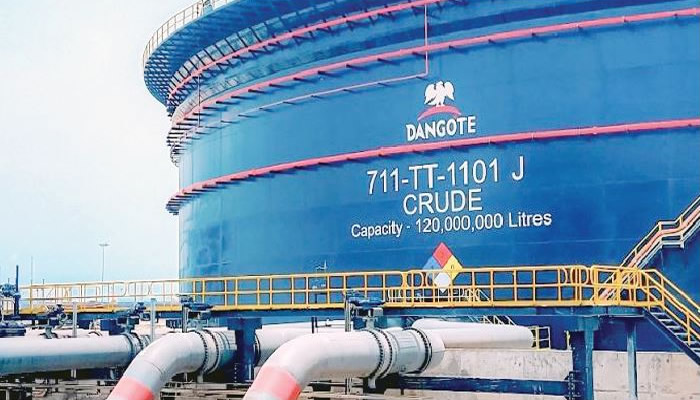
 A major shift in Nigeria’s downstream oil industry has emerged as the Dangote Petroleum Refinery abandoned naira-denominated pricing for Premium Motor Spirit (PMS), adopting a United States dollar-based pricing system in a move that analysts say reflects the growing global battle over the future of the petrodollar.
The decision comes against the backdrop of renewed efforts by United States President Donald Trump to reinforce the dominance of the US dollar in global energy trade, including closer energy cooperation with Saudi Arabia and repeated warnings against attempts by BRICS nations to weaken the dollar’s role in international commerce.
Under the new pricing framework, Dangote Refinery fixed its ex-depot petrol price at $0.779 per litre, while diesel and aviation fuel will also be sold using dollar-denominated pricing.
Based on the prevailing official exchange rate of about ₦1,380.50/$, the benchmark translates to approximately ₦1,075.61 per litre, although the actual naira amount payable will fluctuate daily with movements in the foreign exchange market.
What Changed?
The refinery informed marketers that:
All petrol, diesel and aviation fuel prices will now be denominated in US dollars.
Previously issued naira-denominated Proforma Invoices (PFIs) and Deal Recaps have been cancelled.
Customers with outstanding orders must obtain new invoices reflecting the dollar pricing system.
Marketers will pay the naira equivalent of the dollar price based on the prevailing exchange rate on the day of payment.
The policy effectively ends the refinery’s fixed naira ex-depot pricing model.
Trump’s Petro-Dollar Strategy and BRICS Tensions
The development comes as President Donald Trump intensifies efforts to preserve the US dollar’s dominance in global energy markets.
Trump has repeatedly criticised BRICS nations—including Brazil, Russia, India, China and South Africa—for exploring alternatives to the dollar in international trade. He has threatened higher tariffs and economic measures against countries attempting to replace the dollar in cross-border transactions.
Saudi Arabia, the world’s largest oil exporter, remains central to the global petrodollar system, where crude oil is largely traded in US dollars. Although some countries have experimented with local-currency energy settlements, the dollar continues to dominate global oil transactions.
Analysts say Dangote Refinery’s latest pricing decision reflects this global reality, as crude oil purchases, shipping costs, financing obligations and many international petroleum transactions are still largely settled in US dollars.
Why Dangote Switched
Industry observers say the refinery’s decision is driven by several factors:
Alignment with international crude oil purchasing arrangements.
Protection against exchange-rate volatility.
Easier management of foreign exchange exposure.
Greater transparency in product pricing.
Compliance with Nigeria’s deregulated petroleum market.
Since crude feedstock and several operational inputs are priced in dollars, maintaining naira pricing exposed the refinery to exchange-rate risks.
What It Means for Nigerians
The new pricing structure could have significant implications:
Petrol prices may now change more frequently.
Any depreciation of the naira could immediately raise ex-depot prices.
A stronger naira could reduce fuel costs.
Marketers may adjust pump prices more often.
Consumers could experience increased price volatility.
The policy links domestic fuel prices more directly to Nigeria’s foreign exchange market.
Impact on Marketers
Petroleum marketers are expected to face:
Higher foreign exchange exposure.
More frequent price adjustments.
Increased working capital requirements.
Greater uncertainty in pricing strategies.
Industry players may also need improved access to foreign exchange to finance purchases from the refinery.
Why It Matters
As Africa’s largest single-train refinery, Dangote now plays a dominant role in supplying petrol, diesel and aviation fuel to Nigeria.
Its pricing decisions significantly influence:
National fuel prices.
Distribution costs.
Inflation.
Transportation expenses.
Manufacturing costs.
Overall economic activity.
A sustained weakening of the naira could therefore translate into higher costs across multiple sectors of the economy.
The Ameh News Analysis
The move underscores the complex interaction between domestic economic reforms and global geopolitics.
While Nigeria has embraced petroleum market deregulation, the global oil trade remains overwhelmingly dollar-based. Despite BRICS’ ambitions to expand local-currency trade, the US dollar continues to be the primary currency for international crude oil transactions.
For Nigeria, Dangote Refinery’s decision highlights the economy’s continued exposure to exchange-rate fluctuations. Unless the naira strengthens or broader reforms improve foreign exchange stability, consumers may continue to experience periodic increases in fuel prices.
What Happens Next?
Stakeholders will closely monitor:
Retail pump price adjustments nationwide.
The naira’s performance against the US dollar.
Global crude oil price movements.
Federal Government foreign exchange policies.
The response of independent petroleum marketers.
Whether other refiners adopt similar dollar-based pricing models.
The policy marks another milestone in Nigeria’s transition to a fully market-driven petroleum sector, where exchange rates, international oil prices and market forces increasingly determine what Nigerians pay for fuel.
Discover more from Ameh News
Subscribe to get the latest posts sent to your email.