By The Ameh News
 The Nigerian Safety Investigation Bureau (NSIB) is facing a growing funding crisis as non-compliance by agencies expected to contribute statutory revenues leaves the accident investigation body operating on deficit budgets while its responsibilities continue to expand across Nigeria’s transport sector.
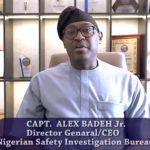
NSIB Director-General, Captain Alex Badeh Jr., disclosed that the bureau is struggling with severe funding gaps arising from delayed and inadequate remittances, particularly from agencies such as the Nigerian Maritime Administration and Safety Agency (NIMASA) and the Nigerian Railway Corporation (NRC).
The situation has created a worrying mismatch: the NSIB’s mandate has expanded from aviation accident investigation to cover air, rail, maritime and road transportation, but its financial capacity has not expanded at the same pace.
The result, according to Badeh, is that aviation-related funds are increasingly being stretched to support investigations in other modes of transportation.
The Ameh News Anatomy: When a Safety Agency Runs on Deficit
The funding problem goes beyond an accounting challenge.
For an accident investigation agency, financial limitations can directly affect the speed, quality and depth of investigations.
NSIB investigators may need to deploy rapidly to accident scenes, secure evidence, recover wreckage, conduct laboratory examinations, engage international specialists and deploy specialised equipment.
Any delay in funding can therefore become a delay in evidence preservation and technical investigation.
Badeh’s disclosure raises an important question for policymakers: How sustainable is a multimodal safety investigation system when the statutory funding architecture has not kept pace with the agency’s responsibilities?
NSIB Opposes Proposed Cut in Aviation Allocation
Badeh also expressed strong opposition to a proposed legislative amendment that would reduce NSIB’s share of the Ticket Sales Charge/Cargo Sales Charge (TSC/CSC) pool from 6 per cent to 4 per cent.
According to him, the proposed reduction would further weaken an agency that already receives one of the smallest shares of aviation-related funding despite its increasingly broad mandate.
The NSIB currently receives 6 per cent of the relevant aviation allocation, while the National Centre for Aerospace Training (NCAT) receives 7 per cent from the 13 per cent pool.
Badeh questioned the rationale for reducing NSIB’s allocation at a time when the bureau is being expected to undertake more complex investigations across multiple transportation modes.
His warning was blunt: “If you think safety is expensive, try an accident.”
The message captures the fundamental economics of safety investigation: funding prevention and investigation may appear expensive, but the consequences of inadequate safety systems can be significantly more costly.
Delayed Disbursements Add to the Pressure
The NSIB boss said the bureau has also experienced delayed and irregular disbursements of its existing 6 per cent TSC allocation since the beginning of 2026.
That situation has complicated budget planning and restricted the bureau’s ability to invest in critical infrastructure and specialist capabilities.
For an organisation whose effectiveness depends heavily on preparedness before an accident occurs, irregular funding creates operational uncertainty.
Accident investigations cannot always wait for budgetary cycles.
When an aircraft crashes, a train derails, a vessel sinks or a road transportation disaster occurs, investigators must respond immediately.
Evidence can disappear, wreckage can be moved, weather and water conditions can change, and witnesses’ recollections can become less reliable.
Maritime Investigations: NSIB Needs Underwater Technology
One of the clearest consequences of the funding constraints is the bureau’s inability to acquire essential Remotely Operated Vehicles (ROVs) for underwater investigations.
Such equipment can be critical in maritime accident investigations, particularly where wreckage lies beneath murky or brackish inland waters.
ROVs can support:
underwater search operations;
wreckage mapping;
recovery of critical evidence;
location and retrieval of bodies;
examination of submerged vessels and structures; and
documentation of underwater accident scenes.
Without adequate specialised equipment, investigators may have to depend on slower or less effective alternatives, potentially compromising the speed and completeness of evidence recovery.
Training and International Expertise Also Affected
Funding constraints are also slowing specialised technical training for investigators in the NSIB’s rail and maritime divisions.
The bureau requires highly specialised expertise because accident investigation differs significantly across aviation, railway, maritime and road transportation.
Aviation investigators require knowledge of aircraft systems, flight operations and cockpit data.
Rail investigators need expertise in signalling, track infrastructure, rolling stock and railway operations.
Maritime investigators must understand vessel design, navigation, marine engineering and underwater evidence recovery.
Building these capabilities requires sustained investment in training, certification, equipment and international collaboration.
Badeh indicated that fiscal limitations have slowed the NSIB’s ability to scale up these capabilities.
Simultaneous Accidents Could Expose the Funding Gap
Another major concern is the NSIB’s ability to respond effectively when several serious incidents occur in different parts of the country at the same time.
A multimodal investigation bureau must maintain sufficient capacity for rapid deployment, on-site evidence preservation, technical analysis and laboratory examination.
Aviation, maritime, rail and road incidents can occur independently and require different specialist teams.
If funding is inadequate, the bureau risks facing resource bottlenecks precisely when its capabilities are most needed.
NIMASA Remittance Dispute Remains Unresolved
Badeh acknowledged that discussions with NIMASA over funding remain ongoing.
He disclosed that the NSIB is working toward a Memorandum of Understanding (MOU) with NIMASA aimed at clarifying how both institutions can fulfil their respective responsibilities.
The problem illustrates a broader weakness in the current funding model.
Where one agency is dependent on another agency’s statutory remittance to finance a critical national safety function, delays or disagreements between the two institutions can quickly become an operational problem for the entire safety investigation system.
Presidency, NRS and NSIB Seek New Funding Formula
Rather than relying indefinitely on inter-agency remittances, Badeh said the NSIB is engaging the Presidency and the Nigeria Revenue Service (NRS) over a more sustainable funding arrangement.
He said the objective is to develop a funding formula that can provide the bureau with greater financial certainty and reduce its dependence on disputes surrounding statutory remittances.
The NSIB is also engaging the NRC and the Presidency as part of efforts to resolve its funding challenges.
Badeh expressed hope that the situation could be addressed through the new budget cycle and a clearer budget code.
The Bigger Question: Who Funds National Transport Safety?
The NSIB’s predicament exposes a structural question in Nigeria’s transport safety architecture.
If the government expects one agency to investigate accidents across four transportation modes, should its financial survival depend largely on contributions from individual agencies operating within those sectors?
The current arrangement creates a potential contradiction.
The NSIB is expected to provide independent, professional and no-blame accident investigations, yet its operational resources may depend on the financial compliance of agencies whose sectors it investigates.
A more predictable funding mechanism could strengthen both independence and operational readiness.
Safety Recommendations Are Not the Same as Regulation
Badeh also clarified the distinction between accident investigation and regulatory enforcement.
The NSIB conducts no-blame safety investigations designed to determine what happened, why it happened and what can be done to prevent a recurrence.
The bureau does not function as the primary regulator.
In aviation, the Nigerian Civil Aviation Authority (NCAA) is responsible for regulatory enforcement, including action relating to safety recommendations.
This distinction is important because an accident investigation agency must be able to examine systemic failures objectively without being perceived as an enforcement arm.
A Young Agency With an Expanding Mandate
Badeh described the NSIB as a young institution that evolved from the former Accident Investigation Bureau (AIB).
The transformation has significantly expanded its responsibilities.
What was once primarily an aviation accident investigation institution has become a multimodal safety investigation organisation.
That transition requires more than a change in name or legislation.
It requires:
more investigators, more equipment, more laboratories, more training, more regional response capacity and, above all, predictable funding.
The Ameh News Anatomy: Safety Cannot Be Funded as an Afterthought
The NSIB funding controversy is ultimately about more than the proposed reduction from 6 per cent to 4 per cent.
It is about whether Nigeria’s accident investigation system is being financed in proportion to the risks it is expected to manage.
Reducing NSIB’s aviation allocation while simultaneously expecting the bureau to investigate accidents across aviation, maritime, rail and road transportation could create a serious capacity mismatch.
At the same time, statutory non-compliance or delayed remittances by agencies such as NIMASA and NRC places additional pressure on an institution already operating within tight fiscal limits.
The emerging solution should therefore go beyond another inter-agency negotiation.
Nigeria needs a transparent, predictable and sustainable funding framework for independent safety investigation—one that guarantees that investigators have the tools, people and resources required before disaster strikes.
Because the real test of a safety system is not how quickly government responds after an accident.
It is whether the institutions responsible for learning from accidents are adequately equipped before the next one happens.
And that is the central warning from the NSIB funding crisis: when safety investigation runs on deficit budgets, the cost may eventually be measured not only in naira, but in lost opportunities to prevent the next accident.
Discover more from Ameh News
Subscribe to get the latest posts sent to your email.