
 Nigeria stands at a critical crossroads in the transformation of the global maritime industry, with innovation emerging as the decisive factor that could determine whether the country becomes Africa’s leading maritime gateway or loses business to faster, smarter and greener competitors.
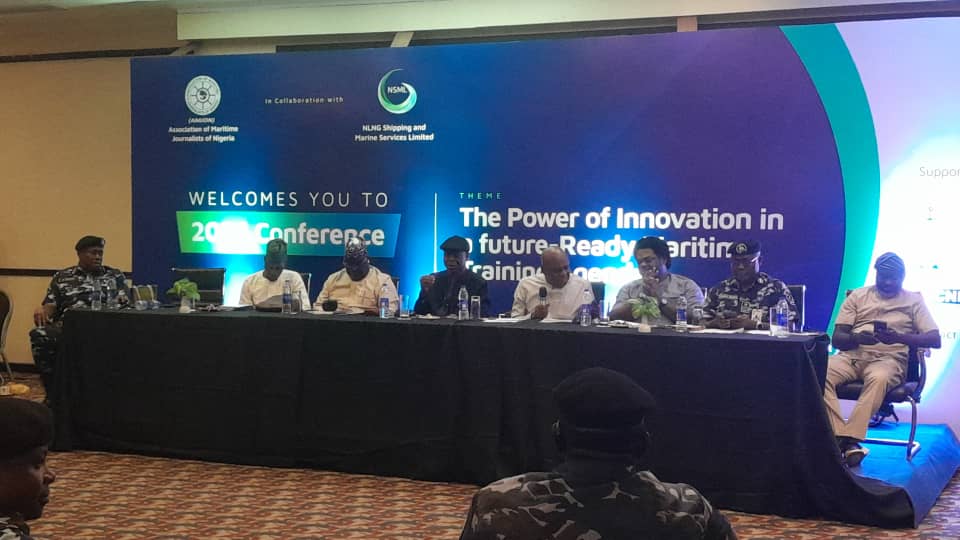
This was the central message delivered by Simeon Akin Omole, Managing Director, Ports Operations SBU, Dangote Industries Limited, in a keynote address titled “The Power of Innovation in a Future Maritime Industry.”
Omole challenged Nigeria’s maritime stakeholders to abandon the traditional notion that the industry’s primary responsibility is simply to move cargo from one destination to another.
Instead, he argued that the ports and shipping industry of the future will be judged by its ability to move cargo faster, safer, cleaner and smarter.
“The future will not reward us for simply moving cargo. The future will reward us for how fast, how safe, how clean, and how smart we move it.”
His warning comes at a time when the maritime sector is confronting simultaneous pressures from larger ships, shorter port turnaround expectations, increasingly demanding customers, stricter safety requirements and the global transition towards lower-carbon shipping.
THE NEW MARITIME COMPETITION
According to Omole, modern ships can now approach 400 metres in length, while ports are increasingly expected to turn vessels around in less than 24 hours.
Customers are demanding real-time visibility of their cargo. Regulators are pushing for increasingly stringent safety performance, while the climate agenda is forcing shipping and port operators to rethink how vessels, terminals and marine equipment are powered.
For Nigeria, he said, these changes represent both a threat and an opportunity.
“Tradition alone will not get us there. Innovation will,” he declared.
INNOVATION IS MORE THAN AI
While artificial intelligence, drones and autonomous vessels have become synonymous with discussions about maritime innovation, Omole argued that technology alone does not constitute innovation.
He identified three fundamental pillars that should underpin Nigeria’s maritime transformation:
Infrastructure. People. Knowledge.
Dangote’s SPM: Innovation Without a Nigerian Template
Using the Dangote Refinery’s offshore marine operations as a practical case study, Omole demonstrated what he described as innovation driven by necessity.
The refinery’s Single Point Mooring (SPM) complex comprises five offshore buoy systems located approximately 15 kilometres offshore, designed to facilitate the handling of very large crude carriers and support round-the-clock marine operations.
Omole said the project presented an operational challenge because there was no established Nigerian template for the scale and complexity of the operation.
The response required collaboration with regulators to delineate the Lekki anchorage, mobilisation of high-bollard-pull tugs and the development of specialised marine-safety and operational procedures.
The result, he said, has been more than 1,100 tanker calls at the facility.
For Omole, the achievement illustrates the real meaning of innovation.
“That is innovation — solving a problem that had no precedent.”
The lesson extends beyond the Dangote facility: Nigeria’s maritime industry must develop solutions suited to its own operational realities instead of waiting for foreign templates to become available.
THE HUMAN CAPITAL QUESTION
Technology may transform ports, but people will remain at the centre of maritime operations.
Omole emphasised that sophisticated infrastructure is of limited value without competent professionals capable of operating it safely and efficiently.
He highlighted investments in the training of indigenous Mooring Masters and marine crews to international SPM standards.
A significant milestone, he noted, was the berthing of the first crude vessel, MT OTIS, by Nigerian professionals.
The achievement, according to Omole, demonstrates the potential of Nigeria’s maritime workforce when given access to the right training, technology and operational exposure.
But he warned that the country’s human-capital challenge must be confronted urgently.
The maritime professional of the future, he said, must be digitally competent, safety-conscious and commercially aware.
“If we don’t build them, we will import them.”
That warning carries significant implications for Nigeria’s maritime academies, training institutions and regulators.
The country cannot aspire to become a global maritime hub while depending excessively on foreign expertise for specialised marine operations.
FROM BOOKS TO BIG DATA
Omole also connected the industry’s future to the evolution of maritime knowledge.
He recalled authoring “Containerisation: An Aspect of Shipping Practice” in 2004 because of the shortage of locally produced reference materials on shipping practice.
Nearly two decades later, he argued, the nature of maritime knowledge has changed.
Data has become a strategic asset.
Tomorrow’s ports will increasingly depend on port community systems, artificial intelligence, predictive analytics and real-time information to make operational decisions.
AI, for example, could help predict vessel delays, optimise berth utilisation and improve the coordination of cargo and marine services.
The broader lesson, however, remains unchanged: knowledge must be generated, shared and translated into practical solutions.
WHAT WILL THE MARITIME INDUSTRY LOOK LIKE IN 2035?
Omole presented three scenarios that could define the maritime industry over the next decade.
1. THE SMART PORT
The port of the future will be increasingly digital.
Artificial intelligence could influence berth allocation and vessel scheduling, while cargo documentation and clearance processes could increasingly be completed before ships arrive.
The traditional waiting game at ports could give way to highly coordinated, data-driven operations.
Turnaround performance could increasingly be measured in hours rather than days.
For Nigerian ports, Omole’s message was blunt:
“Ports that digitize will win. Ports that don’t will be bypassed.”
This places digital transformation at the centre of Nigeria’s quest to compete with leading ports around the world.
2. THE GREEN FLEET
The second major transformation will come from shipping’s energy transition.
Omole identified LNG, methanol, ammonia and wind-assist technologies among the solutions that could influence the next generation of vessels.
This transition will not be limited to ships.
Nigeria’s ports will also need infrastructure capable of supporting new propulsion and bunkering requirements.
Terminals, tug operators, marine service providers and fuel suppliers will need to anticipate the changing needs of shipowners.
By 2035, Omole suggested, the vessels calling Nigerian ports could look fundamentally different from many of today’s ships.
The strategic question is whether Nigerian ports will be ready when that fleet arrives.
AFRICAN TRADE COULD CREATE A NEW MARITIME OPPORTUNITY
The third opportunity is potentially the most strategic for Nigeria: Africa’s growing intra-continental trade.
With the African Continental Free Trade Area creating a framework for deeper economic integration, maritime connectivity will become increasingly important to the movement of goods across African markets.
Omole argued that Nigeria has the geographical position, economic scale and industrial base to become a major logistics and maritime gateway for West Africa.
But geography alone will not guarantee that position.
Nigeria will have to compete on three critical fronts:
Efficiency.
Cost.
Connectivity.
If Nigerian ports can combine those advantages with digital technology, modern infrastructure and reliable marine services, the country could strengthen its position as a regional logistics hub.
If it fails to do so, competing African gateways could capture the opportunity.
THE REGULATORY CHALLENGE
Innovation, Omole acknowledged, is rarely comfortable.
It disrupts established processes.
It forces regulators to consider technologies and operational models that may not fit existing rules.
It requires operators to retrain workers.
And it asks investors and financiers to commit capital to technologies whose commercial performance may not yet be fully proven.
But according to Omole, avoiding innovation carries an even greater risk.
“The alternative is worse: irrelevance.”
He therefore challenged government and regulators to create an environment in which innovation can be safely tested and scaled.
OMOLE’S THREE-POINT AGENDA FOR NIGERIA
1. REGULATE FOR INNOVATION
Government should establish regulatory sandboxes where emerging marine technologies, alternative fuels and new operational models can be tested within controlled environments.
2. INVEST IN PEOPLE
Greater investment is required in maritime academies, simulator training and professional development capable of producing a workforce that can operate at global standards.
3. COLLABORATE
The future port cannot be built by one company or institution.
Government, regulators, terminal operators, shipping lines, technology providers, financiers and academia must collaborate.
Omole called for greater willingness to share data, share risk and share ambition.
THE AMEH NEWS ANALYSIS: A COMPETITIVE TEST FOR NIGERIA
Omole’s keynote goes beyond a call for technological adoption. It represents a broader warning about Nigeria’s position in the emerging African maritime economy.
The next generation of ports will compete not merely on physical infrastructure, but on speed, predictability, data, safety, energy efficiency and connectivity.
A modern quay without efficient digital systems can still produce delays.
A large terminal without properly trained personnel can still experience operational inefficiencies.
And a strategically located port without competitive costs can still lose cargo to another gateway.
For Nigeria, therefore, the innovation question is ultimately a competitiveness question.
The country’s maritime future will depend on whether it can transform its geographical advantage into a technological, operational and commercial advantage.
“THE SEA DOES NOT CARE ABOUT OUR HISTORY”
Omole ended his address with a powerful reminder that Nigeria’s past maritime achievements cannot guarantee future relevance.
“The sea does not care about our history. It only responds to how well we prepare today.”
That statement captures the central challenge confronting Nigeria’s maritime industry.
The opportunity is enormous.
Nigeria can develop smarter ports, build indigenous maritime expertise, support the green transition and position itself as a major logistics gateway for Africa.
But achieving that vision will require more than speeches.
It will require investment, regulatory courage, technological adoption, human-capital development and unprecedented collaboration across the maritime ecosystem.
For Omole, the choice is ultimately straightforward:
“Let us choose innovation. Let us choose to lead.”
And for Nigeria’s maritime industry, the race to the future has already begun.
SEO package for The Ameh News
Primary headline:
Nigeria Must Innovate or Risk Losing Africa’s Maritime Future — Dangote Executive Warns
Dangote Industries’ Simeon Akin Omole challenges Nigeria to embrace smart ports, green shipping, digital technology and indigenous maritime expertise to remain competitive in Africa’s future maritime economy.
Nigeria maritime industry, Dangote Industries, Simeon Akin Omole, smart ports, maritime innovation, green shipping, Nigerian ports, AfCFTA, maritime technology, Dangote Refinery SPM, African maritime gateway, digital ports, future of shipping.
Discover more from Ameh News
Subscribe to get the latest posts sent to your email.