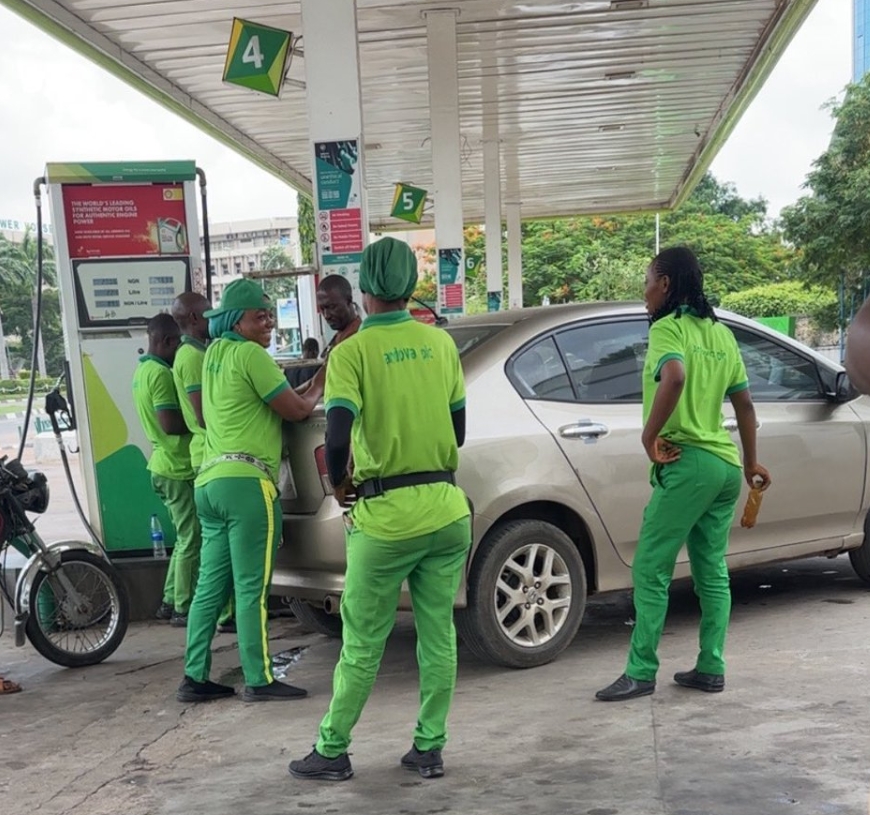
 A routine stop at an AP (Androva Petroleum) filling station in Maitama, Abuja, has revealed a troubling reality facing many fuel station attendants across Nigeria—one that raises serious concerns about labour conditions in the country’s retail petroleum sector.
On Saturday morning, a customer visiting the AP station located opposite Transcorp Hilton Hotel observed a group of attendants engaged in hushed conversation. With few vehicles on the premises, the customer engaged one of the workers in conversation to understand the cause of their apparent discontent.
“We just protested to the management asking for a salary increase, but they refused,” one female attendant disclosed.
When asked about her current earnings, her response was startling: “₦10,000 per month.”
The customer, stunned by the figure, sought clarification, assuming she had meant ₦100,000. However, the attendant reaffirmed the amount, and another colleague called over to verify the claim confirmed the same.
The revelation has sparked widespread concern about the treatment of fuel attendants by major fuel marketing companies, especially in affluent areas like Maitama.
In an economy where the national minimum wage is officially ₦30,000 (though not universally implemented), a monthly wage of ₦10,000 is not only far below legal standards—it borders on exploitative.
“Where is the Nigerian Labour Congress (NLC) in all of this?” the customer questioned. “How are these workers expected to feed their families, transport themselves to work, or avoid the temptation to exploit customers when their basic needs aren’t being met?”
The issue also reignites debate around the role of social and political activists in addressing day-to-day economic injustices that affect ordinary Nigerians. Critics argue that while political advocacy often focuses on the highest offices, more attention must be paid to the labour conditions that affect the majority.
Androva Petroleum, the operators of the AP station in question, have not issued any public response to the allegations as of the time of this report.
The situation raises a broader concern about the need for enforceable labour standards in Nigeria’s downstream oil sector, where contract staffing, wage suppression, and poor working conditions are often underreported.
As calls grow for regulatory agencies and labour unions to investigate and intervene, one thing is clear: a pay of ₦10,000 a month for full-time fuel attendants in a major Nigerian city is not just unsustainable—it is indefensible.
Stay informed, stay ahead with The Ameh News
Discover more from Ameh News
Subscribe to get the latest posts sent to your email.