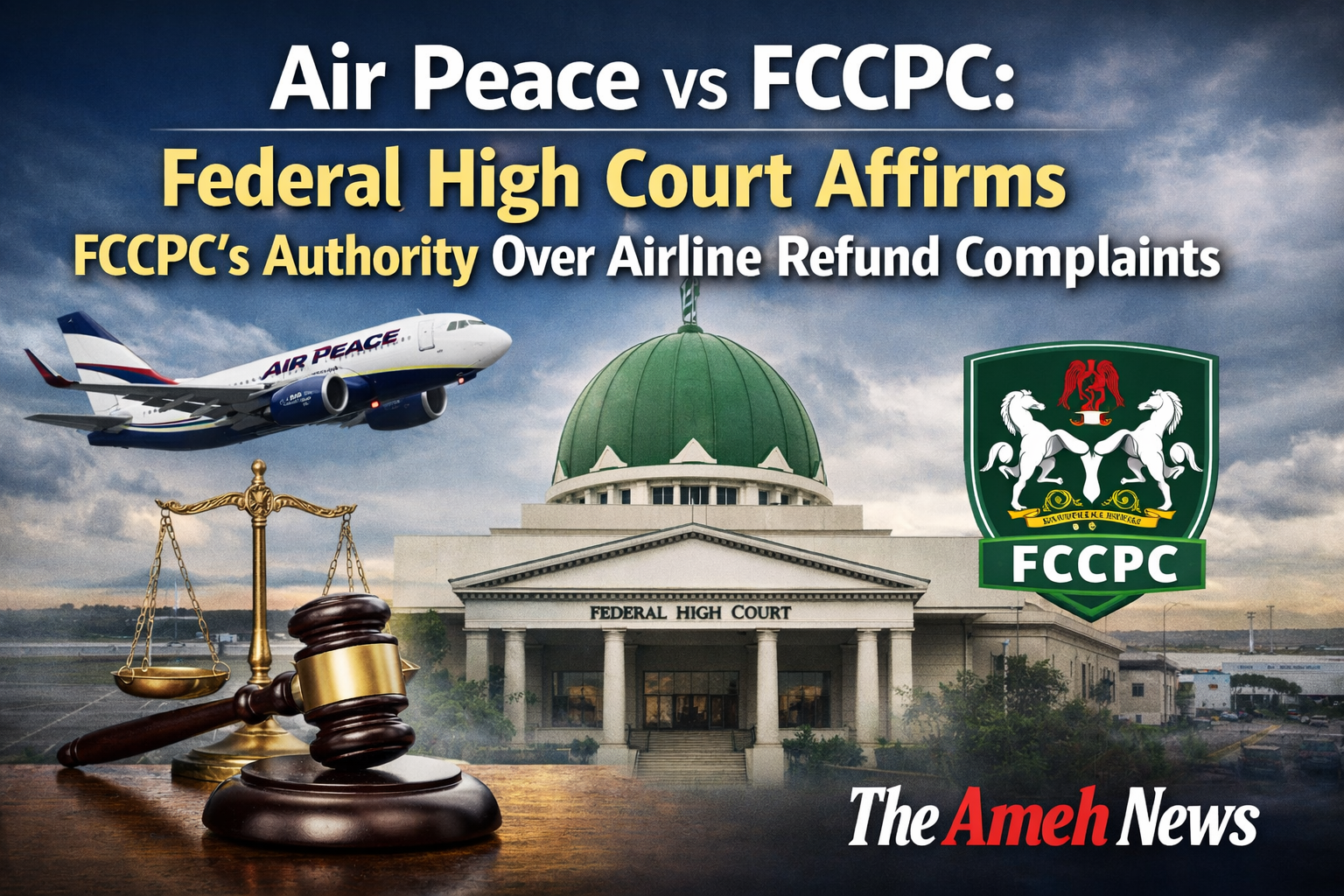
 In a landmark ruling set to reshape consumer protection enforcement in Nigeria’s aviation sector, the Federal High Court in Abuja has dismissed a suit filed by Air Peace Limited, affirming the investigative powers of the Federal Competition and Consumer Protection Commission (FCCPC).
Delivering judgment on Monday, Justice James Omotosho ruled that the FCCPC is fully empowered under the Federal Competition and Consumer Protection Act to receive consumer complaints, assess grievances, and take lawful steps—including investigations—across all sectors of the economy, aviation inclusive.
The case, which has attracted widespread attention within regulatory, legal, and aviation circles, arose from a growing number of consumer complaints against airlines, particularly over unrefunded ticket fares, flight cancellations, and service delivery lapses. Air Peace had approached the court seeking to curtail the FCCPC’s authority, arguing that the Commission lacked jurisdiction to probe such issues within the aviation industry.
However, the court’s ruling has now decisively settled that question, reinforcing the FCCPC’s cross-sector mandate and signalling a significant boost for consumer rights enforcement in Nigeria.
A Victory for Consumers
Reacting to the judgment, the FCCPC described the ruling as a critical affirmation of its statutory role as the country’s foremost consumer protection watchdog. In a statement issued by its Director of Corporate Affairs, Ondaje Ijagwu, the Commission said the decision strengthens its ability to ensure fairness, transparency, and accountability in the marketplace.
Ijagwu, quoting the Executive Vice Chairman and Chief Executive Officer of the FCCPC, Tunji Bello, emphasised that the judgment provides long-awaited clarity on the importance of regulatory oversight in protecting consumers.
According to Bello, the ruling underscores a fundamental principle: that consumers who pay for services are entitled to fair treatment, timely service delivery, and accessible redress mechanisms when things go wrong.
“This judgment reinforces the need for strong institutions that can safeguard consumer interests and promote fair competition across sectors,” Bello stated.
Clarifying the Scope of Regulatory Oversight
A key element of the ruling is its clarification of the FCCPC’s investigative processes. Bello noted that the Commission’s inquiries are administrative in nature and do not, in themselves, imply guilt or wrongdoing by businesses.
This distinction, industry analysts say, is crucial in balancing regulatory oversight with business rights, ensuring that investigations serve as tools for fact-finding and dispute resolution rather than punitive measures without due process.
The FCCPC reiterated its commitment to adhering strictly to due process, maintaining transparency, and engaging all stakeholders professionally in the course of its duties.
Implications for the Aviation Industry
The ruling is expected to have far-reaching implications for Nigeria’s aviation sector, where disputes between airlines and passengers—particularly over refunds—have been a persistent issue.
Passengers have long complained about delays or outright failures in receiving refunds for cancelled or rescheduled flights, often leaving them financially strained and without clear avenues for redress.
By affirming the FCCPC’s authority, the court has effectively expanded the channels available to consumers seeking justice, complementing existing aviation regulatory frameworks and increasing accountability for service providers.
Industry observers believe the decision will compel airlines and other service providers to strengthen their customer service systems, improve responsiveness to complaints, and adopt more transparent operational practices.
Call for Corporate Compliance
In the wake of the ruling, Bello urged businesses operating in Nigeria to cooperate fully with lawful regulatory processes. He also emphasised the importance of establishing robust internal complaint resolution mechanisms to address consumer grievances promptly and fairly.
Such memphasisede noted, would not only enhance consumer trust but also reduce the likelihood of regulatory intervention.
“The goal is not to stifle businesses but to ensure a fair and balanced marketplace where both consumers and service providers can thrive,” Bello added.
A Defining Moment for Consumer Protection
Legal experts and policy analysts have described the judgment as a watershed moment in Nigeria’s consumer protection landscape. By reinforcing the FCCPC’s authority, the court has strengthened the institutional framework for safeguarding consumer rights across industries.
For millions of Nigerian consumers—particularly frequent air travellers—the ruling offers renewed hope that grievances will be addressed more effectively and that service providers will be held to higher standards of accountability.
As the aviation industry continues to evolve amid economic and operational challenges, the judgment stands as a reminder that consumer rights remain central to sustainable growth and public trust.
Federal High Court in Abuja dismisses Air Peace suit, affirming FCCPC’s authority to investigate airline refund complaints and strengthen consumer protection in Nigeria’s aviation sector.
Court ruling upholds FCCPC’s powers under the 2018 Act, dismissing Air Peace’s challenge and reinforcing consumer rights in airline refund disputes across Nigeria.
Discover more from Ameh News
Subscribe to get the latest posts sent to your email.