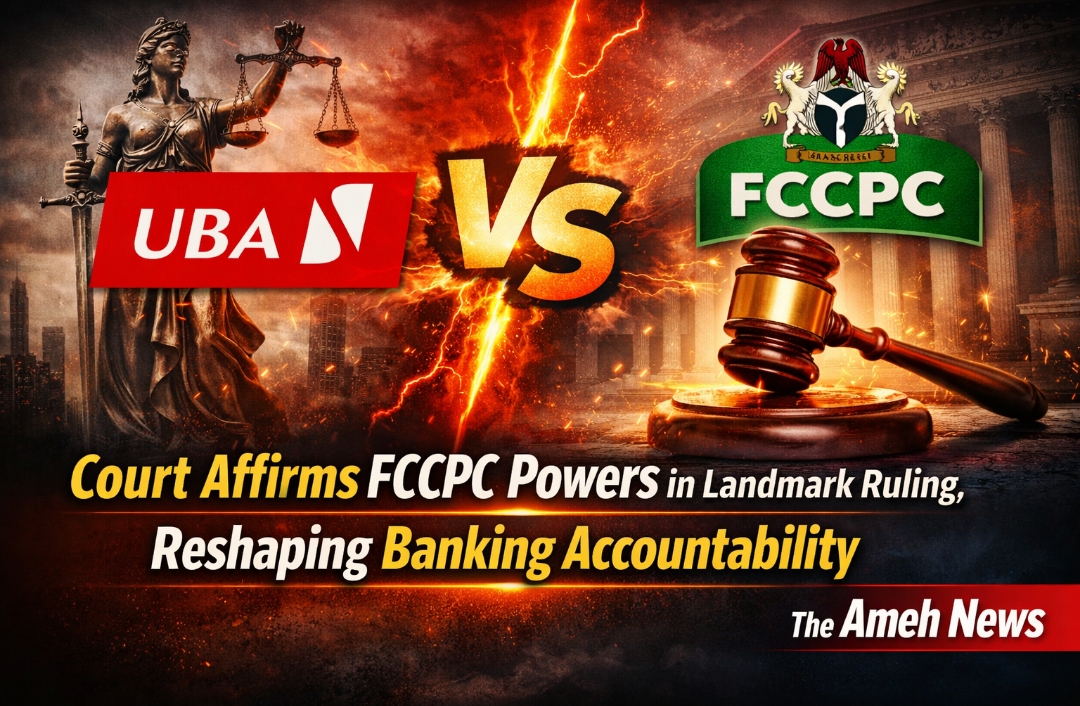
 In a judgment that could permanently alter Nigeria’s financial regulatory landscape, a Federal High Court sitting in Abuja has affirmed the authority of the Federal Competition and Consumer Protection Commission (FCCPC) over consumer complaints in the banking sector, delivering a decisive blow to attempts by financial institutions to limit external oversight.
Presiding over the case, Justice James Omotosho dismissed a suit filed by United Bank for Africa Plc (UBA), which sought to challenge the Commission’s jurisdiction in matters involving banks and their customers. The court described the suit as “frivolous and unmeritorious,” and imposed a ₦2 million fine on the bank.
The case, marked FHC/ABJ/CS/1972/2025, raised fundamental questions about regulatory authority in Nigeria’s financial system—specifically whether the Central Bank of Nigeria (CBN), as the primary regulator of banks, possessed exclusive jurisdiction that excluded the FCCPC from intervening in consumer-related disputes.
In a clear and far-reaching ruling, the court rejected that argument, holding that the FCCPC retains full statutory powers to investigate and resolve consumer complaints across all sectors, including financial services. Justice Omotosho clarified that neither the Constitution nor the Banks and Other Financial Institutions Act (BOFIA) grants the CBN exclusive authority over consumer protection issues.
A Turning Point for Consumer Protection
The judgment marks a significant shift for Nigerian bank customers, who for years have relied largely on the CBN—the same institution that licenses and supervises banks—for dispute resolution. Critics have long argued that this structure created a perceived imbalance, limiting consumer confidence in the fairness of outcomes.
With this ruling, the FCCPC emerges as a legally affirmed, independent arbiter for banking-related complaints, strengthening the framework for accountability and transparency in the sector.
Reacting to the development, FCCPC Executive Vice Chairman, Tunji Bello, described the judgment as “a big victory for bank customers,” noting that it reinforces the Commission’s statutory mandate to protect consumers nationwide.
Expert Insights: Implications for Industry and Economy
Experts who spoke to The Ameh News say the ruling goes beyond legal interpretation, signalling a broader shift in Nigeria’s financial ecosystem.
Dr Akin Olaniyan, a media specialist, digital marketer, and certified leadership coach with over 30 years of experience, described the decision as a “restoration of balance.”
“This judgment changes the narrative. It introduces an independent referee into a system where consumers previously felt disadvantaged. That shift alone will influence public trust in banking institutions,” he said.
According to Olaniyan, banks must now adapt to a more transparent environment where customer grievances can attract regulatory scrutiny beyond traditional channels.
Economist Celestine Ukpong noted that the ruling could strengthen financial inclusion by boosting consumer confidence.
“When people believe the system protects them, they are more willing to engage with it. This is essential for deepening Nigeria’s financial markets,” he explained, while cautioning that the FCCPC must build capacity to handle increased case volumes.
From a public relations perspective, Dr Ejike Nduilo, founder of Henryjvaleens, emphasised the reputational stakes for banks.
“We are entering an era where unresolved customer complaints can escalate into regulatory and public accountability issues. Banks must become more proactive in managing customer relationships and resolving disputes early.”
Financial expert Peter Adebayo, FCA, described the ruling as consistent with global regulatory standards.
“This establishes a dual oversight framework—prudential regulation by the CBN and consumer protection by the FCCPC. It is a healthy development that strengthens governance and reduces systemic risk.”
Beyond the Courtroom: A Lasting Precedent
While the ₦2 million fine imposed on UBA is unlikely to have a financial impact on a bank of its scale, analysts agree that the real consequence lies in the legal precedent established by the court.
The ruling affirms that the FCCPC’s authority—particularly under Section 104 of its Act—extends fully into the banking sector, overriding attempts to limit its jurisdiction in consumer protection matters.
The Road Ahead
The focus now shifts to implementation. With its authority firmly validated, the FCCPC is expected to take on a more prominent role in addressing banking complaints, potentially reshaping how financial institutions engage with their customers.
However, the Commission’s ability to scale operations, enforce decisions, and maintain efficiency will be critical in determining the long-term success of this expanded role.
For Nigerian consumers, the judgment represents a long-awaited shift toward fairness and accountability. It signals that banks are no longer insulated from independent scrutiny—and that customer voices now carry greater legal weight.
As the dust settles, one message stands clear: the era of limited recourse for bank customers has been fundamentally challenged, and a new chapter of consumer protection in Nigeria’s financial sector has begun. A Federal High Court in Abuja has affirmed FCCPC’s authority over banks, dismissing UBA’s suit and reinforcing consumer protection rights in Nigeria’s financial sector, as experts highlight implications for trust, regulation, and accountability. A landmark court ruling affirms FCCPC’s power to regulate consumer complaints in Nigeria’s banking sector, marking a major victory for customers and reshaping financial oversight.
Discover more from Ameh News
Subscribe to get the latest posts sent to your email.