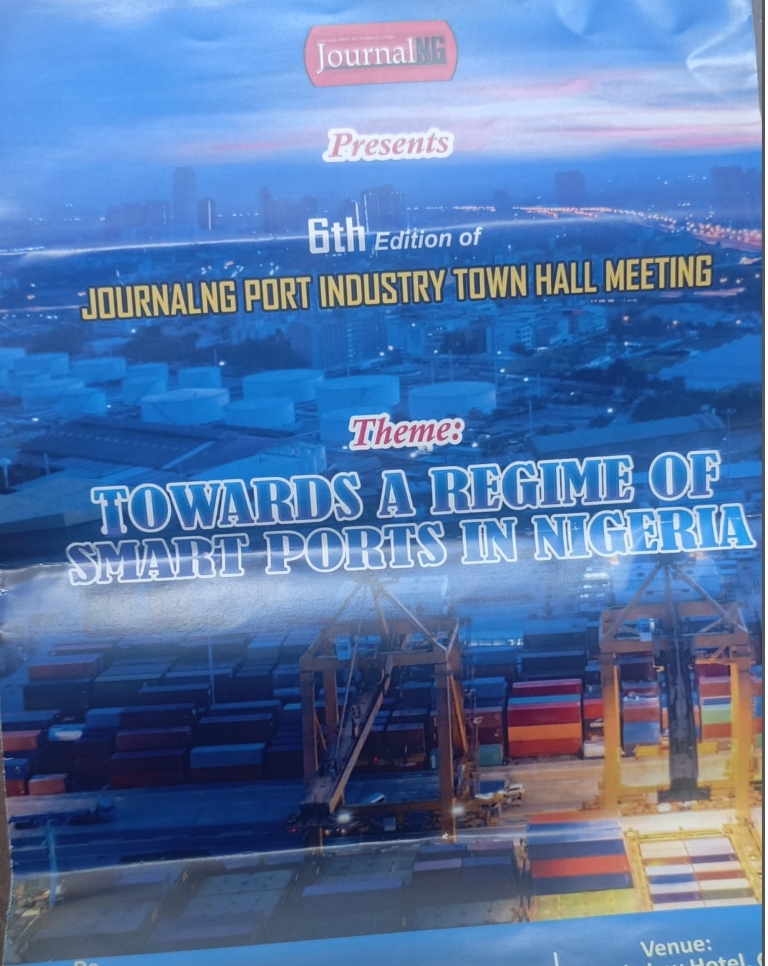
 Nigeria’s maritime sector has received a renewed push for transformation following a high-level convergence of stakeholders at the 6th Edition of the JournalNG Port Industry Town Hall Meeting, where experts declared that the transition to smart ports is no longer optional but critical to national economic growth.
The town hall, held on Friday, April 24, 2026, at Rockview Hotel, was themed “Towards a Regime of Smart Ports in Nigeria.” It brought together policymakers, regulators, terminal operators, freight forwarders, and maritime experts to evaluate the current state of Nigeria’s port system and outline actionable reforms.
Chairman of the event, Eugene Nweke, who is also Head of Research at the Sea Empowerment and Research Centre (SEREC), delivered a keynote address that set the tone for the deliberations.
Describing the gathering as a credible platform for policy dialogue and industry introspection, Nweke stressed that Nigeria must urgently reposition its ports as efficient, technology-driven economic engines capable of supporting trade expansion and revenue growth.
“It is both an honour and a responsibility to contribute to this critical phase in the evolution of Nigeria’s maritime sector,” he said.
Global Trade Dynamics vs Nigeria’s Port Reality
Nweke noted that over 80% of global trade is transported by sea, reinforcing the strategic importance of efficient port systems. However, he warned that Nigeria risks falling behind as global ports increasingly adopt automation, artificial intelligence, and integrated data systems.
According to industry insights shared at the forum, ports that have embraced digitalisation have recorded efficiency gains of between 30% and 50%, while also reducing logistics costs by up to 50%.
In contrast, Nigeria continues to struggle with inefficiencies that significantly inflate trade costs.
He disclosed that logistics costs in Nigeria account for approximately 30% to 40% of total trade costs, far exceeding the global benchmark of 8% to 12%. Cargo clearance delays—ranging from 10 to 24 days—further compound the challenge, weakening Nigeria’s competitiveness and discouraging investment.
“These figures are not just statistics; they represent lost economic opportunities and systemic inefficiencies,” Nweke stated.
Digital Infrastructure: The Core of Smart Port Systems
A major highlight of the discussions was the urgent need to deploy integrated digital platforms such as the Port Community System (PCS) and the National Single Window (NSW).
Nweke described these systems as the backbone of modern port operations, capable of enabling seamless data exchange, reducing duplication, limiting human interference, and enhancing transparency across the maritime value chain.
He emphasised that the National Single Window initiative, once fully implemented, could reduce cargo clearance time by up to 50% while boosting government revenue through improved efficiency and reduced leakages.
Bridging Technology and Human Capacity
While advocating for technology adoption, Nweke warned that digital transformation must be matched with investments in human capacity.
“Smart ports require smart people,” he said, calling for sustained training and upskilling of customs officers, terminal operators, freight agents, and regulators to effectively manage digital systems.
Nigeria’s Strategic Advantage and Untapped Potential
Despite current operational challenges, stakeholders at the town hall acknowledged Nigeria’s strong potential to emerge as a leading maritime hub in West and Central Africa. The country currently handles between 70% and 80% of cargo traffic within the sub-region.
Other advantages highlighted include Nigeria’s strategic geographic location, expanding port infrastructure, large consumer market, and increasing private sector participation.
However, Nweke stressed that unlocking this potential requires stronger coordination, disciplined execution, and policy consistency.
Collective Responsibility for Reform
The chairman underscored that the journey toward smart ports is not a single-agency initiative but a comprehensive industry-wide transformation requiring collaboration among government, regulators, and private operators.
He called for policy clarity, regulatory alignment, and a firm commitment to transparency and accountability.
“We must move beyond dialogue to action. The success of this transition depends on measurable milestones and collective responsibility,” he said.
A Turning Point for Nigeria’s Maritime Sector
The 6th JournalNG Port Industry Town Hall Meeting ended with a consensus among stakeholders that smart port development is central to reducing trade costs, improving operational efficiency, and strengthening Nigeria’s position in global trade.
With growing alignment across the maritime ecosystem and strong advocacy from industry leaders like Eugene Nweke, Nigeria appears set to accelerate its transition toward a modern, digitally driven port system.
Nigeria’s maritime stakeholders, led by Eugene Nweke at the 6th JournalNG Town Hall in Lagos, call for urgent adoption of smart ports to cut costs, boost efficiency, and drive economic growth.
Discover more from Ameh News
Subscribe to get the latest posts sent to your email.