What emerges from the data cited on the Nigeria Communications Commission (NCC) is not just rapid growth, but market concentration at scale, where two operators are translating subscriber dominance into disproportionate revenue gains.
Market Leaders Tighten Grip on Data Revenues
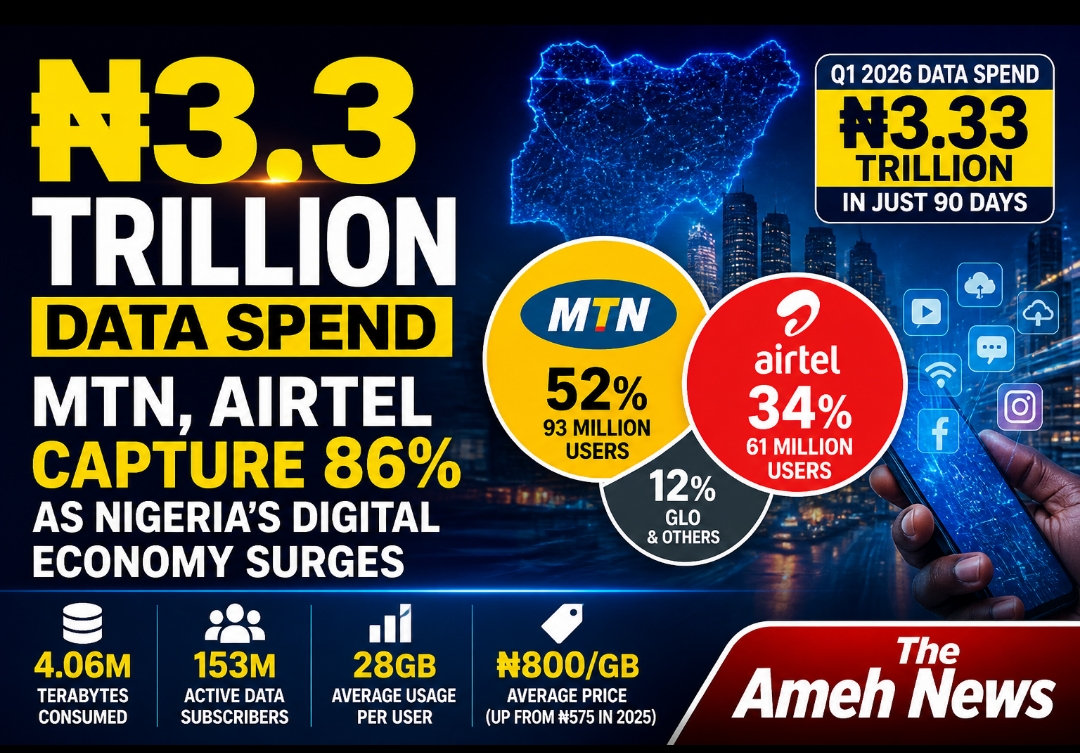
Industry data shows a highly concentrated subscriber base:
MTN Nigeria: ~52% market share (93 million users)
Airtel Nigeria: ~34% (61 million users)
Globacom (Glo): ~12%
With market shares largely stable, revenue capture in Q1 2026 aligns closely with this structure:
MTN Nigeria: ~₦1.73 trillion
Airtel Nigeria: ~₦1.13 trillion
Others combined: ~₦0.47 trillion
Together, MTN and Airtel accounted for approximately 86% of total data spending, translating to ₦2.86 trillion in a single quarter.
This mirrors 2025 performance, when both operators jointly generated ₦3.6 trillion in data revenue, with MTN alone posting ₦2.8 trillion, representing 74% year-on-year growth and more than half of its total revenue.
Usage Surge Defies Rising Costs
The revenue spike is underpinned by record-breaking usage:
4.06 million terabytes consumed in Q1 2026
153 million active subscribers
Average usage: 28GB per user
Average price: ~₦800/GB (up from ₦575 in 2025)
Despite a sharp rise in pricing, demand has continued to surge—highlighting a critical shift: data is no longer discretionary spending; it is essential infrastructure for daily life.
From fintech transactions and remote work tools to streaming and e-commerce, Nigerians are consuming data at levels that reflect deep digital integration.
Traffic Growth Powers Operator Gains
Operational metrics reinforce the trend:
MTN Nigeria recorded a 34% increase in data traffic in 2025, a momentum sustained into 2026
Airtel Nigeria continues to expand capacity and user engagement, benefiting from similar usage patterns
The result is a powerful combination of:
Higher consumption
Rising prices
Expanding margins
Expert Insight: Growth Built on Dependency
Telecoms and digital economy analysts say the numbers point to a structural shift.
Dr Akin Olaniyan, a Lagos Business School lecturer and media analyst, notes:
“What we are witnessing is the transformation of data from a service into a survival infrastructure. Nigerians are no longer choosing to spend on data—they are compelled to, because their economic and social systems now depend on it.”
Similarly, economist Celestine Ukpong highlights the implications of market concentration:
“The dominance of MTN and Airtel means scale efficiency, but it also raises questions about competition and pricing power. When demand is inelastic, operators naturally gain leverage, and that must be balanced with strong regulatory oversight.”
2025 Laid the Foundation
The current surge builds on a historic 2025 performance:
₦7.62 trillion total data spend
171% growth from ₦2.81 trillion in 2024
13.25 million terabytes consumed
89GB annual usage per subscriber
That year marked the tipping point where digital adoption became digital dependence.
The Structural Drivers Behind the Boom
The surge is driven by interconnected sectors:
Fintech: Real-time payments and digital banking
Remote Work: Cloud-based collaboration and enterprise tools
Streaming: High-definition video and social media content
E-commerce: Fully digital transaction ecosystems
These sectors reinforce each other, creating a continuous demand loop that benefits operators with the largest infrastructure footprint.
The Big Question: Can Infrastructure Keep Up?
While revenues soar, network performance challenges persist:
Congestion in high-density areas
Inconsistent speeds
Coverage gaps in underserved regions
As consumption rises, so does pressure on telecom infrastructure.
Outlook: ₦10 Trillion Within Reach
If current trends continue, Nigeria is on track to exceed ₦10 trillion in data spending in 2026, with MTN and Airtel expected to retain dominant shares.
However, sustaining this growth will depend on:
Accelerated infrastructure investment
Improved quality of service
Balanced regulatory frameworks
Nigeria’s data economy is expanding at unprecedented speed—but it is also becoming increasingly concentrated.
At ₦3.3 trillion in just 90 days, one reality is clear:
The country is not just consuming data—it is built on it. And the operators controlling access to that data are shaping the future of its digital economy.
Nigeria spent ₦3.33 trillion on data in Q1 2026, with MTN and Airtel capturing 86% of revenues. Rising usage, higher prices, and market dominance signal a rapidly expanding but concentrated digital economy.
Discover more from Ameh News
Subscribe to get the latest posts sent to your email.