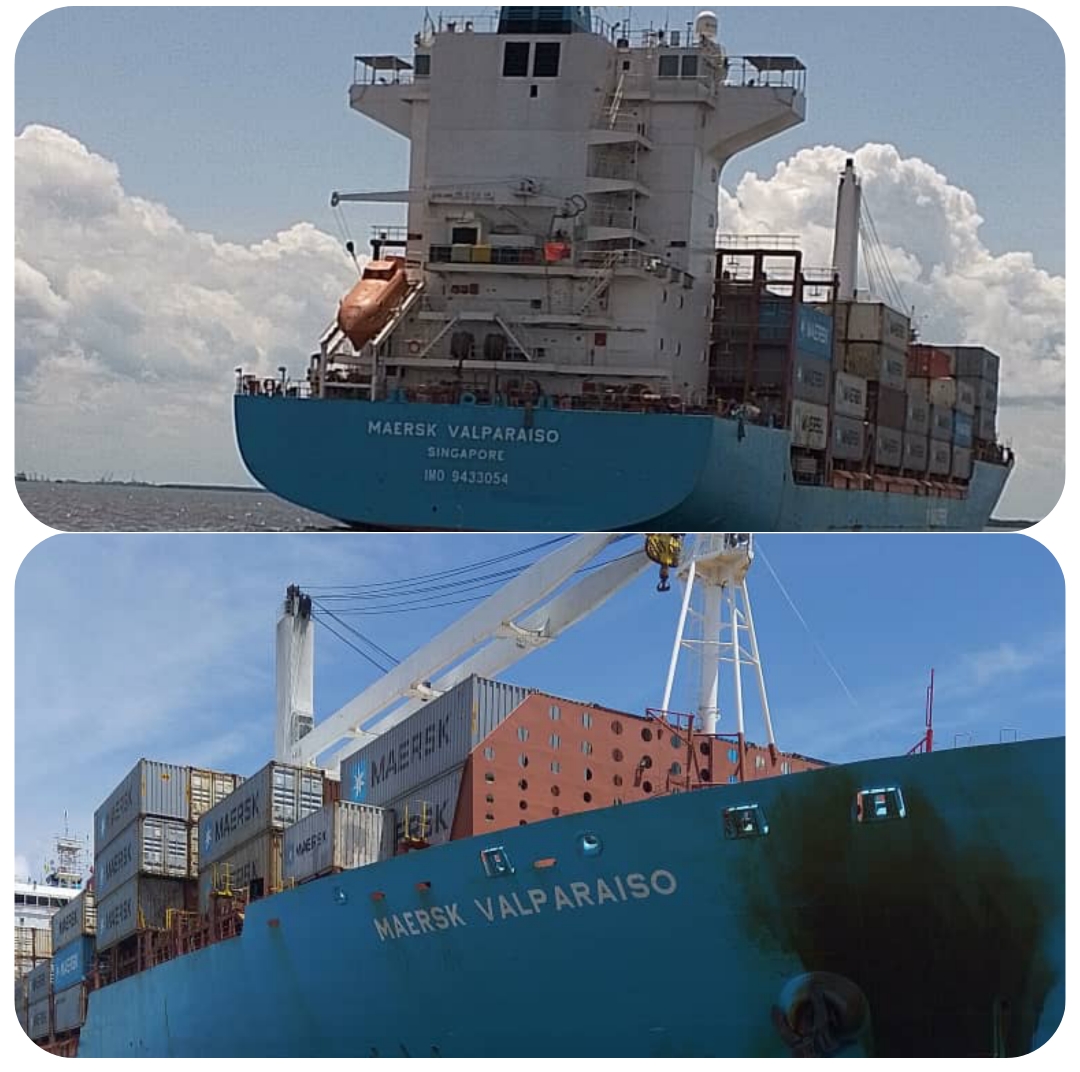
 A major maritime disruption at Onne Port in Rivers State continues to generate debate across Nigeria’s shipping and logistics sector, following a collision involving a Maersk container vessel and a barge that effectively blocked the port channel and left several vessels stranded.
The incident, which reportedly occurred on May 20, 2026, involved the Maersk Valparaiso (Voyage 621S) carrying about 717 containers. The vessel allegedly collided with a barge within the busy Onne navigation channel, causing both craft to run aground. The container ship was said to have become stuck in mud, effectively obstructing marine traffic flow.
The immediate consequence was widespread operational disruption. Vessel movement in and out of Onne Port was suspended, while congestion built up at Bonny Anchorage, leaving ships that had already completed cargo operations unable to sail. The situation triggered delays across shipping schedules and renewed concern over navigational safety in one of Nigeria’s key maritime gateways.
Maritime regulators, including the Nigerian Ports Authority (NPA) and the Nigerian Maritime Administration and Safety Agency (NIMASA), were reportedly notified shortly after the incident, with coordination efforts focused on stabilising the channel and restoring safe passage.
However, attention quickly shifted to the Nigerian Safety Investigation Bureau (NSIB), the national multimodal accident investigation body, following public and industry concerns about its visible role in the early phase of the incident response.
Expert Reactions: Calls for Clarity, Coordination, and Institutional Visibility
Reacting to The Ameh News inquiry on the development, several experts weighed in on the broader implications for Nigeria’s maritime safety governance.
Economic and Systems Perspective
Economist Celestine Ukpong noted that disruptions of this scale go beyond port inconvenience, stressing that Nigeria’s trade competitiveness is directly affected when major shipping corridors are blocked.
He explained that repeated incidents of port congestion and delayed vessel movement reflect structural inefficiencies in maritime logistics coordination. According to him, the economic cost is often “silent but compounding,” affecting import timelines, export reliability, and investor confidence in Nigeria’s port system.
Governance and Safety Leadership
Media and leadership expert Dr Akin Olaniyan, who has over three decades of experience in journalism and leadership coaching, described the incident as a test of Nigeria’s transport safety architecture.
He emphasised that while operational agencies such as NPA and NIMASA typically lead immediate response efforts, investigative bodies like NSIB must maintain visible communication channels to reassure stakeholders and clarify procedural steps.
According to him, “visibility does not mean operational interference, but structured communication that strengthens public trust in institutional response systems.”
Financial Accountability and Risk Exposure
Chartered accountant Peter Adebayo focused on the financial exposure tied to maritime disruptions of this nature.
He explained that blocked channels and stranded vessels create cascading cost pressures on shipping lines, terminal operators, and cargo owners, including demurrage charges, contract delays, and insurance implications.
He added that stronger preventive frameworks and clearer incident reporting protocols could significantly reduce the financial shock absorbed by stakeholders during such events.
Public Relations and Institutional Communication
Public relations strategist Dr Ejike Nduilo highlighted what he described as a “communication vacuum effect” in high-impact infrastructure incidents.
He noted that in crisis situations, the absence of immediate institutional updates—particularly from agencies with investigative mandates—can lead to public perception gaps, even when technical coordination is ongoing behind the scenes.
He stressed that NSIB’s role is not operational intervention but structured safety communication, adding that timely briefings help prevent misinformation and reinforce institutional credibility during crisis events.
What the Incident Ultimately Reveals
Beyond the immediate marine obstruction, the Onne Port collision underscores a broader systemic challenge: coordination between operational agencies and investigative institutions in real-time crisis communication.
While NPA and NIMASA are expected to manage physical response and port control, NSIB’s mandate centres on independent investigation and safety recommendations. However, experts argue that modern transport safety systems now require a more visible and proactive communication layer during incidents of this magnitude.
As clearance operations continue and efforts to restore normal vessel movement intensify, stakeholders are increasingly calling for improved inter-agency communication protocols, clearer public updates, and stronger institutional visibility to maintain confidence in Nigeria’s maritime safety ecosystem.
A vessel collision at Onne Port has blocked the shipping channel and stranded vessels, prompting expert concerns over maritime safety coordination and the visible role of NSIB in Nigeria’s transport investigation system.
Discover more from Ameh News
Subscribe to get the latest posts sent to your email.