Why a Pan-Yoruba Summit Must Convene in Ilorin

Introduction: History as Warning, Memory as Responsibility
“A people who forget their history eventually surrender their future.”
There are moments in the life of a nation when history ceases to be a record of the past and becomes a warning for the present.
For the Yoruba people, the twenty-first century presents such a moment.
Across Yorubaland today, concerns persist about insecurity, economic stagnation, youth unemployment, rural displacement, weakening traditional institutions, political fragmentation, and the long-term preservation of Yoruba identity within a rapidly changing Nigerian state.
These are not isolated challenges. They are part of a longer historical pattern.
From the collapse of Oyo-Ile, through nineteenth-century wars, through colonial partition, and into post-independence political crises, Yoruba history repeatedly demonstrates a central lesson:
Unity strengthens the Yoruba nation; division weakens it.
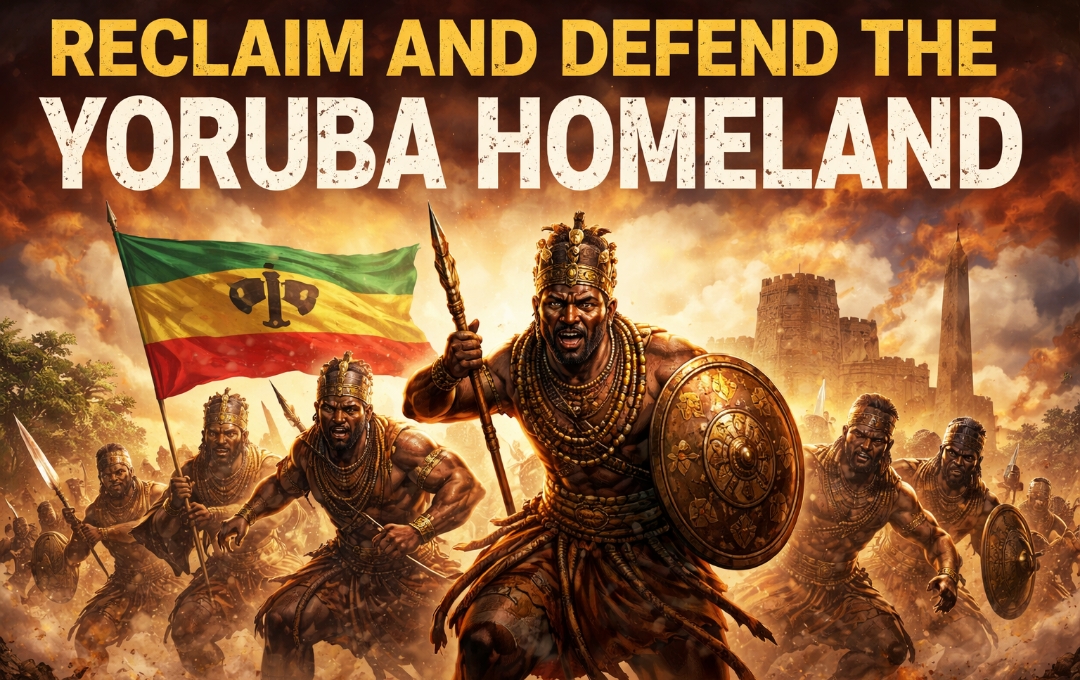
It is therefore necessary to convene a historic Pan-Yoruba Summit under the theme:
RECLAIM AND DEFEND THE YORUBA HOMELAND:
Why a Pan-Yoruba Summit Must Convene in Ilorin
The Classical Yoruba World and the Rise of Oyo
Between the 16th and 18th centuries, the Oyo Empire became one of the most powerful political systems in West Africa.
From its capital at Oyo-Ile, the empire established a sophisticated administrative system consisting of:
The Alaafin (central authority)
The Oyo Mesi (council of state)
The Ogboni (religious-political stabilizing institution)
Provincial governance structures
A powerful cavalry-based military system
By the 18th century, Oyo exerted influence over large parts of what is today southwestern Nigeria and beyond, maintaining tributary relations and trade networks extending toward Dahomey and coastal regions.
However, internal political tensions, succession disputes, and weakening central authority gradually undermined imperial stability in the late 18th and early 19th centuries.
The Collapse of Oyo-Ile (c. 1835–1837)
A decisive turning point came in the early 19th century.
In 1817, Afonja, the Are-Ona-Kakanfo (military commander) of Oyo, rebelled against the Alaafin.
In seeking military assistance, he aligned with Fulani groups associated with broader Islamic reform movements spreading across Northern Nigeria under the influence of the Sokoto jihad led by Usman dan Fodio (whose movement began in 1804).
Following Afonja’s death, Ilorin broke away from Oyo authority around 1823–1824.
By 1835–1837, sustained military pressure, internal fragmentation, and repeated defeats forced the abandonment of Oyo-Ile.
The once-great imperial capital was permanently deserted.
This collapse marked the end of Oyo imperial supremacy and triggered widespread political reorganization across Yorubaland.
The Rise of New Yoruba Centres
Following the collapse of Oyo, new Yoruba political centres emerged:
Ibadan (military republic)
Abeokuta (Egba confederacy)
Ijebu kingdom
Ekiti and Ijesa polities
Owo and Ondo kingdoms
This period was defined by both resilience and rivalry.
While Yoruba states rebuilt themselves, they also entered prolonged cycles of warfare that weakened collective cohesion.
The Battle of Osogbo (12 May 1840)
One of the most important victories in Yoruba military history occurred at the Battle of Osogbo.
On 12 May 1840, Yoruba forces—primarily Ibadan-led coalitions—defeated advancing forces from Ilorin.
The victory halted further expansion into the Yoruba interior and preserved the autonomy of much of Yorubaland.
Osogbo demonstrated a critical historical principle:
When united, Yoruba forces could successfully defend their territory against existential threats.
Jalumi War (16 November 1878)
The internal rivalries among Yoruba states culminated in conflicts such as the Jalumi War.
Fought near Ikirun on 16 November 1878, the battle became infamous due to heavy casualties during retreat across flooded terrain.
“Jalumi” (“fall into water”) became symbolic of the human cost of Yoruba internecine warfare.
By this stage, Yoruba political energies were increasingly consumed by internal conflict rather than external consolidation.
The Kiriji War (1877–1893): The Longest Yoruba Civil Conflict
The most devastating conflict in Yoruba history was the Kiriji War, also known as the Ekiti-Parapo War.
Beginning in July 1877 and ending in September 1893, the war lasted approximately 16 years.
Key features included:
Ibadan vs Ekiti-Parapo alliance (Ekiti, Ijesa, Igbomina, etc.)
Widespread devastation of towns and farmlands
Collapse of trade routes
Mass displacement of populations
Exhaustion of military and economic capacity
The war acquired its name from the sound of gunfire described as “Kiriji”.
By the end of the conflict, Yorubaland was politically weakened and economically drained.
This exhaustion would have profound consequences for the next phase of history.
The Berlin Conference (1884–1885): Partition Without Consent
While the Kiriji War was ongoing, a global geopolitical event reshaped Africa.
Between November 1884 and February 1885, European powers met at the Berlin Conference to divide Africa among themselves.
No African ruler was invited.
No African polity was represented.
Decisions affecting entire civilizations were made in Europe.
For the Yoruba world, the consequences were profound.
Yoruba Territories Beyond Modern Nigeria
Before colonial boundaries were imposed, Yoruba civilization extended beyond present-day Nigeria into what are now:
Republic of Benin
Republic of Togo (Yoruba-speaking communities in border areas and historical settlements)
Key Yoruba cultural and political centres included:
Ketu
Sakete (Saki/Savé region variations in historical sources)
Ifangni
Porto-Novo region (historically linked Yoruba communities)
These were not “extensions” of Nigeria but integral parts of a wider Yoruba civilizational space shaped over centuries.
Colonial Boundary-Making and Fragmentation
Following the Berlin framework:
Britain consolidated influence in the Nigerian region
France expanded control westward (Dahomey → modern Benin)
Germany and later France influenced Togolese territories
The result was the administrative fragmentation of Yoruba communities across colonial borders.
Families, markets, shrines, festivals, and kinship systems were divided by international boundaries that did not reflect historical realities.
Lagos Annexation (1861) and Expansion of British Power
A critical early moment in colonial expansion was the annexation of Lagos in 1861.
This provided Britain with:
A strategic port
Access to Yoruba hinterland trade routes
A base for inland expansion
Following the Kiriji War’s conclusion in 1893, British influence expanded rapidly into Yorubaland through:
Treaties
Military expeditions
Protectorate arrangements
Administrative consolidation
By 1900, most Yoruba territories were under British colonial authority.
Anglo-French and Anglo-German Boundary Consolidation
Between the late 19th and early 20th centuries, further agreements between European powers refined colonial boundaries.
These included:
Anglo-French agreements defining spheres in West Africa
Anglo-German arrangements affecting Togoland and surrounding areas
Later boundary adjustments that finalized modern West African borders
These decisions permanently separated Yoruba-speaking populations into different colonial and later national systems.
The Kiriji Peace (1893): End of Yoruba Civil Wars
The Kiriji War formally ended in 1893 following peace negotiations involving British mediation.
While it ended Yoruba internal warfare, it also coincided with accelerating colonial consolidation.
By the time peace was achieved:
Yorubaland was exhausted
Political unity was fractured
External influence had become dominant
The Western Region Crisis (1962–1965)
In the post-independence period, Yoruba political unity again came under severe strain.
The Western Region Crisis began in 1962 following internal disputes within the Action Group, led by Chief Obafemi Awolowo and Chief Samuel Ladoke Akintola.
Key developments included:
1962: Parliamentary crisis and declaration of emergency rule
1963–1964: Political fragmentation and court battles
1965: Election violence and breakdown of order (“Operation Wetie”)
The crisis weakened one of Nigeria’s most developed regions and significantly reduced Yoruba political cohesion at the national level.
While interpretations differ regarding the role of federal actors, historians broadly agree that internal division played a decisive role in the escalation of the crisis.
Civil War Era and National Politics (1967–1970)
During the Nigerian Civil War, Yoruba leadership—most notably Chief Obafemi Awolowo—played a complex role in federal economic policy and national unity debates.
This period further demonstrated the central role Yoruba political thought played in national decision-making, but also highlighted internal ideological divisions.
Contemporary Challenges in Yorubaland
Today, Yorubaland faces new but interconnected challenges:
Rural insecurity and farmer-herder tensions
Economic fragmentation
Youth unemployment and migration pressures
Weak coordination across states
Cultural dilution and identity concerns
Governance and security coordination gaps
These challenges differ in form from nineteenth-century wars but share one structural feature:
the consequences of fragmentation in the face of complex external and internal pressures.
Why Ilorin Must Host the Summit
Ilorin occupies a unique historical position in Yoruba memory.
It represents:
A frontier of historical transformation
A symbol of nineteenth-century political realignment
A geographical bridge between Yoruba subregions
A reminder of the consequences of division and realignment
Therefore, a Pan-Yoruba summit in Ilorin is symbolically and historically significant.
The Proposed Summit Agenda
Under the theme:
RECLAIM AND DEFEND THE YORUBA HOMELAND
The summit should address:
Regional security coordination
Economic integration across Yoruba states
Cultural preservation and education
Youth development and employment strategy
Agricultural modernization
Infrastructure and industrial policy
Inclusion of Yoruba communities in Benin and Togo
Strengthening traditional institutions
Historical reconciliation and unity framework
Conclusion: A Civilizational Choice
From:
Oyo-Ile (c. 1837 collapse)
Osogbo (1840 victory)
Jalumi (1878 conflict)
Kiriji War (1877–1893)
Berlin Conference (1884–1885)
Colonial consolidation (1861–1900)
Western Region Crisis (1962–1965)
A single lesson emerges:
History repeatedly rewards Yoruba unity and punishes Yoruba fragmentation.
The proposed summit in Ilorin is therefore not an emotional reaction to contemporary concerns.
It is a historically grounded response to a long pattern of political experience.
The goal is not confrontation.
The goal is continuity.
The goal is not division.
The goal is renewal.
The goal is not nostalgia.
The goal is strategic unity for the future.
For a people whose civilization predates colonial borders, the task ahead is clear:
To reclaim historical consciousness.
To defend cultural identity.
To strengthen internal cooperation.
And to ensure that the Yoruba homeland—wherever Yoruba people reside—remains secure, prosperous, and united in purpose.
By Ladi Soyode
Discover more from Ameh News
Subscribe to get the latest posts sent to your email.