By The Ameh News
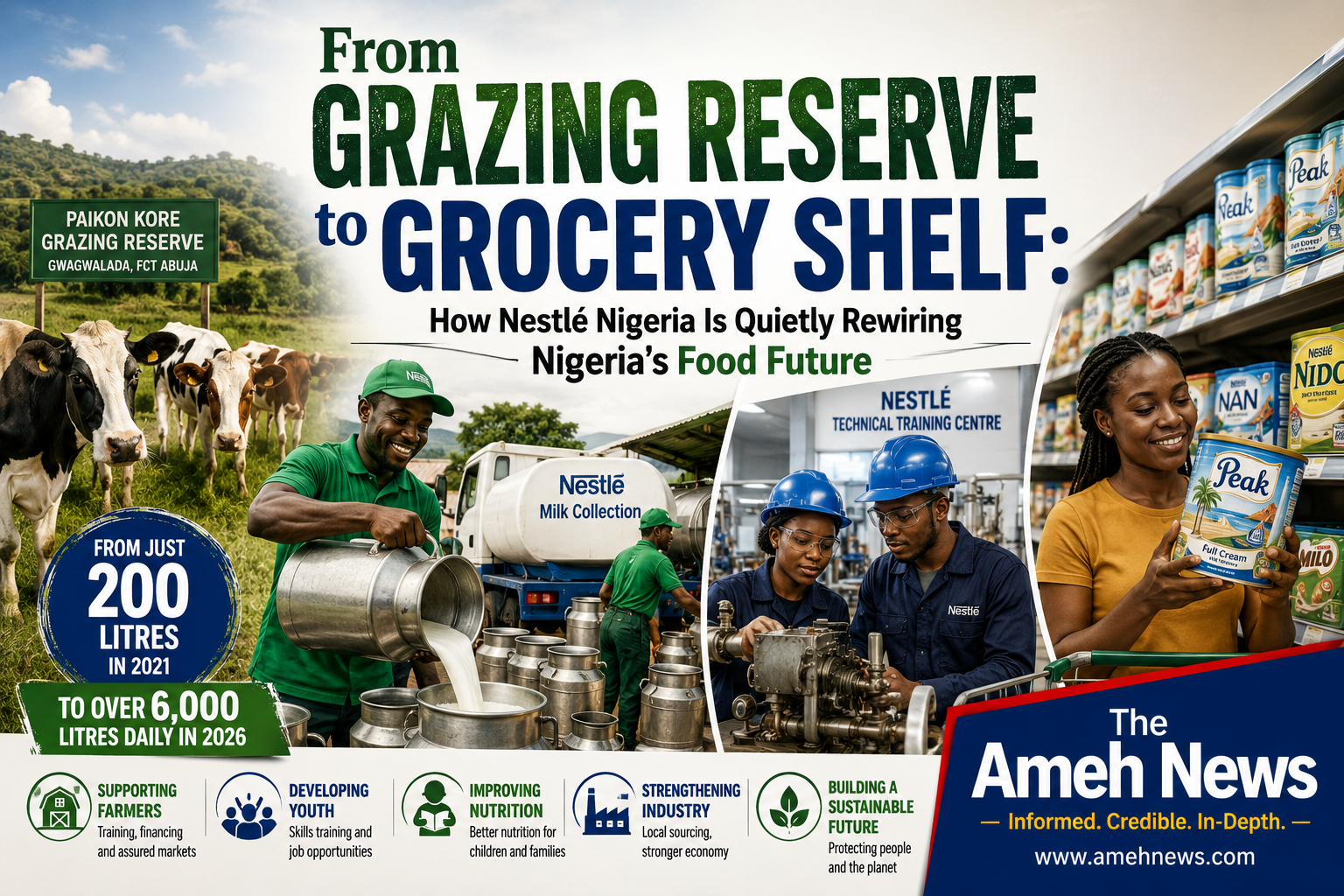
On a dusty morning in Nigeria’s Federal Capital Territory, long before sunrise paints the horizon over the Paikon Kore Grazing Reserve in Gwagwalada, Fulani herders begin another day with a routine that has sustained generations. Cows are milked by hand, aluminium cans are filled with fresh milk, and motorcycles, bicycles and small trucks begin converging on a collection centre that, just a few years ago, did not exist.
For decades, scenes like this represented a paradox at the heart of Nigeria’s agricultural economy. Africa’s most populous nation boasts one of the continent’s largest livestock populations, yet remains heavily dependent on imported dairy products to meet domestic demand. Millions of litres of fresh milk produced by local pastoralists were lost daily due to poor storage, inadequate transportation, weak market access and the absence of reliable buyers.
That reality is beginning to change.
What started in 2021 as a modest pilot project collecting only 200 litres of milk on its first day has evolved into one of Nigeria’s most ambitious private-sector dairy development initiatives. Today, the programme aggregates approximately 6,000 litres of fresh milk every day, has surpassed one million litres in cumulative collection, supports more than 3,000 dairy producers organised into 83 cooperatives, and is targeting an ambitious 30,000 litres daily by 2027.
Behind those numbers lies a broader story—not merely about milk, but about the quiet transformation of Nigeria’s food system.
Over the last five years, Nestlé Nigeria Plc has steadily expanded its investments beyond factory walls into livestock development, farmer capacity building, nutrition education, youth technical training, environmental sustainability and local sourcing. While these initiatives have attracted occasional headlines individually, together they reveal a long-term strategy that industry observers say offers valuable lessons for strengthening Nigeria’s food security, reducing import dependence and creating sustainable employment.
At a time when food inflation continues to squeeze household incomes, child malnutrition remains a national emergency and youth unemployment poses significant economic risks, such investments are increasingly viewed not simply as corporate responsibility but as contributions to national development.
A Nation Confronting a Food Security Challenge
Food security has become one of Nigeria’s defining policy issues.
In markets across Lagos, Kano, Port Harcourt, Enugu and Maiduguri, the rising cost of staple foods continues to reshape household spending. Families increasingly spend larger proportions of their income on food, while farmers contend with insecurity, climate variability, escalating input costs and limited access to finance.
The consequences extend far beyond economics.
According to UNICEF and findings from the 2023 Nigeria Demographic and Health Survey, nearly two million Nigerian children under the age of five suffer severe acute malnutrition every year. Millions more experience stunting and micronutrient deficiencies that affect physical growth, cognitive development and long-term productivity.
Nutrition experts warn that food security cannot be measured simply by whether food is available. It must also reflect whether food is affordable, nutritious, safe and sustainably produced.
For Nigeria, this challenge is becoming increasingly urgent. With a population exceeding 230 million and projected to continue growing rapidly, demand for food will rise significantly in the coming decades.
Successive governments have introduced agricultural reforms, launched intervention programmes and sought to improve local production. Yet many structural obstacles persist, including weak rural infrastructure, post-harvest losses, inadequate processing capacity and heavy dependence on imported raw materials.
Against this backdrop, the private sector has assumed an increasingly important role in complementing public policy.
Among the companies taking a long-term approach is Nestlé Nigeria plc.
Established in Nigeria in 1961, the company has evolved into one of the country’s largest food and beverage manufacturers. Beyond producing globally recognised brands, it has increasingly aligned its business strategy with investments designed to strengthen local supply chains, improve nutrition outcomes and enhance workforce development.
Rather than viewing sustainability as a stand-alone corporate social responsibility initiative, Nestlé has embedded it within its operational strategy through what it describes as its “Creating Shared Value” philosophy—an approach centred on ensuring that business success is linked to positive outcomes for farmers, consumers, employees and communities.
That philosophy would become more visible beginning in 2021.
The Pilot That Planted a Seed
On June 1, 2021, Nestlé Nigeria launched a pilot milk collection initiative.
The figures from the first day offered little indication of what would follow.
Just 200 litres of milk were collected.
For a country importing significant volumes of dairy products annually, the amount seemed almost symbolic.
Yet executives behind the project understood that transforming an agricultural value chain requires patience rather than instant scale.
The programme was designed around a simple principle: if local dairy farmers could rely on a guaranteed market for quality milk, they would have greater confidence to invest in healthier cattle, improve production methods and increase output.
Instead of merely purchasing milk, Nestlé introduced training programmes focused on animal nutrition, veterinary care, hygienic milk handling, quality assurance and cooperative development.
Farmers who had long depended on uncertain middlemen suddenly found themselves participating in a more structured supply chain.
The impact extended beyond higher milk volumes.
Household incomes improved. Cooperative societies strengthened bargaining power. Better production standards enhanced product quality. Local communities began witnessing the emergence of a more organised dairy economy.
For development economists, these outcomes illustrated an important lesson: sustainable agricultural transformation begins not only with financing but also with knowledge, trust and reliable market access.
From Experiment to National Model
The pilot’s early success encouraged expansion.
By February 2025, Nestlé Nigeria formally inaugurated a 5.4-hectare Livestock Development Project within the Paikon Kore Grazing Reserve in Gwagwalada Area Council of the Federal Capital Territory.
The project represented a significant milestone in the company’s dairy development strategy.
Designed in collaboration with government institutions and development partners, it created an integrated ecosystem where livestock farmers could access modern production practices, extension services, improved milk collection systems and dependable commercial opportunities.
Unlike conventional intervention programmes that end after initial funding, the project was structured to become commercially sustainable.
Its objective was not merely to increase milk production but to build a functioning local dairy value chain capable of benefiting producers, processors and consumers alike.
Officials from the Federal Ministry of Livestock Development described the initiative as a practical demonstration of how collaboration between government and the private sector could strengthen Nigeria’s agricultural economy while reducing dependence on imported dairy products.
For thousands of pastoral households, however, the significance was even more immediate.
It meant stable income.
It meant better opportunities for their children.
It meant that milk produced in Nigerian grazing reserves could increasingly find its way onto supermarket shelves, factory production lines and family dining tables without first crossing international borders.
That transformation—from grazing reserve to grocery shelf—captures the essence of Nestlé Nigeria’s evolving investment strategy.
Beyond Milk — Building Human Capital, Better Nutrition and a Stronger Economy
If the dairy programme demonstrated how strategic investment could transform agricultural production, Nestlé Nigeria’s broader development agenda revealed another reality: food security does not end on the farm.
Experts increasingly argue that the future of food security depends on three interconnected pillars—food availability, nutritional quality and human capacity. Producing more food without improving nutrition leaves communities vulnerable to hidden hunger, while expanding agriculture without developing skilled workers limits industrial growth.
Recognising these links, Nestlé Nigeria gradually expanded its investments beyond dairy development into nutrition education, youth skills acquisition and workforce development, initiatives that analysts say complement Nigeria’s long-term economic aspirations.
Changing the Conversation Around Nutrition
Nigeria’s nutrition challenge extends beyond food shortages.
According to health experts, many households consume sufficient calories but lack essential nutrients required for healthy growth and development. The consequences are evident in persistent levels of stunting, micronutrient deficiencies and childhood malnutrition.
Against this backdrop, Nestlé introduced the Nestlé for Healthier Kids (N4HK) initiative to promote healthy eating habits among school-age children.
Rather than focusing solely on product awareness, the programme encourages balanced diets, proper hydration, regular physical activity and healthier lifestyle choices.
Since its introduction, the initiative has reached more than 60,000 pupils and over 1,000 teachers across different parts of Nigeria.
Education specialists say the programme’s greatest value lies in its long-term impact.
Children who understand healthy nutrition are more likely to make informed food choices throughout adulthood, influence family eating habits and reduce the prevalence of diet-related diseases later in life.
Public health analysts note that improving nutrition awareness among children is one of the most cost-effective interventions available to governments and development partners.
Poor nutrition remains a significant contributor to reduced educational attainment, lower labour productivity and higher healthcare expenditure.
Consequently, programmes that combine food production with nutrition education help create healthier and more productive societies.
Investing in Nigeria’s Greatest Resource—Its Youth
While improving agriculture remains critical, another challenge continues to confront Nigeria: unemployment among young people.
Every year, thousands of graduates enter the labour market only to discover that academic qualifications alone do not guarantee employment.
Manufacturers, meanwhile, frequently complain about shortages of technically skilled workers capable of operating sophisticated industrial equipment.
The disconnect between education and industry needs has widened Nigeria’s skills gap.
Nestlé Nigeria sought to bridge that gap through sustained investment in technical education.
Its Technical Training Centre (TTC) has become one of the company’s flagship interventions, representing an investment of approximately ₦6 billion in developing Nigeria’s future industrial workforce.
Located in Agbara, Ogun State; Abaji, Abuja; and Flowergate, the centres offer an intensive 18-month engineering and manufacturing programme that combines classroom instruction with hands-on industrial experience.
Unlike many vocational programmes that end with certificates, the Nestlé model focuses on employability.
Participants are trained to international manufacturing standards in areas such as mechanical engineering, electrical systems, automation, instrumentation and production processes.
By the end of 2025, the flagship centre had graduated 289 young Nigerians, many of whom moved directly into skilled employment within manufacturing and related industries.
Collectively, the programme has equipped thousands of youths with practical technical skills since its inception.
Industry leaders argue that such investments are critical to Nigeria’s industrialisation agenda.
Without skilled technicians, engineers and maintenance specialists, manufacturing growth becomes difficult to sustain.
From Corporate Responsibility to Corporate Strategy
One defining feature of Nestlé Nigeria’s interventions is that they are increasingly integrated into its core business model.
Traditionally, corporate social responsibility focused on philanthropy—building schools, donating equipment or funding isolated community projects.
Global best practice has since evolved.
Today, sustainability is increasingly viewed as a strategic business investment.
For Nestlé Nigeria, supporting dairy farmers strengthens local sourcing.
Training engineers develops the workforce needed for manufacturing expansion.
Teaching children about nutrition contributes to healthier consumers.
Environmental stewardship helps secure future agricultural productivity.
These initiatives reinforce one another while simultaneously strengthening the company’s long-term commercial resilience.
Business analysts describe this approach as creating “shared value,” where economic success and social progress advance together.
Government Recognition
Nestlé Nigeria’s initiatives have attracted recognition from government officials responsible for agriculture, livestock development, education and manufacturing.
At the inauguration of the Paikon Kore Livestock Development Project, officials from the Federal Ministry of Livestock Development described the initiative as an example of how strategic collaboration between government and private enterprise can accelerate agricultural transformation.
According to ministry officials, Nigeria cannot achieve self-sufficiency in dairy production without substantial investment in farmer capacity, infrastructure, quality control and structured markets.
They commended Nestlé’s long-term commitment to local milk sourcing as a practical contribution to reducing Nigeria’s dependence on imported dairy products.
Similarly, government representatives present at the launch of the Nestlé for Good campaign in Lagos observed that responsible corporate investment has become increasingly important in advancing national priorities such as food security, youth empowerment and industrial competitiveness.
Experts Weigh In
Speaking with The Ameh News, economist Celestine Ukpong described Nestlé Nigeria’s investment model as an illustration of how patient private-sector capital can generate broad economic benefits.
According to him, Nigeria’s agricultural transformation will depend less on isolated government interventions and more on sustained partnerships involving businesses, financial institutions and farming communities.
“When companies invest in local production instead of relying almost entirely on imports, they stimulate economic activity across multiple sectors. Farmers earn more income, processors secure reliable raw materials, transport operators benefit, rural businesses expand and employment increases. That multiplier effect is exactly what Nigeria requires,” Ukpong said.
Financial analyst and Fellow of the Institute of Chartered Accountants of Nigeria, Peter Adebayo, FCA, believes integrated investment strategies deliver stronger returns for both businesses and society.
He noted that companies capable of strengthening local supply chains while simultaneously investing in technical education and community development are often better positioned to withstand economic shocks.
“Building resilient local supply chains is no longer simply good corporate citizenship—it is good business strategy. Companies that invest in local sourcing reduce foreign exchange risks, improve operational stability and contribute to national economic resilience,” Adebayo explained.
According to him, Nigeria’s drive towards economic diversification will increasingly depend on businesses willing to make similar long-term commitments.
A Model for Public-Private Partnership
Development economists argue that neither government nor the private sector can independently solve Nigeria’s food security challenges.
Agricultural transformation requires collaboration.
Government provides enabling policies, infrastructure and regulation.
Private companies contribute investment, innovation, technology and access to markets.
Development partners support financing, research and capacity building.
Farmers provide production.
When these actors work together, value chains become stronger.
The evolution of Nestlé Nigeria’s dairy programme demonstrates how that collaboration can function in practice.
What began as a modest milk collection initiative has expanded into an integrated ecosystem connecting farmers, processors, educators, engineers, nutrition experts and policymakers.
It is an ecosystem whose influence now extends far beyond dairy production.
Indeed, many analysts believe its greatest contribution may lie in demonstrating that sustainable investment—rather than short-term intervention—is the foundation upon which Nigeria’s future food system must be built.
From Corporate Investment to National Transformation—Can One Company’s Model Help Feed Nigeria?
By the beginning of 2026, it had become increasingly clear that Nestlé Nigeria’s various sustainability initiatives were no longer isolated projects.
The dairy development programme in Abuja. The nutrition education campaign in schools. The technical training centres producing skilled engineers. The environmental stewardship projects. The local sourcing initiatives supporting Nigerian farmers.
Each programme had been designed to solve a different challenge, yet together they formed a single ecosystem.
Recognising this, Nestlé Nigeria formally brought these initiatives together under one umbrella—”Nestlé for Good.”
Launched in Lagos before government officials, development partners, nutrition experts, farmers’ representatives and members of the organised private sector, the platform was presented not as a new corporate campaign but as a reflection of a philosophy that had guided the company’s operations for years.
Company executives described the initiative as an extension of Nestlé’s long-standing Creating Shared Value (CSV) approach—a business philosophy built on the belief that long-term commercial success depends on creating measurable value for society.
Unlike conventional corporate social responsibility programmes, which often focus on donations or short-term interventions, Creating Shared Value seeks to embed social impact within a company’s core business operations.
For Nestlé Nigeria, this means strengthening local agriculture to improve raw material supply, investing in nutrition education to encourage healthier communities, developing technical skills to support industrial productivity and promoting environmental sustainability to protect future food systems.
It is a strategy that increasingly resonates with policymakers seeking innovative ways to address Nigeria’s complex development challenges.
When Business Success Supports National Development
Nigeria’s economy is at a defining moment.
The country is working to diversify away from oil, strengthen domestic manufacturing, improve food production, reduce unemployment and expand non-oil exports.
Achieving those ambitions requires more than government spending.
It demands sustained investment from businesses willing to develop local supply chains, transfer knowledge, create employment and support innovation.
Nestlé Nigeria’s experience illustrates how those objectives can reinforce one another.
When local dairy farmers receive technical training and guaranteed market access, household incomes rise.
When milk previously lost due to poor preservation enters formal value chains, waste declines while processors obtain more reliable supplies.
When manufacturers source more inputs locally, pressure on foreign exchange demand can ease.
When young Nigerians acquire practical engineering skills, industries gain the workforce required for expansion.
When schoolchildren learn healthy eating habits, long-term public health outcomes may improve.
Taken individually, each outcome appears modest.
Collectively, they contribute to a stronger and more resilient economy.
The Economics Behind Local Sourcing
One of Nigeria’s biggest manufacturing challenges remains dependence on imported industrial inputs.
Foreign exchange shortages and exchange-rate volatility continue to increase production costs for many manufacturers.
Economists argue that expanding local sourcing offers one of the most practical pathways towards reducing those pressures.
By developing domestic agricultural supply chains, manufacturers can lower import dependence while creating economic opportunities within rural communities.
For the dairy sector, the implications are significant.
Nigeria spends substantial amounts importing milk and dairy products despite possessing one of Africa’s largest cattle populations.
The gap lies not in livestock numbers alone but in productivity, infrastructure, quality assurance and organised markets.
Nestlé’s dairy programme attempts to address each of those constraints simultaneously.
Rather than viewing farmers merely as suppliers, the company has invested in helping them become more productive business partners.
The result is a stronger supply chain capable of generating shared benefits for producers, processors and consumers.
Experts See a Replicable Model
Economist said the most valuable aspect of Nestlé Nigeria’s investment strategy is its long-term perspective.
According to Ukpong, sustainable agricultural transformation requires consistency rather than quick wins.
“Nigeria needs more investments that strengthen value chains instead of isolated interventions. When farmers gain access to markets, technical knowledge and stable demand, productivity increases naturally. That benefits businesses, communities and the wider economy.”
Ukpong added that if similar models were replicated across rice, cocoa, cassava, maize, palm oil and livestock production, Nigeria could significantly improve food security while reducing import dependence.
Financial analyst and Fellow of the Institute of Chartered Accountants of Nigeria, believes the company’s integrated approach reflects an important shift in corporate strategy.
Adebayo FCA noted that investors increasingly evaluate companies not only by financial performance but also by their environmental, social and governance practices.
According to him, businesses that invest in resilient local supply chains are often better positioned to manage economic uncertainty.
“The future belongs to companies that build ecosystems rather than simply factories. When businesses invest in farmers, employees and communities, they strengthen the foundation upon which sustainable profitability depends.”
Lessons for Nigeria’s Private Sector
Development specialists say the Nestlé experience offers several lessons for corporate Nigeria.
First, long-term investment often delivers more sustainable impact than short-term philanthropy.
Second, local sourcing can simultaneously improve supply security and stimulate rural economic development.
Third, workforce development remains essential if Nigeria hopes to compete in advanced manufacturing.
Fourth, nutrition should become an integral component of food security discussions rather than an afterthought.
Finally, collaboration matters.
Government cannot solve every challenge alone.
Nor can businesses.
Meaningful progress occurs when public institutions, private companies, financial institutions, development partners, universities and farming communities work toward shared objectives.
Looking Ahead
Nestlé Nigeria has set a target of increasing daily milk collection to 30,000 litres by 2027.
Achieving that milestone would represent another significant step towards strengthening domestic dairy production.
Yet the broader significance extends beyond milk.
It demonstrates that patient investment, strategic partnerships and long-term planning can gradually reshape entire value chains.
For Nigeria, where agriculture remains one of the country’s greatest untapped economic assets, such examples provide practical evidence that transformation is possible.
The country’s journey towards food security will undoubtedly require policy reforms, infrastructure development, improved financing, innovation and stronger institutions.
But it will also require businesses prepared to invest beyond quarterly earnings.
That may prove to be the most enduring lesson from Nestlé Nigeria’s story.
From Grazing Reserve to Grocery Shelf
Five years ago, the programme began with just 200 litres of milk.
Today, more than one million litres have passed through the collection system.
Thousands of dairy farmers have joined organised cooperatives.
Young Nigerians have acquired technical skills that strengthen the country’s manufacturing base.
Schoolchildren have learned healthier eating habits.
Communities have gained new economic opportunities.
Viewed separately, these achievements tell individual success stories.
Viewed together, they reveal something larger—a blueprint for how responsible corporate investment can contribute to national development.
The journey from a grazing reserve in Gwagwalada to supermarket shelves across Nigeria is about more than milk.
It is about rebuilding confidence in local production.
It is about proving that Nigerian farmers, when supported with knowledge, markets and investment, can compete.
It is about showing that food security begins long before food reaches the dinner table.
Ultimately, it is about recognising that the future of Nigeria’s economy will not be built solely in boardrooms or government offices.
It will also be built on farms, in classrooms, in training workshops and along the countless value chains that connect rural communities to factories, markets and consumers.
For Nestlé Nigeria Plc, that future is already taking shape—one farmer empowered, one engineer trained, one child educated and one litre of locally sourced milk at a time.
From a 200-litre milk pilot to a national dairy ecosystem, discover how Nestlé Nigeria’s investments in local sourcing, nutrition, youth skills and sustainable agriculture are contributing to food security, job creation and economic growth.
Nestlé Nigeria, food security, dairy development, local milk production, Paikon Kore Grazing Reserve, Nestlé for Good, Creating Shared Value, youth employment, Technical Training Centre, nutrition, agriculture, manufacturing, Nigerian economy, local sourcing, dairy farmers, job creation.
Discover more from Ameh News
Subscribe to get the latest posts sent to your email.