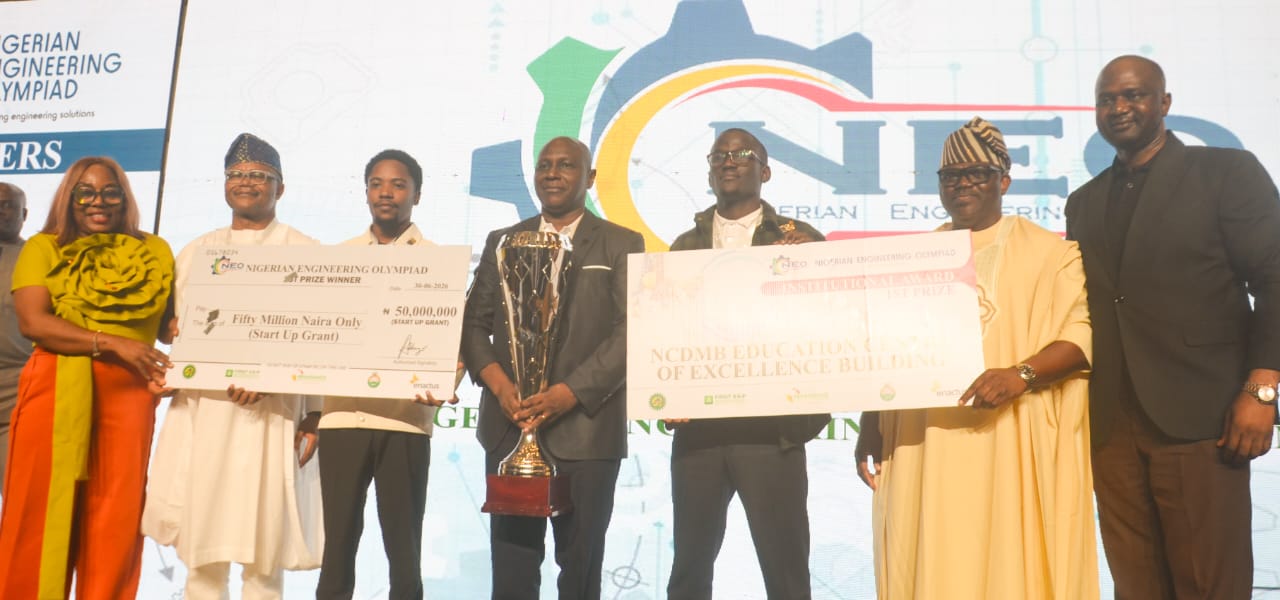
 Nigeria’s drive to build a technology-driven economy received a significant boost as four universities emerged victorious at the maiden edition of the Nigerian Engineering Olympiad (NEO), sharing a combined ₦235 million in seed funding and institutional grants designed to transform promising engineering ideas into commercially viable products.
The landmark competition, which culminated in a colourful grand finale held in Lagos on June 30, 2026, celebrated some of the country’s brightest engineering talents while reinforcing the growing importance of innovation, research commercialisation and home-grown technological solutions to Nigeria’s development challenges.
The overall winner, Modibbo Adama University of Technology (MAUT), Yola, received ₦50 million in seed funding alongside a Centre of Excellence Building for its Faculty of Engineering. The University of Ibadan (UI) finished second with ₦30 million in seed funding and an additional ₦75 million institutional grant for engineering research.
The University of Jos (UniJos) secured third place with ₦20 million, while the University of Nigeria, Nsukka (UNN) received ₦10 million for finishing fourth, in addition to a ₦50 million grant to strengthen engineering education and research.
Beyond the financial rewards, the winning teams will receive extensive technical mentorship, business incubation, commercialisation support, strategic industry partnerships and investor engagement aimed at ensuring that their innovations move successfully from prototype to the marketplace.
Four Innovations That Could Change Nigeria
The competition showcased engineering solutions designed to tackle some of Nigeria’s most pressing socio-economic challenges.
MAUT clinched the overall prize with Ubuntu Sapphire, a decentralized, community-powered rapid security alert and intelligence network developed specifically for rural and peri-urban communities where internet connectivity is weak and conventional security infrastructure remains inadequate.
Designed to function effectively even on basic feature phones, the innovation promises to improve emergency communication and strengthen community security across underserved regions.
The University of Ibadan impressed judges with Aurora Birth, an innovative healthcare technology created to reduce neonatal deaths resulting from birth asphyxia, particularly in low-resource hospitals where access to advanced medical equipment remains limited.
University of Jos earned third place through Sentra, a solar-powered, Artificial Intelligence-enabled crop diagnostic device capable of detecting pests, diseases and soil nutrient deficiencies before visible symptoms appear, enabling farmers to intervene early and improve agricultural productivity.
Meanwhile, the University of Nigeria, Nsukka, secured fourth position with Flameless, a modular power-generation platform that captures associated natural gas and converts it into electricity, providing affordable and reliable energy for homes, businesses and rural communities while reducing environmental pollution.
According to the judges, the winning innovations stood out because they combined technical excellence with practical relevance, scalability, commercial potential and measurable societal impact.
Fierce National Competition
The maiden Olympiad attracted remarkable participation from engineering students nationwide.
A total of 984 students from 80 tertiary institutions participated in the competition, while 375 teams successfully qualified for the initial evaluation process.
Following rigorous assessments based on innovation, engineering excellence, scalability, commercial viability, sustainability and social impact, 30 teams advanced to regional competitions held across Nigeria’s six geopolitical zones in Yenagoa, Enugu, Ibadan, Abuja, Yola and Kano.
Each shortlisted team received ₦3 million in prototype development funding to refine their ideas before competing at the regional level.
The best 12 teams—two from each geopolitical zone—qualified for the National Innovation Bootcamp in Lagos, where they underwent intensive mentoring by engineering professionals, entrepreneurs, investors and industry experts before advancing to the semi-final knockout rounds that eventually produced the four national winners.
NSE: Engineering Must Drive National Development
Speaking during the grand finale, the immediate past President of the Nigerian Society of Engineers (NSE), Engr. Margaret Oguntala, described the Olympiad as a transformative initiative capable of repositioning Nigerian engineering for sustainable national development.
She noted that despite the abundance of engineering talent across Nigerian universities, there has long existed a disconnect between academic research and industrial application.
According to her, the Nigerian Engineering Olympiad was deliberately designed to bridge that gap by exposing students to real-world innovation challenges while creating pathways for commercialisation.
She stressed that nurturing engineering innovation would play a vital role in accelerating industrialisation, improving productivity and creating high-value jobs.
Engineering Determines National Prosperity
Also speaking, Engr. Olutosin Ogunmola, who represented the Nigerian Society of Engineers on the Olympiad Steering Committee, said engineering remains the defining factor separating developed economies from developing nations.
He observed that sectors such as entertainment and sports have flourished largely because structured competitions continuously reward excellence.
According to him, the Olympiad seeks to create a similar culture of healthy competition within engineering education, encouraging universities and students to pursue excellence while developing innovative solutions for national development.
Investing in Young Innovators
Country Director of Enactus Nigeria, Mr. Michael Ajayi, said Nigeria’s future prosperity depends largely on how effectively the country invests in its young innovators.
He noted that the Olympiad aligns perfectly with Enactus’ mission of developing entrepreneurial leaders capable of solving real societal challenges through innovation.
Ajayi said Nigerian youths possess immense creativity and technical competence that must be intentionally nurtured to build globally competitive businesses capable of creating jobs and driving economic growth.
NCDMB Pledges Continued Support
Executive Secretary of the Nigerian Content Development and Monitoring Board (NCDMB), Engr. Felix Omatsola Ogbe, reaffirmed the Board’s commitment to identifying and developing engineering talents capable of transforming Nigeria’s industrial landscape.
Represented by Mr. Silas Omomehin Ajimijaye, Director of Planning, Research and Statistics, Ogbe praised all the programme partners for successfully delivering the maiden edition of the Olympiad.
He urged stakeholders to ensure that the winning innovations do not remain academic projects but evolve into commercially successful technologies that improve lives and strengthen Nigeria’s industrial competitiveness.
Partners Increase Investment
Funding partner Renaissance Africa Energy Company Limited expressed satisfaction with the quality of innovations showcased during the competition.
Represented by Dr. Igo Weli, Vice President, Relations and Sustainable Development, the company announced that prototype development grants for future participants would increase from ₦3 million to ₦5 million, demonstrating growing confidence in the programme.
Similarly, FIRST Exploration & Petroleum Development Company (First E&P) described the Olympiad as a strategic investment in Nigeria’s engineering future.
Represented by Engr. John Alamu, General Manager, Engineering and Capital Projects, the company said the initiative would strengthen STEM education while helping to address Nigeria’s growing brain drain by providing young engineers with opportunities to develop impactful solutions at home.
He noted that the country must deliberately create platforms that reward engineering excellence and encourage innovations tailored to Nigeria’s unique challenges in energy, infrastructure, manufacturing and sustainability.
NASENI Applauds Initiative
The Executive Vice Chairman and Chief Executive Officer of the National Agency for Science and Engineering Infrastructure (NASENI), Mr. Khalil Halilu, represented by Engr. (Dr.) Emmanuel Ajani, congratulated the winning teams and praised the organisers for creating a platform capable of identifying exceptional engineering talent across Nigerian universities.
He described the Olympiad as an important initiative that aligns with Nigeria’s broader industrialisation agenda by encouraging innovation, local manufacturing and technology development.
Building Nigeria’s Innovation Economy
The Nigerian Engineering Olympiad was conceived as more than a competition.
Organisers describe it as a strategic national initiative aimed at closing Nigeria’s engineering skills gap while creating a robust innovation ecosystem capable of producing globally competitive technology entrepreneurs.
The programme is sponsored by the Nigerian Content Development and Monitoring Board (NCDMB), funded by Renaissance Africa Energy Company Limited and First Exploration & Petroleum Development Company (First E&P), with the Nigerian Society of Engineers (NSE) serving as technical partner and Enactus Nigeria managing programme implementation.
Over the next three years, the initiative is expected to support the development of more than 150 engineering prototypes, facilitate the emergence of multiple technology start-ups and contribute significantly to Nigeria’s industrial transformation.
By combining funding, mentorship, technical guidance, industry partnerships and commercialisation support, the Olympiad aims to reduce dependence on imported technologies while positioning Nigerian universities as engines of innovation capable of delivering practical solutions to national and global challenges.
Modibbo Adama University, University of Ibadan, University of Jos and University of Nigeria, Nsukka emerged winners at the maiden Nigerian Engineering Olympiad, securing ₦235 million in grants, seed funding and infrastructure support to commercialise breakthrough engineering innovations.
Nigerian Engineering Olympiad, NEO 2026, MAUT, University of Ibadan, University of Jos, University of Nigeria Nsukka, engineering innovation Nigeria, NCDMB, Enactus Nigeria, Nigerian Society of Engineers, STEM education, engineering competition, technology innovation, industrial development Nigeria.
Discover more from Ameh News
Subscribe to get the latest posts sent to your email.