…Experts say stronger institutions, fiscal discipline, policy consistency hold key to unlocking billions in global investment
By The Ameh News
 The race to secure investment-grade sovereign credit ratings has emerged as one of Africa’s defining economic priorities, with governments across the continent increasingly pursuing reforms aimed at attracting cheaper capital, strengthening macroeconomic stability and improving investor confidence.
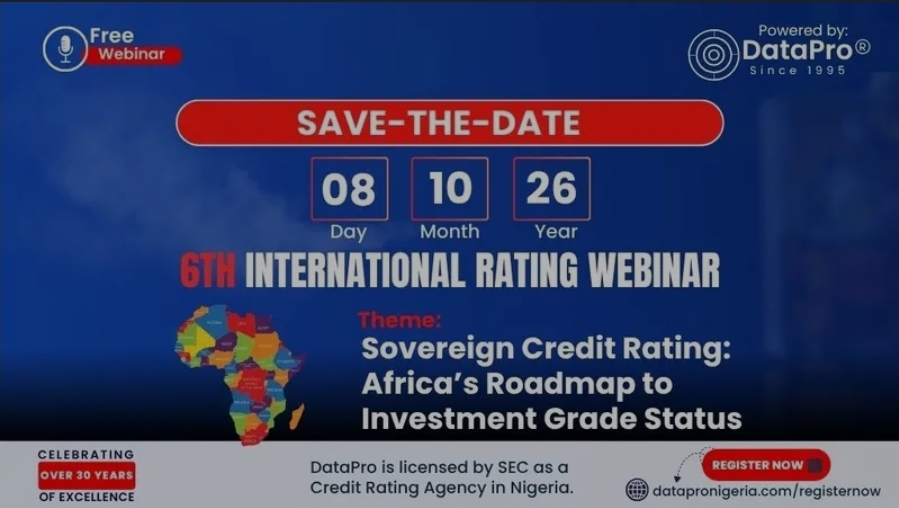
Against this backdrop, DataPro Limited has announced the theme for its 2026 International Credit Rating Webinar as “Sovereign Credit Rating: Africa’s Roadmap to Investment-Grade Status,” setting the stage for what analysts describe as one of the continent’s most significant policy and investment conversations this year.
The virtual conference, scheduled for Thursday, October 8, 2026, is expected to convene policymakers, sovereign debt managers, financial regulators, development finance institutions, institutional investors, economists, capital market operators, commercial banks and corporate executives to examine practical strategies for improving Africa’s sovereign creditworthiness.
The timing of the event reflects growing optimism following Nigeria’s recent sovereign credit rating upgrade, which has renewed attention on the reforms necessary to achieve full investment-grade status and improve access to global capital markets.
Across Africa, governments are implementing fiscal consolidation programmes, tax reforms, debt management initiatives and governance improvements to strengthen their economic fundamentals. Analysts say achieving investment-grade status would significantly reduce borrowing costs, attract long-term foreign direct investment, deepen domestic capital markets and accelerate infrastructure financing.
DataPro said this year’s webinar goes beyond analysing sovereign ratings. Instead, it seeks to address fundamental questions confronting African economies, including the characteristics that distinguish investment-grade sovereigns, the reforms international investors consider indispensable, strategies for enhancing investor confidence amid global economic uncertainty and lessons from countries that have successfully improved their sovereign credit profiles.
The discussions are expected to provide practical policy recommendations for governments seeking to improve fiscal sustainability, institutional credibility, monetary policy effectiveness and economic resilience.
Industry stakeholders believe sovereign credit ratings now play a central role in determining investor perception, capital inflows and access to international financing, making the topic increasingly relevant as African economies compete for global investment.
Speaking on the significance of the initiative, economists said sovereign ratings have evolved beyond technical assessments into powerful indicators of a nation’s economic direction, governance quality and investment attractiveness.
Reacting to the announcement, economist Celestine Ukpong told The Ameh News that Africa’s development ambitions cannot be realised without stronger sovereign credit profiles.
According to him, “Investment-grade status is not simply about earning a better rating. It represents international confidence in a country’s institutions, fiscal management, transparency and economic policy. Countries that consistently pursue reforms ultimately enjoy lower borrowing costs and attract more productive investments that stimulate economic growth.”
Ukpong noted that many African economies possess enormous natural and human resources but continue to face financing constraints because investors remain concerned about policy inconsistency, governance challenges and debt sustainability.
Also speaking with The Ameh News, financial analyst and Fellow of the Institute of Chartered Accountants of Nigeria (FCA), Peter Adebayo, described the webinar as timely, saying sovereign credit ratings have become one of the most influential indicators guiding international investment decisions.
He explained that improving sovereign ratings creates a positive ripple effect throughout the economy.
“When sovereign creditworthiness improves, domestic banks, listed companies and private businesses also benefit because international investors become more willing to provide capital at competitive rates. This lowers financing costs, encourages infrastructure development and strengthens overall economic competitiveness,” Adebayo said.
He added that African governments must sustain structural reforms, improve revenue mobilisation, strengthen public financial management and ensure regulatory stability if the continent is to compete effectively for global investment.
Market observers believe the webinar will provide a valuable platform for constructive engagement among policymakers, regulators, investors and development partners on practical pathways for building resilient economies capable of attaining and sustaining investment-grade ratings.
With sovereign credit ratings increasingly shaping fiscal policy, capital allocation and international investment flows, the 2026 International Credit Rating Webinar is expected to generate fresh policy ideas that could influence economic reforms across Africa.
For governments, businesses and investors alike, the event represents more than an industry conference; it is an opportunity to chart a roadmap toward stronger institutions, improved investor confidence and sustainable economic prosperity across the continent.
Africa’s investment-grade ambitions take centre stage as DataPro announces its 2026 Sovereign Credit Rating Webinar. Experts say fiscal discipline, institutional reforms and policy consistency are critical to attracting global investment and strengthening African economies.
Discover more from Ameh News
Subscribe to get the latest posts sent to your email.