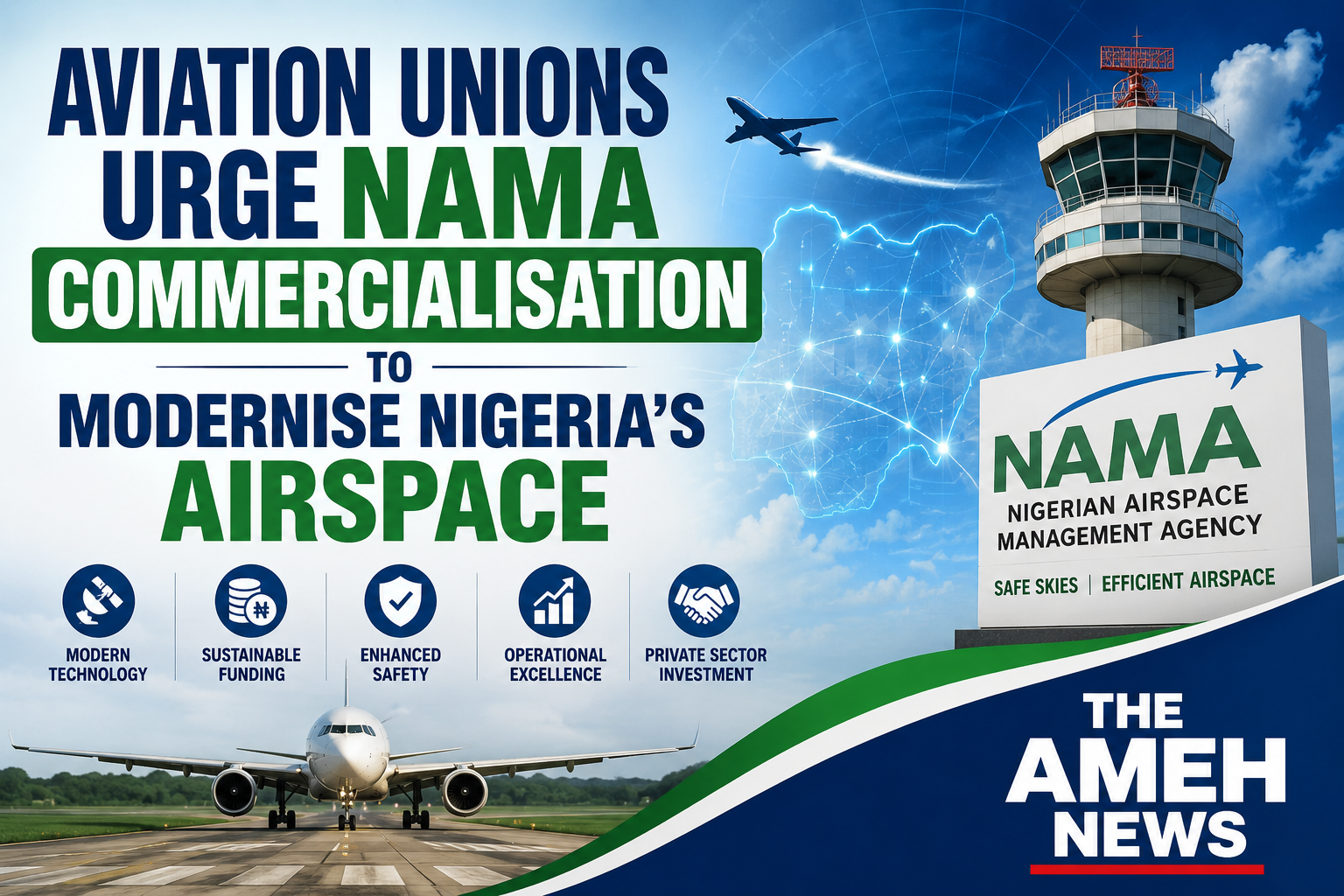
 The Joint Action Committee (JAC) of the Nigeria Civil Aviation Authority has called for the commercialisation or privatisation of the Nigerian Airspace Management Agency (NAMA), declaring that sweeping institutional reforms are essential to modernise Nigeria’s air navigation system, improve safety standards, and position the country as a leading aviation hub in Africa.
The committee argued that the current funding structure, which relies heavily on government budgetary allocations and statutory revenue sources, has become inadequate for the demands of a rapidly evolving global aviation industry.
In a statement jointly signed by Obasi Ugwumba, Salami J. Adeniyi, Omaga Joshua, and Celestine N. Chukwu on behalf of the aviation unions, the committee said commercialising or privatising NAMA would unlock access to private equity, international financing, capital markets, and bond issuance, enabling the agency to deploy cutting-edge air navigation technologies, including satellite-based Automatic Dependent Surveillance-Broadcast (ADS-B) systems and modern backup infrastructure.
According to the committee, the proposed reform has become increasingly urgent as funding constraints, prolonged budget approval processes, changing government priorities, and bureaucratic delays continue to slow critical investments in aviation safety infrastructure.
It noted that transforming NAMA into a commercially driven organisation would make it financially self-sustaining and empower it to finance long-term infrastructure projects without depending solely on annual government appropriations.
The committee maintained that such a model would enable management to make faster operational decisions focused on efficiency, technological innovation, service delivery, and aviation safety.
Drawing from international best practices, the unions pointed to successful Air Navigation Service Providers (ANSPs) such as Nav Canada, NATS Holdings, and Airways New Zealand, which operate under commercially oriented, user-pays models that have delivered financial sustainability, operational excellence, and continuous technological advancement.
The statement also highlighted that, based on the 2024 Government-Owned Enterprises Budget Proposal, NAMA derives most of its internally generated revenue from en-route navigation charges, overflight charges, its statutory five per cent share of the Ticket Sales Charge (TSC), and other non-navigational service charges.
Additional revenue streams include charter flight charges, Air Traffic Services provided at private and state-owned airports, aeronautical telecommunication services, calibration services, obstacle evaluation fees, aeronautical information publications, cartographic surveys, aerial operation charges, and special Hajj and pilgrimage operations.
Despite these multiple revenue sources, the unions expressed concern over what they described as inadequate transparency in certain aspects of the agency’s financial reporting.
They specifically called for greater public disclosure of revenue generated from airspace violation penalties and Extension of Service Hours Charges collected for navigation services rendered beyond normal airport operating hours.
The committee questioned the rationale behind NAMA’s proposal before the National Assembly seeking to increase the Ticket Sales Charge by between 23 and 40 per cent, insisting that improving financial transparency should precede any additional burden on airlines and passengers.
On aviation safety, the unions stressed that commercialisation would reinforce rather than weaken regulatory oversight by establishing clear institutional responsibilities.
Under the proposed framework, NAMA would concentrate exclusively on providing efficient and safe air navigation services, while the NCAA would continue to function as an independent government regulator responsible for safety certification, compliance monitoring, inspections, and enforcement in line with the provisions of the Civil Aviation Act and the standards of the International Civil Aviation Organization (ICAO).
According to the committee, this separation of operational and regulatory responsibilities would eliminate conflicts of interest and ensure that commercial objectives never compromise aviation safety.
The unions further recommended either full commercialisation, outright privatisation, or a carefully structured Public-Private Partnership (PPP) model that would transform NAMA into an independent corporate entity with private sector participation, measurable performance targets, improved corporate governance, and adequate safeguards to protect national security interests.
They warned that retaining the current operational model, characterised by ageing infrastructure, inadequate funding, and operational inefficiencies, could leave Nigeria trailing behind global aviation standards at a time when efficient airspace management has become a strategic driver of economic growth, regional connectivity, and international competitiveness.
The committee concluded that commercialising or privatising NAMA represents a practical and globally tested solution for delivering safer skies, modern air navigation infrastructure, stronger financial sustainability, and world-class operational performance.
It urged the Federal Government to seize the opportunity to harness private sector expertise, innovation, and investment in repositioning Nigeria’s airspace management system for the benefit of the aviation industry, the travelling public, and the nation’s economic future.
Discover more from Ameh News
Subscribe to get the latest posts sent to your email.