 The Nigerian Safety Investigation Bureau (NSIB) has disclosed that a critical breakdown in cockpit coordination, conflicting decisions among the flight crew, and repeated ignored terrain warnings culminated in the dramatic landing of a private jet on a construction road near Asaba International Airport in Delta State.
The Bureau’s preliminary investigation into the June 10, 2026 incident revealed that the U.S.-registered Bombardier Challenger 601-3A business jet, operated by VMO Aero Limited, mistakenly landed on an uncompleted concrete highway bypass in the Ogwashi-Uku area while attempting to land at Asaba International Airport after departing Lagos.
The preliminary report, based on data recovered from the aircraft’s Flight Data Recorder (FDR) and Cockpit Voice Recorder (CVR), paints a disturbing picture of poor cockpit resource management, disagreement among the pilots, and failure to respond promptly to critical safety alerts during the approach.
According to the NSIB, the operating flight crew maintained that the aircraft’s navigation systems indicated they were correctly aligned with the published RNAV Runway 11 approach into Asaba Airport.
However, investigators found a sharply different account from the observer pilot, who told investigators that the aircraft remained inside thick cloud until the final stages of the approach, making visual identification of the runway difficult.
The report further disclosed that during the descent, the aircraft’s Ground Proximity Warning System (GPWS) repeatedly issued urgent “TERRAIN, TERRAIN, PULL UP” alerts, warning the crew of imminent danger.
Despite the continuous warnings, the aircraft continued its descent.
The observer pilot reportedly spotted a telecommunications mast directly ahead of the aircraft and immediately instructed the pilot flying to execute a missed approach and climb away from the area. The instruction was not carried out.
Investigators also uncovered evidence of disagreement inside the cockpit, with the conflicting decisions creating confusion during one of the most critical phases of flight.
The tension inside the cockpit was reportedly noticeable inside the cabin.
A cabin crew member informed investigators that one of the passengers overheard the pilots arguing and became concerned enough to ask whether one of the pilots was still undergoing training.
The passenger was reassured that all three pilots on the flight were experienced captains.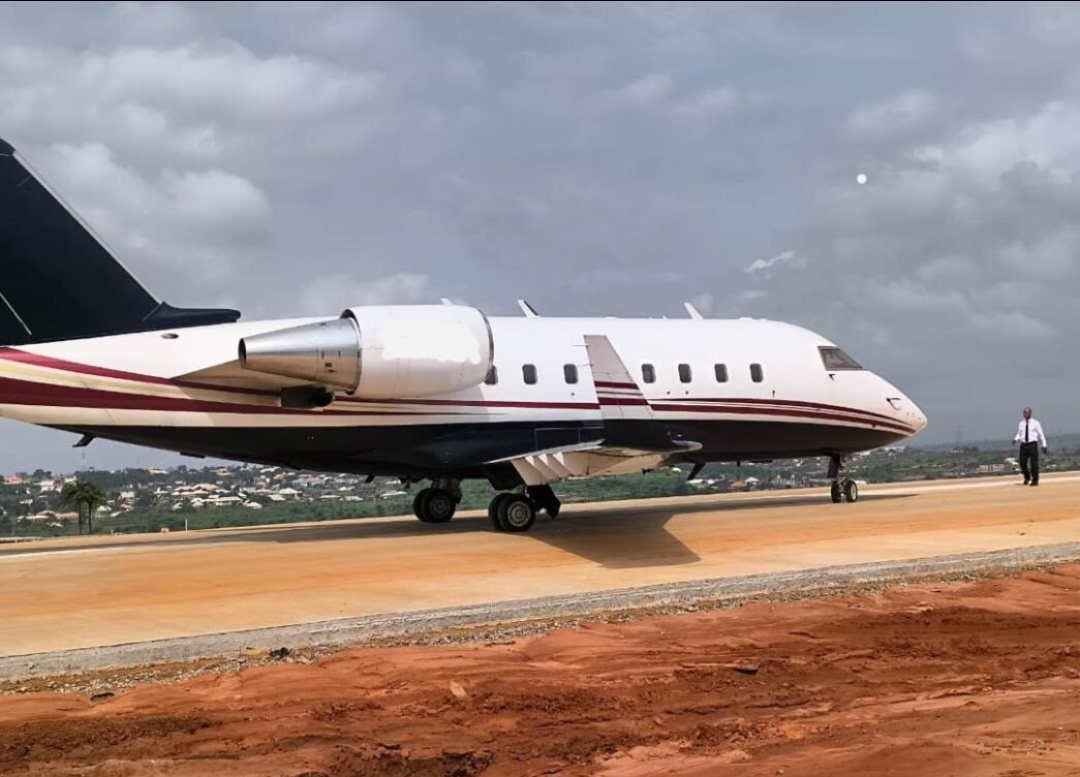
Despite touching down on a public infrastructure project instead of the airport runway, all seven occupants—comprising four crew members and three passengers—escaped without injuries.
Subsequent inspection revealed structural damage to the aircraft’s left nose-wheel assembly.
The incident took a more controversial turn after landing.
Rather than waiting for aviation authorities to assess the aircraft, the crew reportedly inspected the jet on the construction road, took off directly from the public roadway without obtaining Air Traffic Control (ATC) clearance, and flew the aircraft back to Lagos.
Minister of Aviation and Aerospace Development, Festus Keyamo, had earlier confirmed that the aircraft suffered no mechanical failure, reinforcing the investigation’s focus on operational and human-factor issues rather than technical malfunction.
Following the unauthorized departure from the scene, the Nigeria Civil Aviation Authority (NCAA) grounded the aircraft, suspended VMO Aero Limited’s operating permit, and handed the flight crew over to the Department of State Services (DSS) as part of a broader national security investigation.
The NSIB stressed that its findings remain preliminary and are intended solely to enhance aviation safety by preventing future accidents rather than assigning blame or determining liability.
The Bureau said investigators are continuing detailed technical examinations of the aircraft’s systems, flight data and cockpit recordings at its Abuja laboratory before issuing a final report containing definitive conclusions and additional safety recommendations.
The incident has renewed concerns within Nigeria’s aviation industry over cockpit discipline, adherence to standard operating procedures, crew resource management, and compliance with mandatory responses to automated terrain warning systems.
Aviation safety experts say the final NSIB report is expected to provide critical recommendations that could strengthen pilot training, improve approach procedures in poor weather conditions, and reinforce regulatory oversight of business aviation operations in Nigeria.
Discover more from Ameh News
Subscribe to get the latest posts sent to your email.