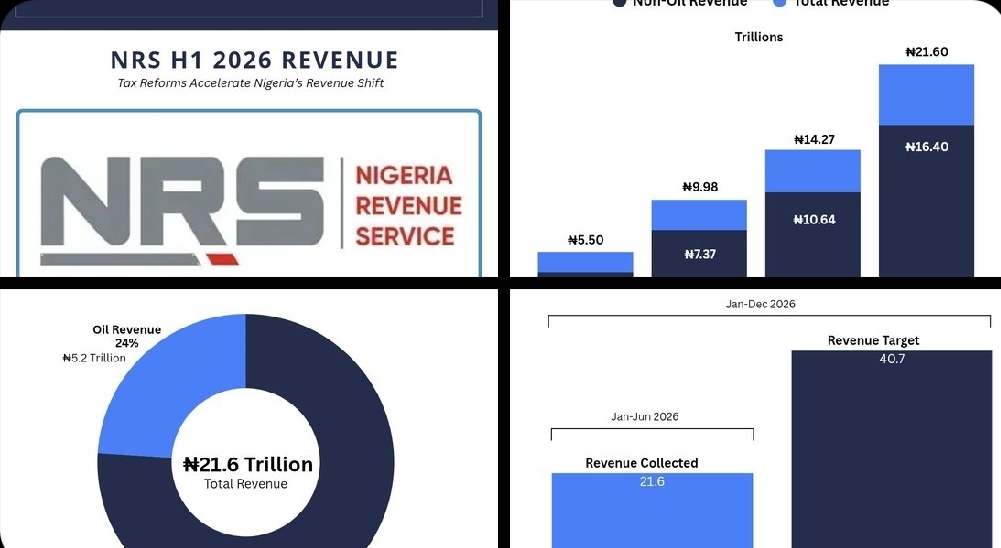
 Nigeria’s sweeping tax reform agenda is delivering unprecedented results, with the Nigeria Revenue Service (NRS) announcing tax collections of ₦21.6 trillion in the first half of 2026, representing a 49 per cent increase over the ₦14.27 trillion generated during the corresponding period in 2025.
The remarkable performance comes under the leadership of the Executive Chairman of the Nigeria Revenue Service (NRS), Dr. Zacch Adedeji, whose administration has spearheaded a comprehensive transformation of Nigeria’s tax administration through digital innovation, institutional reforms, improved compliance mechanisms and stronger inter-agency collaboration.
The figures, compiled by the NRS and reviewed by financial analysts at CSL Stockbrokers, highlight the growing effectiveness of the Federal Government’s efforts to diversify revenue sources, strengthen fiscal sustainability and reduce dependence on oil earnings.
Historic Revenue Growth
The H1 2026 performance continues Nigeria’s remarkable upward revenue trajectory.
Total tax collections rose from ₦12.3 trillion in 2023 to approximately ₦21 trillion in 2024, before climbing to ₦28.29 trillion in 2025. Having already generated ₦21.6 trillion within the first six months of 2026, the NRS appears well positioned to exceed its previous annual record if current momentum is sustained.
The growth has significantly improved Nigeria’s fiscal outlook, with non-oil revenue now accounting for about 76 per cent of total collections, while the country’s tax-to-GDP ratio has increased from 10.3 per cent to 13 per cent, reflecting gradual progress towards international standards for domestic revenue mobilisation.
Adedeji’s Reform Agenda Gains Momentum
Since assuming office, Dr. Adedeji has championed an ambitious reform programme aimed at modernising Nigeria’s tax administration and making revenue collection more transparent, technology-driven and efficient.
A major milestone was the transformation of the Federal Inland Revenue Service (FIRS) into the Nigeria Revenue Service (NRS) under newly enacted tax legislation, expanding the agency’s mandate beyond traditional tax collection to include selected non-tax revenues previously managed by different government institutions.
The restructuring has created a more integrated revenue administration system, reduced duplication and strengthened accountability across federal revenue-generating agencies.
Under his leadership, the NRS also accelerated the nationwide rollout of an electronic invoicing platform, enabling real-time monitoring of commercial transactions, reducing tax leakages and improving voluntary compliance among businesses.
Industry observers believe these reforms have significantly enhanced revenue transparency while broadening Nigeria’s tax base without imposing excessive burdens on compliant taxpayers.
Landmark Tax Laws Reshape Revenue Administration
Another major factor behind the impressive performance is the implementation of four landmark tax laws, which came into effect on January 1, 2026.
The legislation includes the Nigeria Tax Act, Nigeria Tax Administration Act, Nigeria Revenue Service (Establishment) Act, and the Joint Tax Board (Establishment) Act.
The new legal framework simplifies tax administration, harmonises collection processes, improves dispute resolution and strengthens cooperation among tax authorities at the federal, state and local government levels.
Economic analysts describe the reforms as the most comprehensive overhaul of Nigeria’s tax system in decades.
Executive Order Closes Oil Revenue Leakages
Revenue collection also received a major boost following the implementation of Executive Order 9, signed in February 2026.
The Order requires upstream oil and gas companies to remit royalties, petroleum taxes and production-sharing contract profit oil directly into the Federation Account, eliminating long-standing remittance bottlenecks.
As a result, monthly Federation Account receipts reportedly increased by about 60 per cent, rising from ₦1.8 trillion in February to approximately ₦2.88 trillion in March 2026, significantly improving government cash flow.
Experts Commend the Progress
Reacting to the latest revenue figures, economist Celestine Ukpong described the achievement as evidence that structural reforms are beginning to yield sustainable outcomes.
“A 49 per cent increase in revenue within six months demonstrates that better administration, technology and compliance can produce stronger government earnings without necessarily increasing tax rates. The focus should now be on ensuring that these resources are transparently deployed to improve infrastructure, education, healthcare and economic productivity,” he said.
Also commenting, Dr. Ejike Nduilo, Lecturer at Covenant University, Ota, and Chief Thinker at Henryjvaleens Limited, said the success of the reforms would ultimately depend on maintaining a tax environment that encourages investment and business expansion.
According to him, broadening the tax base through improved compliance is more sustainable than placing additional burdens on existing taxpayers.
Financial expert and Fellow of the Institute of Chartered Accountants of Nigeria (ICAN), Peter Adebayo, FCA, noted that improved digital systems, stronger data integration and tighter enforcement have substantially reduced tax leakages.
He urged the government to ensure that the increased revenue translates into visible improvements in infrastructure, electricity, transportation, healthcare and security.
“When taxpayers see evidence that their contributions are being prudently managed, voluntary compliance naturally improves,” he said.
NRS Targets ₦40.7 Trillion for 2026
Building on the strong first-half performance, Dr. Adedeji has set an ambitious ₦40.7 trillion revenue target for the 2026 fiscal year, representing a 44 per cent increase over the ₦28.29 trillion generated in 2025.
Analysts believe the target is achievable if the agency sustains its reform momentum, strengthens digital compliance systems, expands taxpayer education and continues collaborating with other government institutions to eliminate revenue leakages.
Although some international reports, including Bloomberg, placed collections at ₦15.8 trillion for the January-to-May period, experts note that the differences simply reflect varying reporting periods rather than conflicting revenue data.
As Nigeria continues its transition towards a more diversified economy, the latest performance by the Nigeria Revenue Service under Dr. Zacch Adedeji reinforces the growing importance of domestic revenue mobilisation in financing national development, reducing reliance on oil earnings and creating a more resilient fiscal future.
The Nigeria Revenue Service, led by Executive Chairman Dr. Zacch Adedeji, generated ₦21.6 trillion in tax revenue in the first half of 2026, a 49% increase driven by landmark tax reforms, digital innovation and stronger compliance.
Dr. Zacch Adedeji, Nigeria Revenue Service, NRS, H1 2026 tax revenue, Nigeria tax reforms, FIRS, tax collection, non-oil revenue, Executive Order 9, fiscal reforms, Nigerian economy.
Discover more from Ameh News
Subscribe to get the latest posts sent to your email.