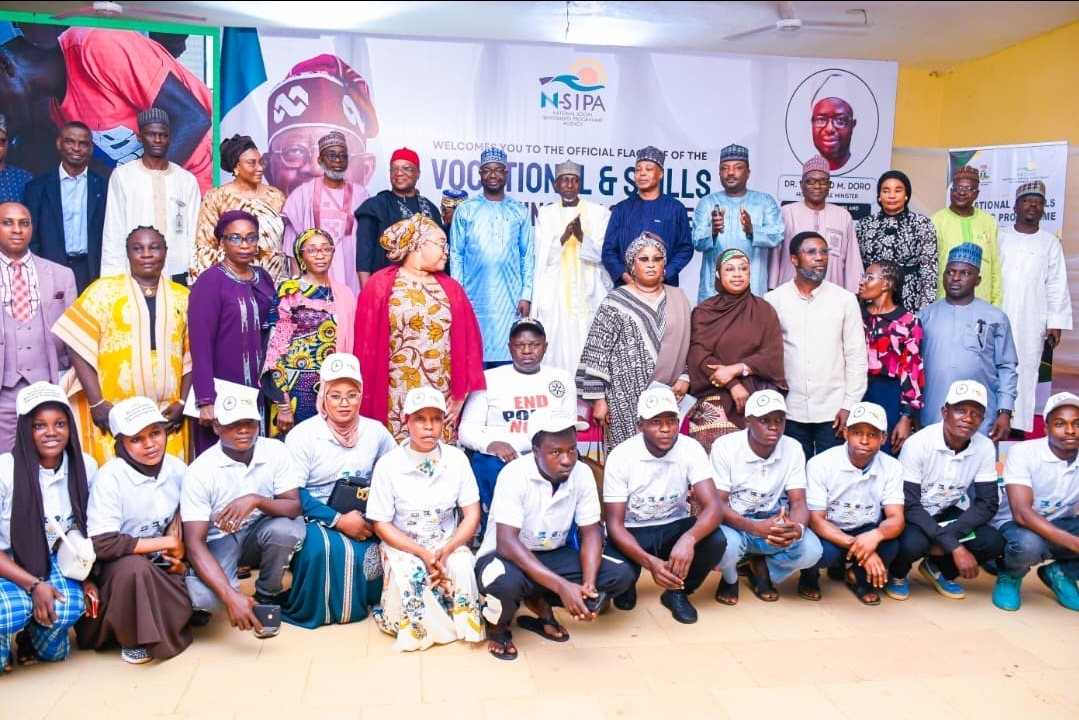
 The Honourable Minister of Humanitarian Affairs and Poverty Reduction, Dr. Bernard M. Doro, has described the Federal Government’s Renewed Hope Vocational and Skills Training Programme (VSTP) as a strategic investment in Nigeria’s human capital, reaffirming the Tinubu Administration’s commitment to empowering Nigerians with practical skills that create sustainable livelihoods.
This was contained in a statement issued by the Minister’s Senior Technical Adviser on Information Systems and Data Analysis, Dr. Abimbola Fasanu, following the official flag-off of the programme in Abuja.
Speaking at the launch of the programme at the Government Technical College, Area 3, Garki, Abuja, Dr. Doro said the initiative represents a major shift in the Federal Government’s approach to poverty reduction by placing greater emphasis on skills acquisition, entrepreneurship, and economic self-reliance.
> “This programme is more than a training exercise; it is a strategic investment in Nigeria’s future. Under the Renewed Hope Agenda of President Bola Ahmed Tinubu, we are moving from palliatives to pathways by equipping Nigerians with practical skills that create opportunities, restore dignity, and build lasting prosperity,” the Minister said.
The programme, a flagship initiative of the National Social Investment Programme Agency (NSIPA), will equip 18,510 beneficiaries across the 36 states and the Federal Capital Territory (FCT) with practical vocational and entrepreneurial skills designed to improve employability and expand opportunities for self-employment.
Dr. Doro explained that the initiative forms part of the Ministry’s broader reform agenda under the One Humanitarian–One Poverty Response System (OHOPRS), which seeks to eliminate fragmented interventions by integrating humanitarian assistance, social protection, and poverty reduction into a single coordinated national framework.
According to him, the Vocational and Skills Training Programme has been deliberately linked to the National Social Investment architecture to ensure that beneficiaries do not stop at skills acquisition but are connected to entrepreneurship opportunities, cooperative structures, and poverty graduation pathways that promote long-term economic independence.
The intensive two-week programme combines technical vocational training with entrepreneurship development, while every participant will receive a starter pack aligned with his or her chosen trade to facilitate immediate business start-up upon graduation.
Beneficiaries will receive training in 14 high-demand vocational trades, including Automobile Technology, Agric-Tech, Baking and Confectionery, Carpentry, Cooks and Catering, Electrical Installation, Housekeeping, Jewellery and Bead Making, Masonry, Plumbing, Welding, Sewing and Fashion Design, Grinding Operations, and Vulcanising.
Dr. Doro stressed that the true measure of the programme’s success would not be the number of certificates awarded but the number of sustainable livelihoods created.
> “Our vision is to see today’s trainee become tomorrow’s entrepreneur, employer, and contributor to national development. This is how we will build resilience, reduce poverty, and create inclusive economic growth for Nigerians.”
The Minister commended the National Social Investment Programme Agency (NSIPA), training providers, development partners, and private sector organisations supporting the initiative, urging them to ensure quality delivery, effective monitoring, and sustained post-training support for beneficiaries.
He reaffirmed that the Ministry would continue to champion reforms that empower vulnerable Nigerians through coordinated interventions, practical skills development, and sustainable livelihood opportunities in line with President Bola Ahmed Tinubu’s Renewed Hope Agenda.
Discover more from Ameh News
Subscribe to get the latest posts sent to your email.