By Ummie Kabir
A look at the Central Bank’s drive to bring every Nigerian into the formal economy — and why the finish line keeps moving*
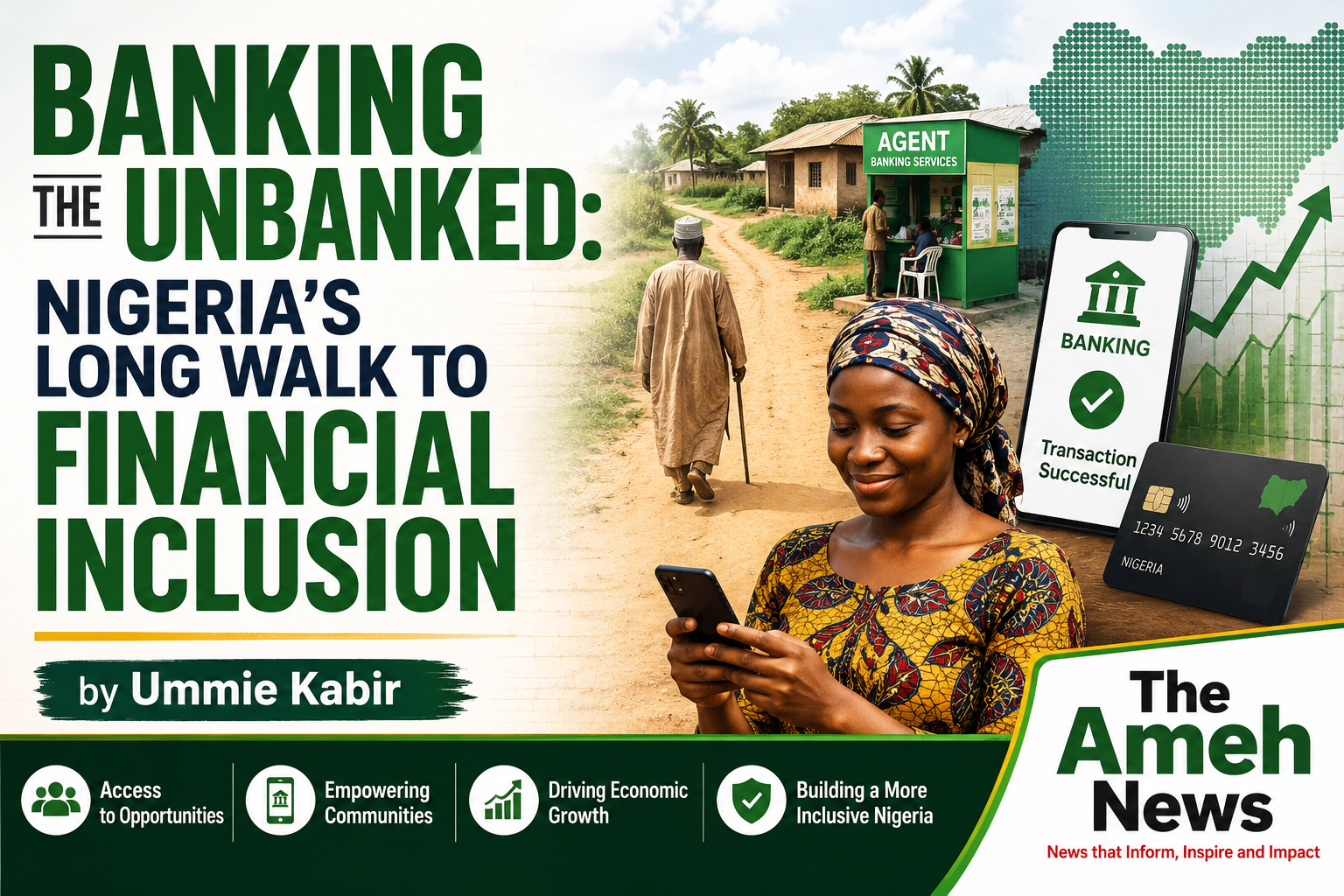
In a market in Brass, a fishing town tucked into the creeks of Bayelsa State, a trader sells smoked fish to customers who tap their phones to pay rather than count out naira notes. Scenes like this, once rare outside Lagos and Abuja, are becoming more common across Nigeria. An evidence that the Central Bank of Nigeria (CBN) applaud ythat its decade-long push for financial inclusion is finally gaining real traction. Yet for every market woman now banking digitally, millions more remain locked out of the formal financial system entirely.
The CBN’s financial inclusion journey began in earnest in 2012 with the launch of the National Financial Inclusion Strategy (NFIS), which set an ambitious goal to significantly reduce the financially excluded adults to 20 percent by 2020. The strategy focused on expanding access to financial services through mobile banking, agent banking, microfinance, and other channels.
It didn’t work out that way. By the 2020 deadline, the headline inclusion figure stood at 64.1 percent, short of the 80 percent target the bank had set for itself under a later revision of the strategy. Breaking the numbers down revealed that payments services had reached only 45 percent of adults against a 70 percent target, savings stood at 32 percent against 60 percent, credit access languished at three percent against a 40 percent goal, insurance at two percent, and pensions at seven percent.
The bank revised its ambitions rather than abandon them. Under NFIS 3.0, the target became reducing exclusion to 25 percent by 2024 and here, the story brightens considerably. A 2023/2024 survey by Enhancing Financial Innovation and Access (EFInA) found formal financial inclusion had risen to 64 percent, up from 56 percent in 2020, while other tracking put the figure as high as 74 percent. Speaking at the time, CBN Governor Olayemi Cardoso described Nigeria’s financial inclusion drive as a long and sometimes arduous journey, admitting the bank had at times worried about the slow pace of progress.
But even celebrated gains come with a sobering footnote. EFInA’s chair, Dr Agnes Martins, welcomed the progress while stressing that a 26 percent exclusion rate still means 28.8 million adult Nigerians, a population roughly the size of Ghana remain shut out of the financial system.
Undeterred by years of missed deadlines, the CBN has now set its sights even higher. At a recent fintech and inclusion event, Cardoso unveiled “Vision 2028,” declaring that by 2028, every Nigerian, from Birnin Kebbi to Brass and Badagry to Baga, should be able to send and receive money faster than they can blink, with inclusion rather than exclusion as the watchword.
Concretely, the governor wants inclusion to reach 95 percent, which would bring 15 million more market women, farmers, and young people into the formal financial fold, and he insisted that cash should no longer define who gets to participate in the economy.
Cardoso also used the occasion to make a point about narrative ownership, urging Nigerians to project their fintech achievements globally and warning that if the country doesn’t tell its own story, others will tell it in less flattering terms.
Now, What’s really Driving forces behind the much anticipated gains? Several initiatives explain the recent upward trend like the Agent banking networks, The Shared Agent Network Expansion Facility (SANEF) has been central to reaching rural and semi-urban locations. In a recent review 69,094 new agents were onboarded, bringing the total to over 2 million and pushing access points to 1,903 per 100,000 adults. Combined with Payment Service Banks (PSB) and mobile money operators (MMO), these networks now extend across all 774 local government areas in the country.
Also, Governance structures put in place to drive the financial inclusion initiatives have significantly impactful. The National Financial Inclusion Secretariat operates through a Steering Committee chaired by the Governor, a Technical Committee chaired by the Deputy Governor for Financial System Stability, and four working groups covering products, channels, literacy, and interventions have brought coordination to what had often been a fragmented effort.
Rapid developments in the Fintech sub-sector are responsible for the growth being witnessed the inclusion drive. A recent CBN fintech report framed regulatory modernization as inseparable from inclusion goals, noting that improved currency and economic stability now make it clearer than ever that financial innovation can advance inclusion at scale, while acknowledging gaps remain in regulatory frameworks, payments infrastructure, and support for startups.
The place Mobile phone penetration cannot be downplayed as the spread of smartphones continues to be the single biggest enabler thereby reducing reliance on physical bank branches and making digital banking and payment solutions accessible even in remote areas.
However, some noticeable pitfalls still exist in the forms of gender and rural-urban divide. An analysis of Global Findex data spanning 2011 to 2021 found that despite real advances in formal account ownership and digital service use, exclusion gaps along gender, rural-urban, and digital lines remain prominent. An indication that the inclusion gains have not been evenly shared. Women, rural dwellers, and the poorest Nigerians continue to lag behind.
Tangential to the above is the most accounts opened don’t do much as having a bank account is not the same as using the financial system productively. The same research noted that while formal accounts are increasingly used for savings, real barriers persist around using those accounts for borrowing and sending remittances. This gap shows up in the CBN’s 2020 numbers, where credit penetration sat at just three percent against a 40 percent target.
Stringent Know Your Customer (KYC) rules, while necessary for security, have an unintended cost for identification and documentation. Strict KYC requirements sometimes exclude individuals who lack the required identification documents in the first place. A particular problem in a country where national ID coverage is still incomplete after several decades.
Way forward for a more Inclusive System should by going beyond infrastructure to literacy and trust. As one payment service bank executive put it, true inclusion requires going further than agent networks — accelerating investment in nationwide digital infrastructure, enhancing financial literacy, developing solutions in local languages, and designing products that are intuitive and affordable.
Meanwhile, in order to Deepen credit and insurance access beyond payments only, the seemingly lopsided progress which is strong in payments but weak in credit and insurance, the next phase needs products tailored to farmers and small traders who need working capital and risk protection, not just a place to receive transfers.
The identity gap must be closed by Linking national identity enrollment campaigns directly to account-opening drives to remove one of the most persistent barriers to entry for the undocumented poor.
Generic inclusion campaigns target must women and rural dwellers to close the gender and geographic gaps in addition to Sustaining multi-sector collaboration. Because Achieving comprehensive financial access will require continued partnerships across private companies, NGOs, and public institutions to drive innovation and broaden service delivery — a recognition that the CBN cannot do this alone.
In conclusion, as millions of adults still are outside the formal system, and with credit, insurance, and rural-gender gaps still wide, Vision 2028’s 95 percent target will test whether Nigeria’s financial system can finally convert access into genuine economic opportunity.
Discover more from Ameh News
Subscribe to get the latest posts sent to your email.