

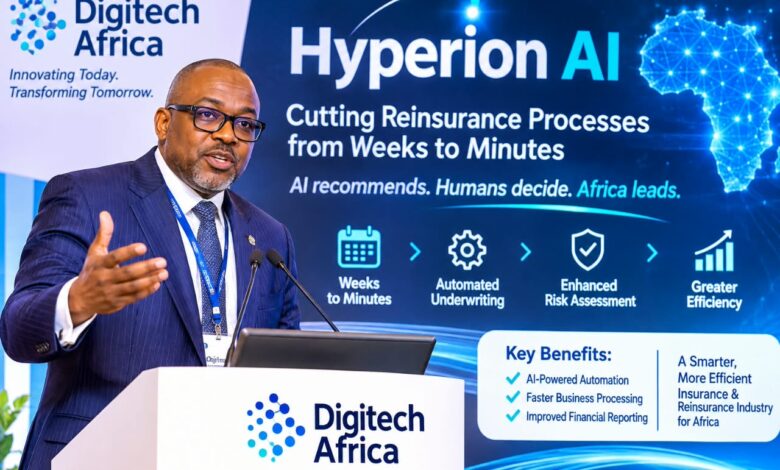
Digitech Africa has unveiled an artificial intelligence-powered platform, Hyperion AI, designed to transform insurance and reinsurance operations by reducing processes that traditionally take weeks to hours or minutes, while improving underwriting efficiency, risk assessment and financial reporting.
The platform, presented by Digitech Africa’s Founder and Chief Executive Officer, Alexandre N’Djore, at the 30th African Reinsurance Forum in Mauritius, deploys multiple specialised AI agents to execute complex business processes, analyse information, verify outputs and deliver completed work, subject to human approval.
N’Djore said the technology addresses persistent operational challenges confronting insurance and reinsurance companies, particularly fragmented information systems, manual data processing and the heavy dependence on spreadsheets to transfer and reconcile information across departments.
According to N’Djore, cedant rating can take approximately three weeks, treaty analysis about five days, while month-end accounting processes may require up to 10 working days.
The Hyperion AI platform is designed to address these inefficiencies through coordinated AI agents capable of handling specialised assignments across underwriting, cedant rating and technical accounting.
Under its underwriting application, the platform can undertake burning-cost calculations, technical pricing, concentration checks and treaty memorandum preparation.
Its cedant-rating functionality incorporates a six-factor assessment model with sensitivity analysis, while its technical accounting application supports IFRS 17 journal preparation, financial close processes and draft CIMA regulatory returns.
In his presentation, N’Djore highlighted the growing financial and competitive implications of artificial intelligence adoption in the global insurance industry, citing opportunities to improve productivity, accelerate business processing and strengthen underwriting performance.
It noted that underwriters spend up to 70 per cent of their time gathering and cleaning data, a situation that AI-powered automation could significantly improve.
He also cited the potential to reduce commercial-lines quotation turnaround from between 10 and 20 days to less than 24 hours, alongside possible loss-ratio improvements of up to seven percentage points.
Referencing developments in the global insurance market, N’Djore highlighted Swiss Re’s reported engineering productivity gains of up to 80 per cent and the growing integration of AI into underwriting operations by major international reinsurers, including Munich Re.
He argued that speed and efficiency are increasingly becoming important competitive advantages in insurance, particularly as companies seek to improve underwriting margins and shareholder returns.
The financial case for adoption, according to N’Djore, is equally significant. It estimated that AI investment could generate first-year value of between five and 14 times the initial investment, with a potential payback period of less than 18 months.
However, he described these figures as business-case estimates that would require validation through a 90-day review.
On the platform’s operational capabilities, Digitech Africa demonstrated three major applications: underwriting, cedant rating and technical accounting.
The demonstration, which used synthetic data, showcased AI reasoning and an audit trail, with human approval retained at critical decision-making stages.
N’Djore said Hyperion had been in production since 2020, with the company reporting deployments across more than 200 insurers and reinsurers in over 15 countries within the CIMA and ECOWAS zones.
He explained that the platform incorporates read-only data connectors, documented operational rulebooks, designated human approvers and comprehensive audit logs to support accountability and control.
The technology architecture combines Digitech’s specialised AI agents and operational methodologies with Claude, developed by Anthropic and delivered through Amazon Bedrock, alongside AWS infrastructure deployed with Silicon Overdrive.
Digitech Africa is also a member of Anthropic’s Claude Partner Network and NVIDIA Inception programme.
Addressing concerns around data ownership and security, N’Djore, in the presentation stated that clients would retain control over their data, which would remain within a region and account under their control. It also explained that operational methodologies would be documented in rulebooks owned and accessible to clients.
The company further indicated that qualifying projects could benefit from relevant AWS programmes and funding opportunities.
On implementation, Digitech Africa proposed a phased adoption strategy to enable insurers and reinsurers to assess the technology before committing to full-scale deployment.
The first phase involves deploying a single AI agent using anonymised company files over a 30-day period. This would be followed by a cluster integrating underwriting, cedant rating and accounting functions over approximately four months, before eventual expansion to full bureau or group-wide operations.
The phased approach, he said, is intended to allow organisations to establish the platform’s effectiveness, assess operational improvements and demonstrate measurable business value before scaling up.
This comes at a time when African insurance markets are under pressure to improve operational efficiency, strengthen risk management and compete more effectively in an increasingly technology-driven global financial services industry.
For N’Djore, the future of insurance operations will depend not simply on deploying artificial intelligence but on integrating intelligent systems into existing business processes without compromising professional judgement and accountability.
The presentation’s central message captured the company’s approach to AI adoption: “AI recommends. Humans decide. Africa leads.”
Discover more from Ameh News
Subscribe to get the latest posts sent to your email.