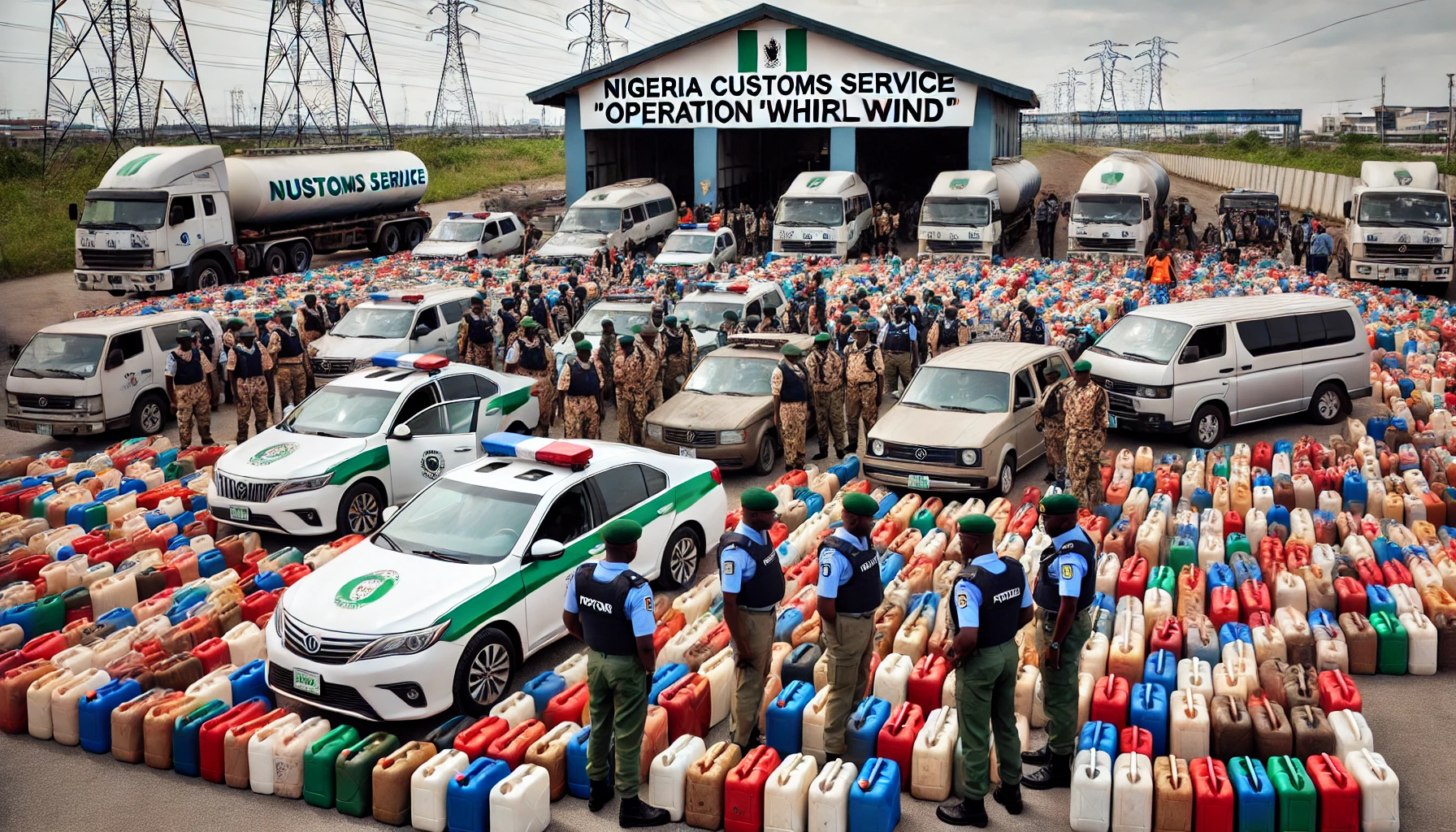
 The relentless battle against petroleum smuggling intensified as the Nigeria Customs Service (NCS), under the leadership of the Comptroller-General, delivered a resounding blow to economic saboteurs through its special enforcement initiative, Operation Whirlwind.
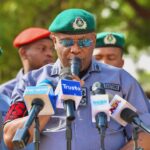
At a press briefing in Lagos on February 28, 2025, the NCS revealed that intelligence-driven operations in the Lagos-Ogun corridor resulted in the interception of 28,300 liters of Premium Motor Spirit (PMS), with a Duty Paid Value (DPV) of ₦35.8 million. This latest seizure brings the total volume of confiscated petroleum products under Operation Whirlwind to 273,670 liters, effectively crippling illicit networks and safeguarding Nigeria’s energy security.
The briefing was more than a statistical recount—it was a reflection on the deep-seated economic war against fuel smuggling. The Comptroller-General emphasized that every liter of fuel illegally diverted beyond Nigeria’s borders represents lost revenue, market instability, and a direct attack on national sovereignty.
The Battle Against Smuggling: A War of Tactics and Resolve
For decades, fuel smuggling has remained an Achilles’ heel in Nigeria’s economic landscape. Government efforts to reform the petroleum market and stabilize supply chains have been persistently undermined by criminal syndicates, exploiting regional price disparities to sustain a lucrative black market. The emergence of Operation Whirlwind marked a turning point, signaling a shift from reactive enforcement to a strategic, intelligence-led offensive.
The success of this operation stems from inter-agency collaboration, with critical backing from the Office of the National Security Adviser (ONSA) and the Nigeria Midstream and Downstream Petroleum Regulatory Authority (NMDPRA). By integrating intelligence-sharing and tactical precision, the NCS has recalibrated its approach to disrupt the evolving smuggling networks.
Lagos Zone ‘A’: A Strategic Battleground
The Lagos-Ogun axis remains a notorious hotspot for petroleum smuggling due to its proximity to the Republic of Benin. The latest seizures in this zone were executed across four key corridors:
- Badagry-Seme Route (35%) – A long-standing smuggling artery due to its border access and waterway networks.
- Imeko-Afon Axis (25%) – An emerging hotspot where smugglers exploit rural communities to store and transport fuel.
- Ilaro-Ojodan Network (22%) – Increasingly active with sophisticated concealment tactics.
- Owode-Ajilete Route (18%) – A growing corridor used to bypass enforcement choke points.

Evolving Tactics of Smugglers: A Moving Target
The press briefing highlighted how smugglers have adapted their strategies in response to heightened enforcement. These adaptations include:
- Daylight Smuggling: Previously dominated by nighttime movements, smugglers now operate between 9:00 AM – 2:00 PM, leveraging periods of reduced scrutiny.
- Community-Based Storage: Small, decentralized depots within border towns serve as transit hubs for fuel stockpiling.
- Modified Vehicles: Custom-built compartments, fake registration documents, and foreign-registered vehicles are increasingly used to bypass detection.
- Small-Volume Shipments: Instead of bulk smuggling, syndicates now employ multiple small-scale movements to evade large-scale interceptions.
Beyond Seizures: Strengthening the Firewall
The NCS has acknowledged that sustained victories require continuous evolution. Moving forward, the service plans to implement:
- Advanced surveillance technology to monitor high-risk corridors.
- Specialized tactical response teams trained for petroleum interdiction.
- Community engagement programs to strengthen local intelligence gathering.
- Risk assessment frameworks for optimal resource deployment.
The Nigerian Navy, Nigeria Security and Civil Defence Corps (NSCDC), and border community stakeholders will be integrated into this expanded security architecture.
No Safe Haven for Smugglers
Closing the briefing, the Comptroller-General reaffirmed zero tolerance for smuggling activities. Operation Whirlwind is not just a temporary initiative but a long-term strategic enforcement campaign aimed at eradicating fuel smuggling from Nigeria’s economic landscape.
“This is a fight for Nigeria’s economic survival,” he declared. “There will be no safe haven for smugglers. We will deploy every available resource to protect Nigeria’s petroleum resources and ensure they serve the citizens, not criminal syndicates.”
The Nigeria Customs Service remains steadfast in its commitment to securing the country’s economic integrity. With ongoing political backing from President Bola Ahmed Tinubu, and reinforced inter-agency cooperation, Operation Whirlwind is poised to not only disrupt smuggling networks but to dismantle them permanently.
Stay informed, Stay ahead with The Ameh News
Discover more from Ameh News
Subscribe to get the latest posts sent to your email.