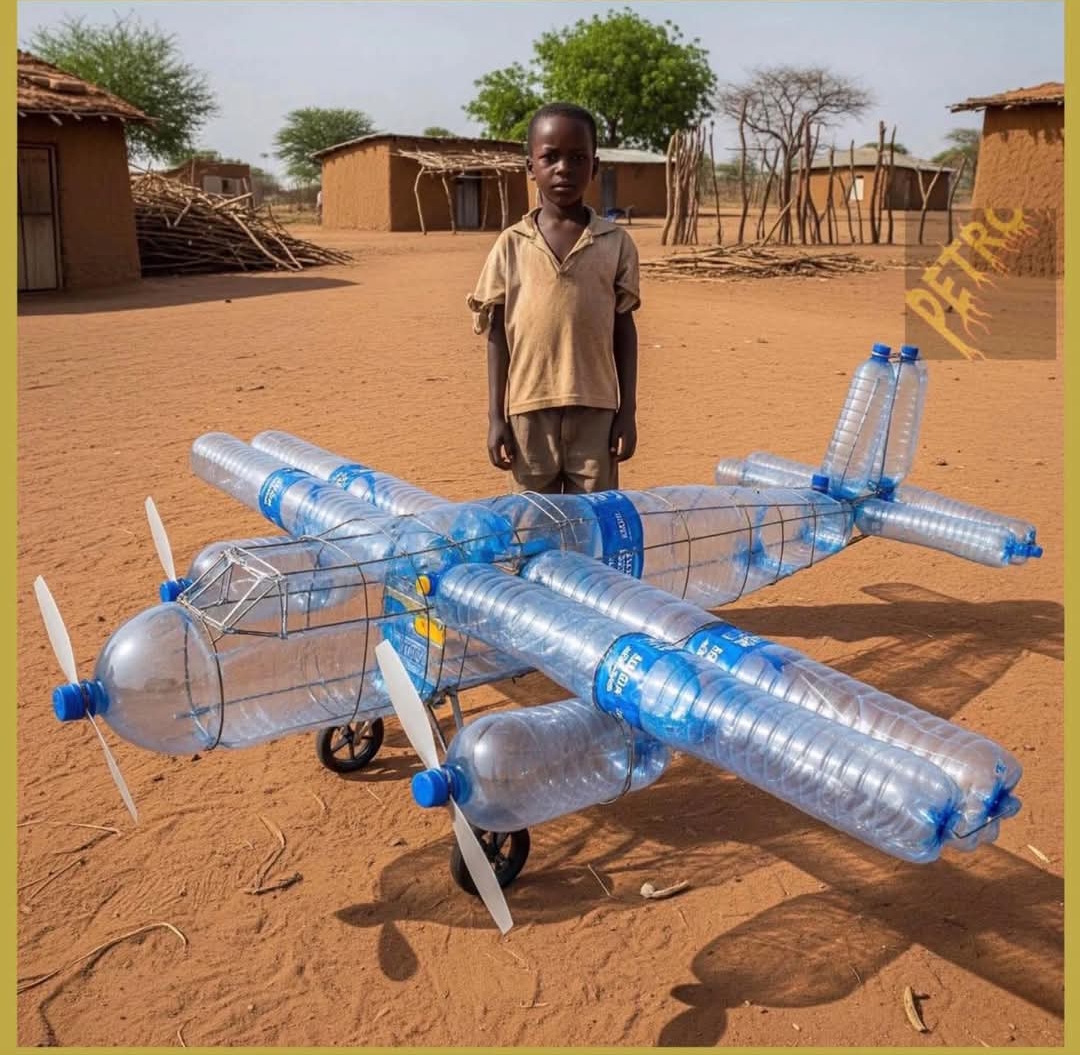
 They say ideas rule the world, and nowhere is that truer than in aviation. The thought that human beings could one day soar like birds once seemed impossible, yet the Wright brothers’ daring experiment more than a century ago proved that imagination could defy gravity. Today, the same principle is alive in unlikely places—even in the playful construction of aircraft models from plastic bottles.
For many, these bottle-made planes may appear as nothing more than children’s toys or idle experiments. Yet aviation experts insist they represent something far more significant: the enduring power of curiosity.
“Every innovation in flight began with a small idea,” said Dr. Ibrahim Kana, aviation historian and former lecturer at the Federal University of Technology, Minna. “When a child builds an aircraft from a discarded bottle, they are not just playing—they are reenacting the process of creative thinking that gave birth to modern aviation. It’s imagination in motion.”
Globally, engineers have often drawn inspiration from such humble beginnings. From kites flown in ancient China to paper airplanes folded in classrooms, the seed of flight has always been sown in simplicity. The transition from toys to technology underscores the timeless lesson that no idea is too small to shape the future.
Reflecting on this, Professor Linda Okafor, an aeronautical engineer at Cranfield University, explained: “The principle is not in the plastic bottle itself but in the thought process it encourages. Every time a student or child asks, ‘How can this object fly?’ they are training their mind to solve bigger problems—fuel efficiency, sustainable aircraft design, even space travel.”
The aviation industry today is investing billions in sustainable technology—electric aircraft, biofuels, and flying taxis. Yet, at its core, the same spark drives progress: imagination turned into engineering. The story of plastic bottle aircraft echoes the humble beginnings of the Wright brothers, who studied birds before sketching gliders that would change the world.
The lesson is simple but profound: innovation begins not in billion-dollar labs but in the human mind. As nations push for greener aviation and more efficient designs, it is worth remembering that the future often starts with a child tinkering with waste material, daring to imagine what could be.
In a world grappling with climate change and technological disruption, the enduring message remains—ideas, no matter how small, rule the world.
Discover more from Ameh News
Subscribe to get the latest posts sent to your email.