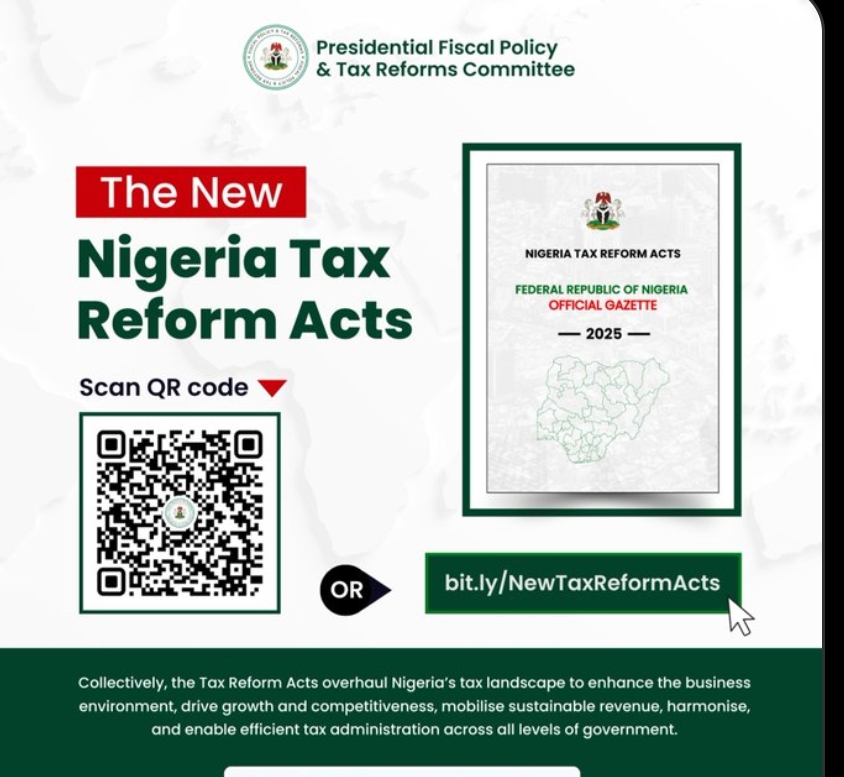
 When President Bola Ahmed Tinubu inaugurated the Presidential Fiscal Policy & Tax Reforms Committee in 2023, many Nigerians were skeptical. For decades, tax reform had been the subject of countless debates, yet little had changed. But two years later, the country has crossed a significant milestone: the enactment and publication of Nigeria’s new tax reform laws in the Official Gazette on June 26, 2025.
The four landmark legislations are:
- Nigeria Tax Act, 2025 (NTA)
- Nigeria Tax Administration Act, 2025 (NTAA)
- Nigeria Revenue Service (Establishment) Act, 2025 (NRSEA)
- Joint Revenue Board (Establishment) Act, 2025 (JRBEA)
Together, they represent the most comprehensive restructuring of Nigeria’s tax framework in decades, designed to promote fairness, efficiency, and economic growth.
A Break from the Past
For years, small and medium-sized enterprises (SMEs)—which account for nearly 90% of businesses in Nigeria—complained of crippling tax obligations that stifled growth. The new laws respond directly: small companies with annual turnover not exceeding ₦100 million and fixed assets below ₦250 million are now exempt from company income tax.
Meanwhile, large corporations—often accused of bearing the brunt of Nigeria’s high tax environment—may see their corporate tax rate reduced from 30% to 25%, once the President issues an order on the advice of the National Economic Council.
“These reforms are not just numbers on paper,” said Taiwo Oyedele, Chairman of the Tax Reforms Committee. “They reflect a deliberate effort to build a system that supports small businesses, encourages big firms to expand, and ensures that Nigeria remains globally competitive.”
New Incentives for Growth
Another standout provision is the 5% annual tax credit for investments in priority sectors. This is expected to drive funds into industries such as renewable energy, manufacturing, and agriculture—sectors critical for diversifying Nigeria’s oil-dependent economy.
The law also provides relief on currency usage. Businesses engaging in foreign exchange transactions can now pay taxes in naira, at the prevailing official exchange rate. Analysts believe this will help stabilize corporate operations amid Nigeria’s volatile FX market.
Expert Views: Balancing Revenue with Growth
Economists and investors have broadly welcomed the reforms, though with cautious optimism.
Celestine Ukpong, an economist and investor based in Lagos, told reporters the reforms are “a much-needed balancing act.”
“On one hand, you’re giving breathing space to small companies that are the backbone of our economy. On the other, you’re signaling to big businesses and foreign investors that Nigeria is ready to compete fairly. The phased approach until 2026 shows maturity—it avoids the shock of overnight changes while giving institutions time to adjust.”
Ukpong also noted that while tax reliefs may reduce short-term government revenues, the long-term benefits of expanding the tax base and stimulating investment could outweigh initial losses.
“Think of it as planting seeds,” he added. “You don’t harvest immediately, but if nurtured well, the gains will be far greater.”
A Phased Rollout for Stability
The reforms are structured with foresight. The NRSEA and JRBEA took effect immediately in June 2025 to strengthen tax administration and coordination. However, the NTA and NTAA will commence on January 1, 2026. This staggered rollout is intended to give tax authorities, businesses, and stakeholders time to prepare for smooth enforcement.
A New Fiscal Era?
As Nigeria looks ahead to 2026, expectations are high. Advocates believe the reforms could broaden the tax net, reduce the country’s dependence on oil revenue, and stimulate industrial growth. Critics, however, caution that the real test lies in execution.
“Good laws don’t automatically translate into good outcomes,” said Ukpong. “The challenge will be in building trust, simplifying compliance, and ensuring transparency in how tax revenues are used. Nigerians want to see that their taxes lead to better infrastructure, healthcare, and education.”
For many, the new tax laws are a reflection of what governance should look like—policies rooted in logic, fairness, and practicality. The reforms are not just about revenue collection; they are about building a fiscal foundation that supports Nigeria’s long-term ambition of becoming a $1 trillion economy.
As Taiwo Oyedele put it, “We’ve created the framework; now it’s about implementation.”
The coming years will reveal whether these laws become a cornerstone of Nigeria’s economic transformation—or another well-intentioned reform stalled by poor execution.
@2025 The Ameh News: All Rights Reserved
Discover more from Ameh News
Subscribe to get the latest posts sent to your email.