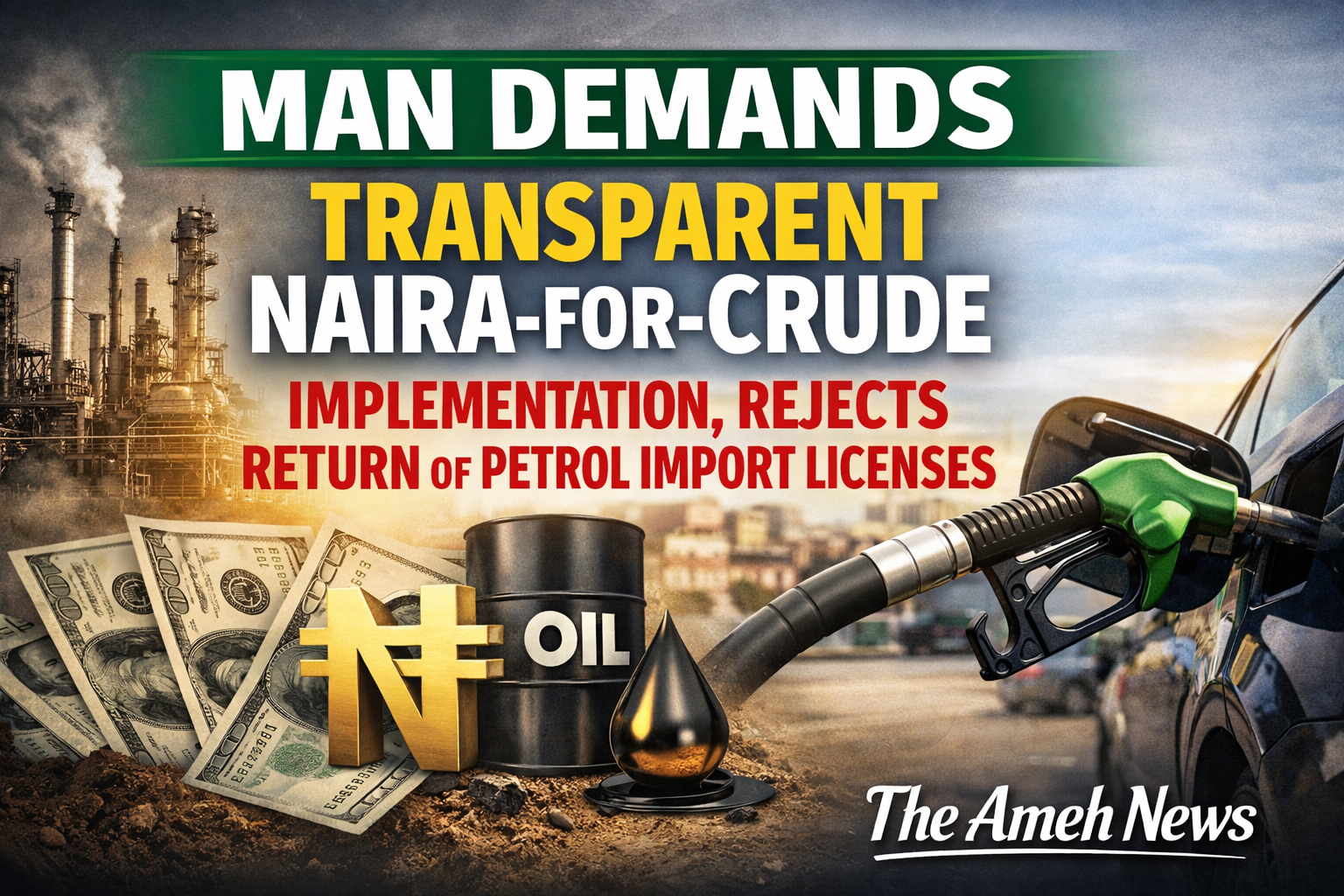
 The Manufacturers Association of Nigeria (MAN) has strongly cautioned against proposals to reintroduce petrol import licenses, describing the idea as economically destabilising and a direct threat to Nigeria’s fragile industrialisation drive.
In a detailed review of the April 2026 Nigeria Development Update (NDU) by the World Bank and its subsequent clarification on downstream petroleum policy, MAN acknowledged the institution’s emphasis on energy security but firmly rejected any suggestion that fuel importation should be used as a tool to manage inflation.
Speaking through its Director General, Segun Ajayi-Kadir, mni, the association warned that reopening Nigeria’s downstream market to imported Premium Motor Spirit (PMS) would amount to reversing recent gains in domestic refining and exposing the economy to renewed structural vulnerabilities.
He argued that such a policy direction would “lock Nigeria into a cycle of exporting jobs and importing poverty,” while undermining long-term industrial development and national economic sovereignty.
“Short-Term Fix, Long-Term Damage” – MAN’s Core Argument
MAN described the argument that fuel import liberalisation could ease inflationary pressure as overly simplistic and detached from Nigeria’s macroeconomic realities.
According to the association, the suggestion fails to account for the deeper drivers of inflation in the country, particularly exchange rate instability and production costs across the real sector.
It warned that reintroducing petrol imports would intensify pressure on Nigeria’s already constrained foreign exchange market, forcing manufacturers and other productive sectors to compete with fuel importers for scarce dollars.
This, MAN noted, would further weaken the naira, increase the cost of imported raw materials and machinery, and ultimately fuel broader inflationary pressures across all sectors of the economy.
“The inflation challenge in Nigeria is fundamentally cost-driven and heavily influenced by foreign exchange volatility,” the association explained, adding that any policy that increases FX demand for fuel imports would worsen, rather than solve, the inflation problem.
Concerns Over Industrialisation and Job Creation
A central theme in MAN’s position is the long-term impact of fuel import dependence on Nigeria’s industrial development.
The association stressed that Nigeria’s historical reliance on imported refined petroleum products had for decades resulted in capital flight, job losses, and the strengthening of foreign manufacturing economies at the expense of local industrial capacity.
It described recent progress in domestic refining capacity as one of the most significant structural shifts in Nigeria’s energy sector in over half a century, warning that reversing this progress would undermine investor confidence in local refining projects and discourage further industrial expansion.
According to MAN, sustaining domestic refining is not just an energy policy choice but a strategic economic imperative that supports manufacturing growth, job creation, and value retention within the Nigerian economy.
Energy Security and Global Risks
The association also highlighted the importance of energy sovereignty in an increasingly unstable global environment.
Citing geopolitical tensions affecting global oil supply chains, MAN noted that reliance on imported fuel exposes Nigeria to external shocks, price volatility, and freight-related cost increases that are beyond domestic control.
It argued that true price stability in the downstream sector can only be achieved through local production and supply resilience, which insulates the economy from global disruptions.
The group further aligned with recent global acknowledgements that energy security has become a critical national priority, particularly for developing economies seeking sustainable growth.
Policy Recommendations: Focus on Domestic Solutions
Rather than reverting to fuel importation, MAN outlined a series of domestic-focused policy measures it believes would better address inflationary pressures and strengthen economic resilience.
Optimising the Naira-for-Crude Arrangement
The association called for improved transparency and efficiency in the implementation of the Naira-for-crude oil policy, describing it as a landmark reform in Nigeria’s energy sector.
It urged the government to eliminate administrative bottlenecks and ensure consistent crude supply to local refineries, arguing that effective implementation would significantly reduce production costs and ease pressure on retail fuel prices.
Accelerating CNG Adoption
MAN also advocated for a faster rollout of the Presidential Compressed Natural Gas (CNG) initiative, particularly for commercial transport and logistics operators.
It noted that transportation costs remain a major driver of inflation in Nigeria and argued that a large-scale shift from petrol and diesel to CNG would significantly reduce operating costs across supply chains.
The association called for targeted subsidies to support vehicle conversion and infrastructure development to accelerate adoption.
Reducing Structural Cost Burdens on Manufacturers
On the industrial front, MAN urged government to prioritise reforms that reduce production bottlenecks rather than expand import dependence.
Key recommendations included the full optimisation of the National Single Window trade platform, the removal of the 4% Free on Board (FOB) levy, and improved access to single-digit credit facilities for manufacturers.
According to MAN, reducing production costs is a more sustainable path to lowering inflation than increasing reliance on imported fuel.
Strengthening Power Infrastructure
The association also emphasised the need for urgent investment in Nigeria’s power sector, noting that industrial dependence on diesel generators continues to significantly increase production costs.
It called for accelerated grid rehabilitation alongside incentives for captive power and renewable energy solutions within industrial clusters.
MAN argued that reducing reliance on liquid fuels for power generation would significantly lower operating costs and improve industrial competitiveness.
A Call for Policy Consistency and Industrial Protection
Concluding its position, MAN reiterated that Nigeria must prioritise self-sufficiency in critical sectors, particularly energy, if it is to achieve sustainable economic growth.
The association warned that policies encouraging fuel importation could reverse gains made in domestic refining, destabilise the foreign exchange market, and discourage long-term investments in Nigeria’s energy and manufacturing sectors.
It stressed that Nigeria, as a major crude oil producer with emerging refining capacity, should focus on producing what it consumes rather than returning to an import-dependent model.
“We must avoid policy directions that export jobs and import poverty,” the association cautioned, urging the Federal Government to remain committed to protecting local industries and deepening domestic value addition.
MAN maintained that the path to lower inflation, stronger currency stability, job creation, and inclusive growth lies in strengthening domestic production capacity—not reopening structural dependencies on imported fuel.
MAN has warned that reintroducing petrol import licenses could destabilise Nigeria’s economy, worsen FX pressure, and derail industrial growth, describing the policy as a “recipe for deindustrialisation.”
Discover more from Ameh News
Subscribe to get the latest posts sent to your email.