How Faster Settlement Became a Symbol of Nigeria’s Capital Market Reform
 In global capital markets, time is no longer just a measure—it is a risk factor, a liquidity driver, and a test of regulatory efficiency.
For decades, the settlement of securities transactions followed a slow but familiar rhythm: T+3, meaning three business days after a trade before cash and securities exchanged hands. Investors lived with the waiting period as part of market reality—exposure to price swings, counterparty uncertainty, and delayed liquidity.
Then came T+2, a reform wave that swept across major markets, including Nigeria, as regulators sought alignment with global best practice. And now, the Nigerian capital market stands at another historic turning point: the transition to T+1 settlement, where trades are completed one business day after execution.
This shift, coordinated by the Securities and Exchange Commission (SEC), under the leadership of Director-General Dr. Emomotimi Agama, marks one of the most significant post-trade infrastructure reforms in Nigeria’s financial history.
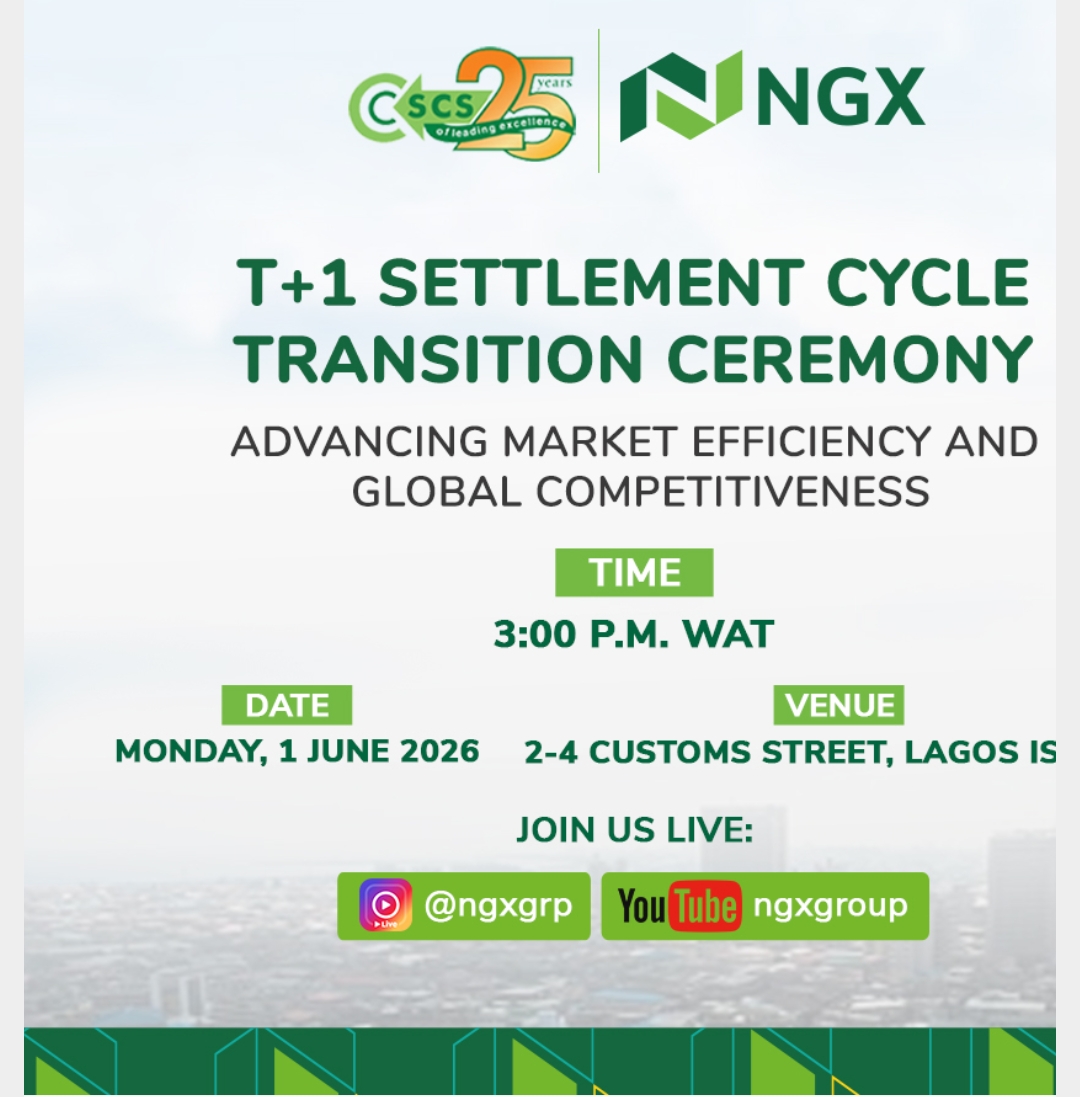
According to official market disclosures from the Central Securities Clearing System (CSCS), Nigeria is set to fully activate the T+1 settlement cycle on June 1, 2026, following extensive industry-wide testing, stakeholder engagements, and operational readiness assessments.
A Reform Rooted in Risk Reduction and Market Efficiency
Speaking on the broader reform direction, SEC leadership under Agama has consistently emphasized that shortening settlement cycles is not just a technical upgrade, but a systemic risk management strategy.
Market data and regulatory assessments show that every additional day between trade execution and settlement increases exposure to:
Counterparty default risk
Liquidity constraints
Market volatility impacts
Operational settlement failures
SEC officials have described the move as part of a broader modernization agenda designed to strengthen investor confidence, improve liquidity turnover, and align Nigeria with global financial infrastructure standards.
A regulatory briefing cited that the reform aligns with global markets such as the United States, Canada, and Mexico, which already transitioned to T+1 in 2024, reflecting a worldwide convergence toward faster settlement systems.
Inside Nigeria’s Transition: From T+2 to T+1
Nigeria’s journey has been deliberate and structured:
T+2 adoption (2025): A preparatory step that reduced settlement delays and improved operational efficiency.
T+1 rollout (2026): Full acceleration of settlement cycles across equities and key secondary market transactions.
Under the new framework, trades executed on a given day are settled the next business day—meaning cash moves to sellers and securities move to buyers almost immediately after trade confirmation.
The Central Securities Clearing System (CSCS), working with the SEC and exchanges, has led system upgrades, industry testing, and stakeholder coordination to ensure a seamless transition.
Agama’s Two Years in Office: Reform as a Strategic Doctrine
As Dr. Emomotimi Agama marks two years in office as Director-General of the SEC, the T+1 transition has become one of the defining milestones of his regulatory leadership.
Since his assumption of office in 2024, Agama has overseen:
Deepening capital market digitalization
Strengthening post-trade infrastructure
Expanding investor protection frameworks
Driving reforms aligned with the Capital Market Master Plan
SEC policy direction under his leadership has repeatedly emphasized building a faster, safer, and more globally competitive capital market system.
In earlier regulatory statements, Agama noted that reducing settlement cycles is essential to unlocking trapped liquidity and enhancing market confidence—key ingredients for attracting both domestic and foreign capital inflows.
Data-Driven Impact: Why T+1 Matters for Nigeria
Capital market analysts and regulatory briefings highlight measurable benefits expected from the transition:
1. Liquidity Acceleration
Faster settlement means investors regain access to capital quicker, increasing reinvestment cycles and trading activity.
2. Reduced Counterparty Risk
Shorter exposure windows reduce the likelihood of settlement failure or market disruptions.
3. Improved Foreign Investor Confidence
Global investors increasingly prefer markets with faster, predictable settlement cycles aligned with international benchmarks.
4. Operational Efficiency
Brokerage firms, custodians, and clearing systems operate with tighter, more synchronized timelines.
From Waiting Days to Near-Real-Time Finance
The evolution from T+3 → T+2 → T+1 reflects more than regulatory adjustment—it signals a transformation in financial philosophy.
Where investors once accepted waiting as part of trading, modern markets now treat speed as a foundation of trust. Nigeria’s adoption of T+1 places its capital market within a global ecosystem where financial transactions are increasingly instantaneous, data-driven, and digitally coordinated.
As one SEC-aligned market report observed, shortening the settlement cycle is “not an aspirational feature, but a baseline requirement for a globally competitive market.”
A Market Rewired for Speed and Trust
Nigeria’s transition to T+1 settlement represents a structural leap in capital market modernization. Under SEC coordination and Dr. Emomotimi Agama’s reform-driven leadership, the system is being redesigned for efficiency, resilience, and global alignment.
What once took three days now takes one. But beyond speed, the deeper transformation is trust—trust in systems that move faster, settle cleaner, and support a more dynamic investment environment.
As the June 2026 go-live approaches, the message from regulators and market operators is clear: Nigeria’s capital market is no longer just catching up—it is actively repositioning itself for the next generation of global finance.
Nigeria’s capital market transitions to T+1 settlement cycle in June 2026 under SEC leadership led by Dr. Emomotimi Agama, marking a major reform aimed at boosting liquidity, reducing risk, and improving global investor confidence.
Discover more from Ameh News
Subscribe to get the latest posts sent to your email.