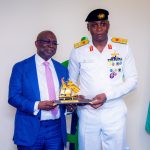
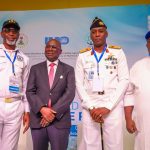
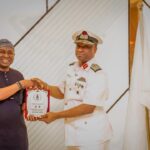
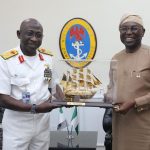
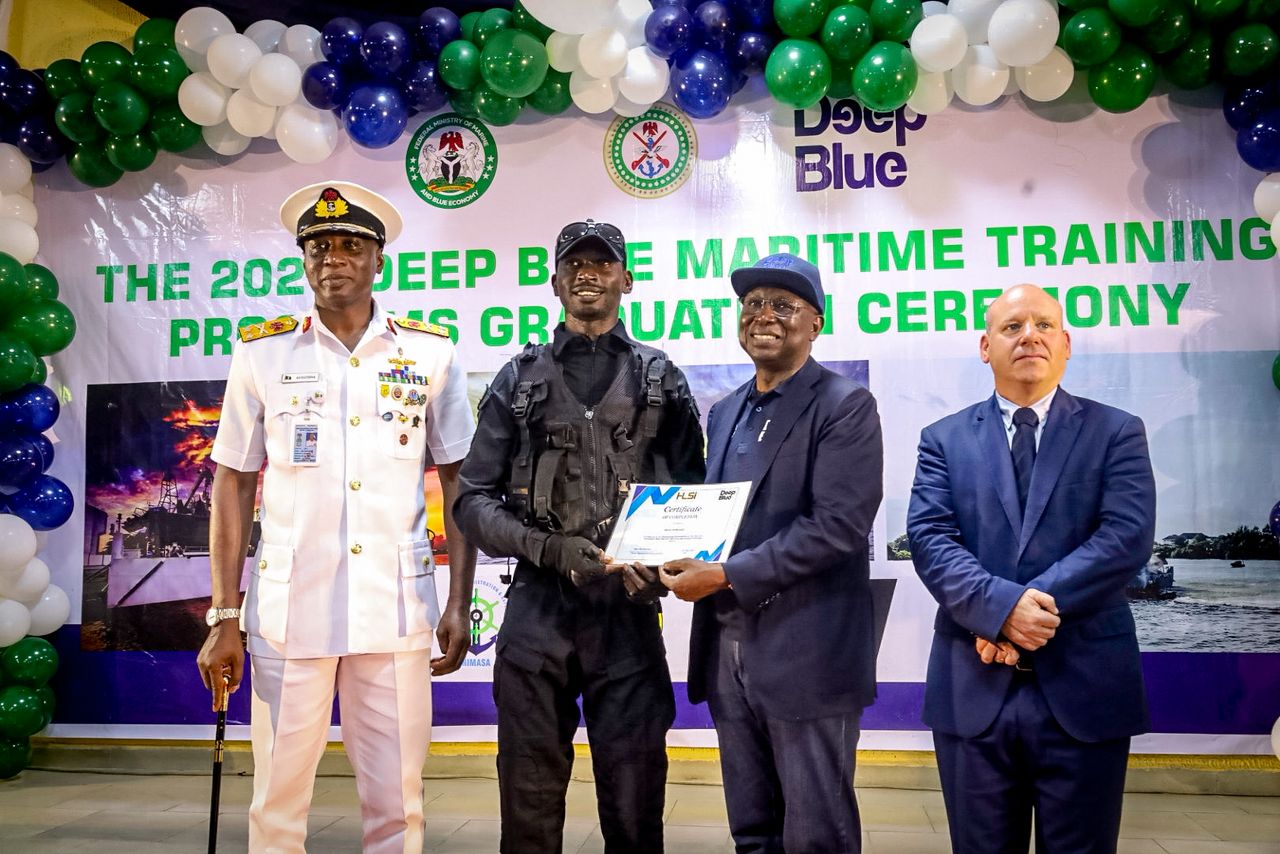
 L-R: Director General Nigerian Maritime Administration and Safety Agency, NIMASA Dr. Dayo Mobereola, representative of the Chief of Naval Staff, Flag Officer Commanding (FOC), Western Naval Command, Rear Admiral Abdulahi Mustapha; Executive Director Maritime Labor and Cabotage services, NIMASA Mr. Jibril Abba; Commodore IU Agwu, Commander Deep Blue task group; commodore S.O Ohunenese during the Deep Blue maritime training graduate ceremony in Lagos.
Nigeria’s drive to secure its maritime domain received a major boost on Tuesday as the Nigerian Maritime Administration and Safety Agency and the Nigerian Navy renewed calls for stronger inter-agency collaboration following the graduation of 177 specialised security personnel under the Deep Blue Project.
The graduation ceremony, held in Lagos, underscored the Federal Government’s commitment to sustaining maritime security, curbing piracy, and strengthening Nigeria’s blue economy ambitions through coordinated enforcement and strategic capacity development.
Representing the Chief of the Naval Staff, Vice Admiral Idi Abbas, the Flag Officer Commanding Western Naval Command, Rear Admiral Abdullahi Mustapha, described the Deep Blue Project as one of Nigeria’s most effective inter-agency security initiatives.
According to him, the complexity of modern maritime threats requires continuous cooperation among all security and maritime institutions operating within Nigerian waters and across the Gulf of Guinea.
He stressed that maritime security remains critical to Nigeria’s economic survival, considering the strategic importance of shipping, oil exports, offshore assets, and international trade routes.
“The Deep Blue Project remains a classic example of effective inter-agency collaboration. Modern national security demands sustained cooperation, professionalism, vigilance, and continuous capacity development among all maritime stakeholders,” he stated.
Rear Admiral Mustapha commended the graduating officers and operatives for their discipline, professionalism, and operational competence displayed during tactical demonstrations at the event.
He noted that the performance reflected the quality of training and preparedness needed to tackle piracy, oil theft, illegal fishing, smuggling, and other transnational maritime crimes threatening regional stability.
The Nigerian Navy also reaffirmed its readiness to continue supporting initiatives aimed at improving maritime safety, security, and national economic stability.
177 Operatives Trained in Advanced Maritime Security Operations
Speaking at the event, Director General of Nigerian Maritime Administration and Safety Agency, Dayo Mobereola, said the agency remains committed to expanding strategic partnerships and strengthening operational capabilities under the Deep Blue Project.
Mobereola disclosed that the graduating batch included 33 Special Mission Vessel Officers, 14 Special Mission Vessel Engineers, 107 Fast Intervention Boat Operators, Technicians and Boarding Team personnel, alongside 23 Helicopter Team members.
He explained that the personnel underwent rigorous specialised training covering helicopter operations, tactical boat manoeuvres, unmanned aerial systems, communications, combat medic procedures, intelligence coordination, and emergency medical evacuation.
According to him, the training was specifically designed to enhance rapid-response operations and improve Nigeria’s ability to combat maritime threats within its territorial waters and the Gulf of Guinea.
“These specialised trainings are designed to improve operational efficiency, intelligence coordination, and rapid response capabilities within Nigeria’s maritime domain and the Gulf of Guinea,” Mobereola said.
Nigeria Sustains Zero Piracy Record
The NIMASA DG revealed that Nigeria has successfully maintained zero piracy incidents within its territorial waters for four consecutive years — a development he attributed to sustained investments in maritime security infrastructure and inter-agency collaboration under the Deep Blue Project.
He noted that the achievement has significantly improved Nigeria’s international maritime reputation and boosted investor confidence in the nation’s shipping and port sectors.
According to Mobereola, the improved security environment has also contributed to reduced war-risk insurance premiums for vessels operating within Nigerian waters, lowering operational costs for shipping companies and strengthening trade competitiveness.
He added that Nigeria’s improved maritime security profile played a major role in the country’s election into Category C of the International Maritime Organization.
“For four consecutive years, Nigeria has maintained zero piracy incidents. This achievement has not only restored global confidence in our maritime domain, but was also a significant contributor to Nigeria’s election into Category C of the International Maritime Organization,” he said.
FG Pushes Blue Economy Agenda
Mobereola also praised the MOrganisationarine and Blue Economy, Adegboyega Oyetola, for supporting reforms and investments aimed at unlocking Nigeria’s blue economy potential.
He further commended the Nigerian Armed Forces, the Department of State Services, the Nigeria Police Force, Homeland Security International, and other strategic stakeholders for sustaining the successes recorded under the Deep Blue Project.
Industry observers say the Deep Blue Project has become central to Nigeria’s maritime security strategy, particularly in combating piracy and criminal activities that once made the Gulf of Guinea one of the world’s most dangerous shipping routes.
Tactical Demonstration Highlights Ceremony
One of the major highlights of the graduation ceremony was a live operational capability demonstration involving Special Mission Vessels, helicopters, fixed-wing aircraft, and fast interceptor boats.
The exercise simulated the rescue of a merchant vessel under attack, showcasing coordinated maritime response operations and the growing synergy among Nigeria’s security agencies.
The demonstration drew applause from stakeholders and industry participants, many of whom described it as a reflection of Nigeria’s improving maritime enforcement capacity and readiness to protect critical national assets.
Nigeria’s maritime security architecture received a boost as the Nigerian Navy and NIMASA strengthened collaboration under the Deep Blue Project, graduating 177 specialised operatives to combat piracy and maritime crimes across Nigerian waters and the Gulf of Guinea.
The Nigerian Navy and NIMASA have renewed calls for stronger maritime security collaboration as 177 operatives graduated under the Deep Blue Project, reinforcing Nigeria’s fight against piracy and maritime crimes.
Discover more from Ameh News
Subscribe to get the latest posts sent to your email.