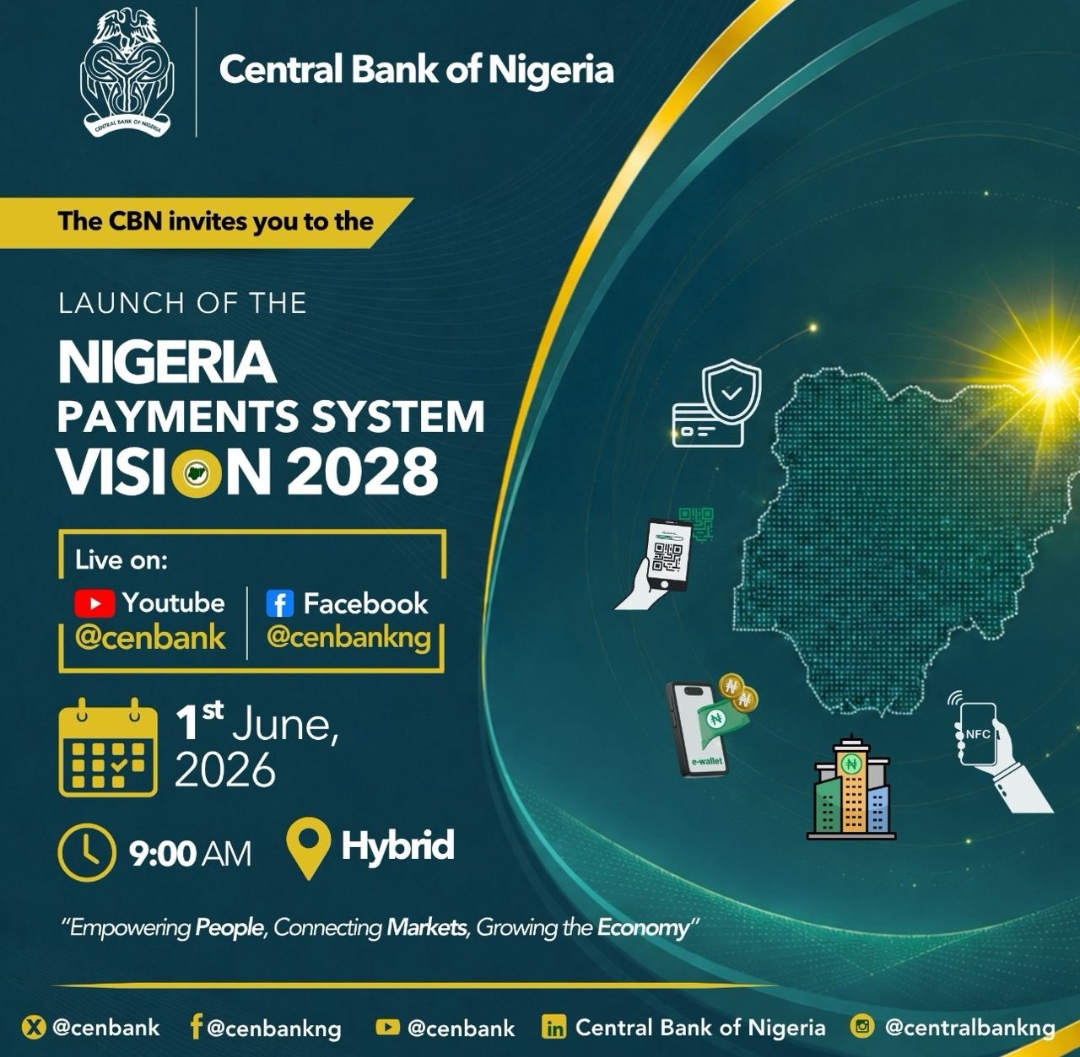
 The planned launch of the Nigeria Payments System Vision (PSV) 2028 by the Central Bank of Nigeria has continued to attract reactions from financial experts, economists, communication strategists, and industry stakeholders who describe the initiative as a major step toward strengthening Nigeria’s digital economy and modern financial ecosystem.
The apex bank recently announced that the official unveiling of PSV 2028 will take place on Monday, June 1, 2026, at 9:00 a.m., with the event expected to bring together regulators, fintech operators, banks, policymakers, telecommunications firms, and development institutions.
The framework is expected to provide strategic direction for the evolution of Nigeria’s payments architecture, digital transactions, financial inclusion, innovation, cybersecurity, and cashless policy implementation over the next four years.
Reacting to the development in separate interviews with The Ameh News, renowned media scholar and leadership coach, Dr Akin Olaniyan, described the initiative as a timely policy response to the fast-changing global digital economy.
Olaniyan, who has over three decades of experience in journalism and currently lectures at the Lagos Business School, said the future of economic competitiveness would largely depend on how nations build resilient and trusted digital payment systems.
According to him, the CBN’s move signals Nigeria’s readiness to consolidate gains already recorded in electronic payments and fintech innovation.
“The world is moving rapidly toward digital financial ecosystems, and Nigeria cannot afford to remain behind. A robust payments vision is critical to building trust, transparency, efficiency, and competitiveness within the economy,” he stated.
He further stressed that beyond technology deployment, public confidence, regulatory consistency, and consumer education would remain vital to the success of PSV 2028.
Also speaking, economist Celestine Ukpong said the initiative could significantly improve economic productivity if properly implemented.
Ukpong noted that Nigeria’s digital payments sector has grown substantially over the years, fueled by mobile banking penetration, agency banking expansion, and rising fintech adoption among young Nigerians and small businesses.
According to him, the new vision may help reduce transaction inefficiencies, improve tax transparency, lower cash-handling costs, and deepen financial inclusion across rural communities.
“A stronger digital payments ecosystem can stimulate commerce, reduce leakages, and support broader economic formalisation. PSV 2028 could become one of the foundational pillars for Nigeria’s next phase of economic modernisation,” he said.
He, however, warned that infrastructure deficits, unstable electricity supply, cybersecurity threats, and internet accessibility challenges must be addressed to achieve the framework’s objectives.
On his part, public relations expert and founder of Henryjvaleens, Dr Ejike Nduilo, said strategic communication would play a decisive role in driving public acceptance of the initiative.
Nduilo observed that while digital payment innovations continue to emerge rapidly, many Nigerians still remain sceptical about data security, transaction failures, and digital fraud.
He urged the CBN and financial institutions to prioritise transparency, public engagement, and continuous consumer awareness campaigns.
“People must understand the benefits, protections, and opportunities embedded in the system. Communication is central to trust-building in every financial reform process,” he explained.
Meanwhile, chartered accountant Peter Adebayo said the payments vision could enhance financial accountability and strengthen formal business activities within the economy.
Adebayo argued that digital payment expansion would improve audit trails, transparency in transactions, and revenue monitoring across sectors.
He added that businesses, especially SMEs, would benefit from faster settlements, lower operational risks, and improved integration into the formal financial system.
“An efficient payments ecosystem strengthens economic governance and improves financial reporting standards. It also helps businesses scale more efficiently within a structured financial environment,” he said.
Industry stakeholders believe PSV 2028 could further reinforce Nigeria’s position as one of Africa’s leading fintech markets, particularly as digital transactions continue to rise across banking, e-commerce, telecommunications, transportation, and public service sectors.
Analysts also expect the framework to provide new policy direction on emerging areas such as open banking, cross-border payments, digital identity integration, blockchain innovation, artificial intelligence-driven financial services, and cybersecurity resilience.
The launch comes amid increasing competition among African economies to attract fintech investments and expand digital financial infrastructure capable of supporting inclusive economic growth.
The CBN has urged members of the public and stakeholders to join the live unveiling through its official YouTube and Facebook channels.
Experts have praised the Central Bank of Nigeria’s Payments System Vision 2028, describing it as a strategic roadmap for digital finance growth, fintech innovation, and financial inclusion.
Discover more from Ameh News
Subscribe to get the latest posts sent to your email.