
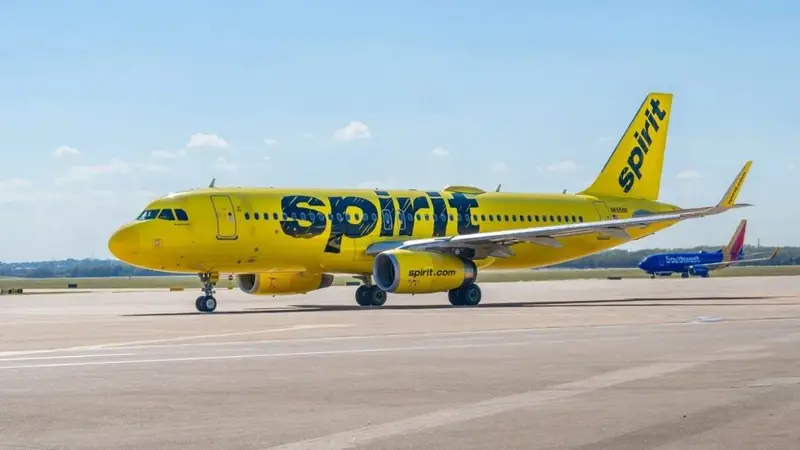
 The financial strain facing Spirit Airlines has become a textbook example of how credit rating signals can accurately flag risk long before markets fully respond—but still fail to prevent deterioration.
Across multiple reporting cycles, analysts and credit observers tracked a gradual weakening in the airline’s fundamentals. Yet the broader investment narrative often lagged behind the data, shaped more by post-pandemic recovery optimism than balance-sheet realities.
What emerges is not a story of sudden collapse, but of slow financial erosion that was visible in advance.
A Business Model Built for Efficiency—But Sensitive to Shock
Spirit Airlines built its competitive identity on an ultra-low-cost structure—high-density seating, strict cost discipline, and revenue expansion through ancillary fees.
For years, this model delivered strong growth visibility and allowed the carrier to compete aggressively on price in a crowded U.S. aviation market.
However, structural weaknesses became more pronounced as operating conditions shifted.
Rising fuel and labor costs, combined with intensified fare competition from both low-cost carriers and legacy airlines adopting hybrid pricing strategies, began to erode Spirit’s cost advantage.
The result was a tightening margin environment and weakening pricing power—two critical pressure points in airline credit analysis.
DataPro Excerpts: What the Credit Signals Showed Early
According to DataPro-style credit analysis observations, Spirit’s financial trajectory reflected a progressive shift in risk classification rather than a sudden shock.
1. Earnings Quality Deterioration
Earnings performance moved from cyclical volatility to structural inconsistency, reflecting persistent cost pressure and weakening revenue resilience.
2. Liquidity Cushion Compression
Cash flow became less predictable, reducing the airline’s internal buffer and increasing reliance on external financing channels.
3. Rising Leverage Persistence
Debt levels remained elevated even as operating performance softened, widening the gap between earnings and debt servicing capacity.
4. Refinancing Sensitivity Increased
Higher global interest rates materially raised the cost and complexity of refinancing existing obligations, particularly for speculative-grade issuers.
Collectively, these signals pointed toward a tightening financial environment long before liquidity stress became widely discussed.
From Growth Story to Credit Stress Narrative
For much of its expansion phase, Spirit was viewed through a growth-and-efficiency lens. But credit markets gradually shifted their tone.
The narrative evolved in stages:
From “high-risk but stable within bounds”
To “earnings volatility increasing”
To “liquidity pressure and refinancing uncertainty”
This shift is critical in credit analysis: it marks the transition from cyclical weakness to structural risk.
At that point, ratings were no longer speculative—they were descriptive of a deteriorating trajectory already in motion.
Market Optimism vs Financial Reality
Despite clear credit signals, broader market interpretation remained partially anchored in the airline sector’s post-pandemic rebound narrative.
Many investors treated performance weakness as temporary rather than structural, expecting normalization in demand and yields.
However, credit analysis consistently highlighted a different story—one defined by structural cost pressure, constrained margins, and increasing dependence on external financing.
This divergence created a delayed response gap between risk recognition and market pricing.
When Financial Flexibility Becomes Survival Strategy
As conditions tightened further, Spirit’s operational model increasingly relied on financial flexibility rather than earnings strength.
This is a critical inflection point in corporate credit cycles.
When companies shift from funding operations through cash generation to sustaining themselves through refinancing and liquidity management, their resilience begins to narrow significantly.
At this stage, strategic growth decisions often give way to balance-sheet preservation.
Credit Ratings: Warning Systems, Not Intervention Tools
The Spirit Airlines case reinforces a core principle in financial markets: credit ratings are diagnostic tools, not corrective mechanisms.
They are designed to:
Identify emerging risk trends
Track liquidity and leverage pressures
Signal refinancing vulnerabilities
But they cannot:
Restore profitability
Reverse operational inefficiencies
Or align market perception with financial reality
A Slow-Burn Risk That Was Visible Early
The trajectory of Spirit Airlines demonstrates a key market lesson—financial distress rarely appears without warning.
Credit signals, as reflected in DataPro-style analysis, consistently pointed to rising liquidity pressure, weakening earnings quality, and refinancing risk.
However, the broader market response lagged behind these indicators, shaped by optimism and cyclical interpretation of sector trends.
Ultimately, the story is not one of missed data—but of delayed reaction to data that was already pointing in a clear direction. A detailed financial analysis of Spirit Airlines shows how credit rating signals—highlighting liquidity pressure, rising debt stress, and weakening earnings—anticipated the airline’s financial strain long before market sentiment fully adjusted.
Discover more from Ameh News
Subscribe to get the latest posts sent to your email.