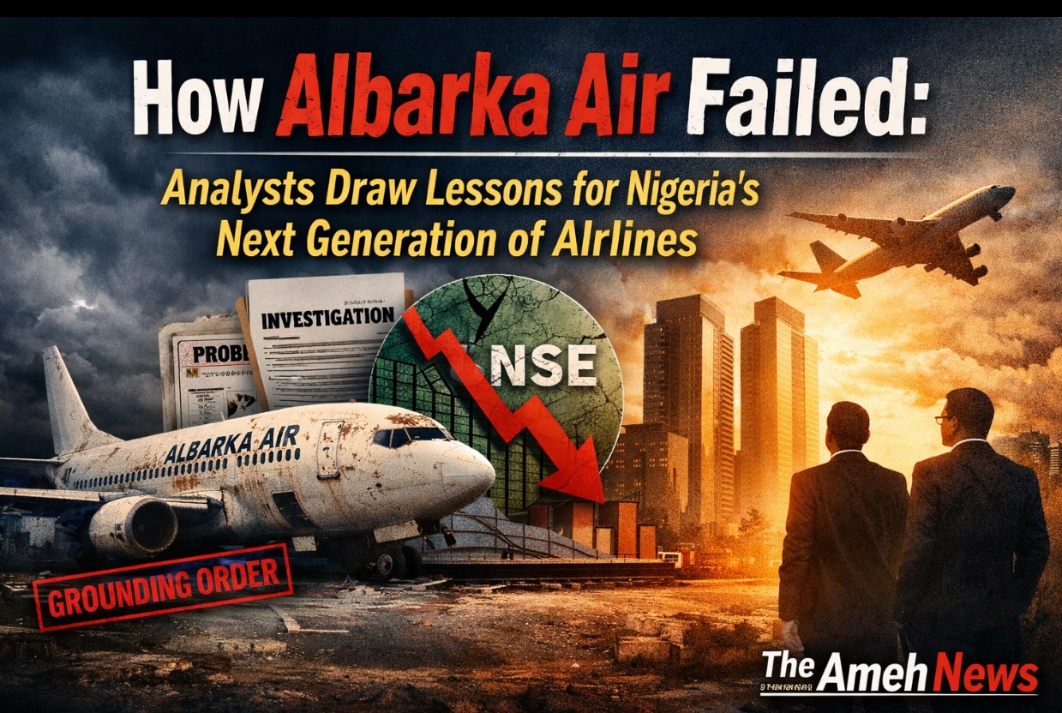
 Albarka Air remains one of the most referenced case studies in Nigeria’s aviation and capital market history — a privately owned airline that transitioned from stock exchange recognition to operational collapse within less than a decade, leaving behind unresolved investor obligations, governance questions, and policy lessons that still shape today’s aviation industry.
Its rise and fall unfolded during a critical transformation period in Nigerian aviation, particularly under the regulatory reforms led by Dr. Harold Olusegun Demuren, whose tenure as Director General of the Nigerian Civil Aviation Authority (NCAA) from 2005 to 2013 marked a decisive shift in safety enforcement, international compliance, and regulatory modernization.
NSE Listing and Early Promise
Albarka Air entered Nigeria’s aviation landscape in 1999 and commenced operations in March 2000, at a time when private participation in aviation was expanding rapidly.
A key milestone came on August 14, 2002, when the airline was listed on then Nigerian Stock Exchange (NSE) but now Nigerian Exchange (NGX). This positioned Albarka Air as one of the early aviation companies to access public capital markets, becoming the second airline listed on the NSE after ADC Airlines.
“Industry observers noted that the planned listing was designed to boost the airline’s financial capacity and fund fleet expansion amid Nigeria’s aviation reform programme. The reforms culminated in 2007 with the grounding of seven airlines that failed to comply with newly introduced capital base requirements, underscoring the government’s determination to enforce stronger financial and operational standards across the sector”:
₦500 million for domestic operations
₦1 billion for regional routes
₦1.5 billion for international operations
Despite this capital market advantage, structural weaknesses in governance and operations would later define its trajectory.
Leadership and Corporate Structure
At its early stage, Albarka Air was led by Brigadier General Buba Marwa (rtd.), who served as Chairman/CEO until September 2003.
However, despite its NSE listing and leadership profile, there is no publicly documented record of regulatory sanctions against the management team for the airline’s eventual failure — a governance gap that continues to attract analysis from financial and aviation experts.
Aborted IPO and Investor Exposure
One of the most critical turning points in Albarka Air’s financial history was its aborted Initial Public Offer (IPO).
The airline attempted to raise additional capital during the 2003–2004 aviation recapitalization exercise, but the effort failed to stabilize its balance sheet. By 2009, Albarka Air had entered liquidation status without returning shareholders’ funds linked to the aborted IPO.
The company reportedly maintained that investor repayment would only occur after receiving government compensation for grounded aircraft — leaving shareholders exposed for years without resolution.
This situation highlighted weaknesses in investor protection frameworks within Nigeria’s capital market at the time, especially for highly regulated sectors like aviation.
Demuren Era: Aviation Reform and Regulatory Transformation (2005–2013)
Albarka Air’s collapse unfolded during a major regulatory transformation in Nigerian aviation led by Dr. Harold Olusegun Demuren, who served as NCAA Director General from 2005 to 2013.
His tenure is widely recognized as a turning point in Nigerian aviation safety and regulation. Under his leadership:
Nigeria achieved significant improvements in aviation safety oversight
NCAA strengthened maintenance and airworthiness inspections
The country secured improved international aviation safety ratings
Enforcement of global safety compliance standards became stricter
It was within this tightening regulatory environment that Albarka Air, along with several other carriers, faced increased scrutiny over safety compliance, maintenance standards, and financial viability.
In December 2005, shortly after Demuren assumed office, Albarka Air was grounded by the NCAA for maintenance and safety violations, reflecting the beginning of stricter enforcement actions.
By April 2007, the airline ceased operations after failing to meet recapitalization requirements, becoming one of several operators unable to withstand the new regulatory discipline introduced during the reform era.
Operational Collapse and Policy Pressure
Albarka Air’s operational decline was not isolated. It was part of a broader aviation restructuring effort aimed at improving safety and financial stability in Nigeria’s airline sector.
However, the transition period was difficult for many operators, as stricter enforcement met weak capital structures and limited financial resilience.
Albarka Air reportedly had seven aircraft positioned in the United States for deployment, but regulatory restrictions, financial limitations, and policy tightening prevented fleet expansion.
The airline officially shut down operations in April 2007, marking the end of its commercial presence.
Compensation Payments and Senate Probe
Years after its collapse, Albarka Air resurfaced in financial records due to compensation payments.
In 2015, reports indicated that the airline received approximately ₦1 billion in government compensation for grounded aircraft. This payment later triggered a Senate probe in 2016, which examined compensation payments made to defunct airlines.
The investigation raised concerns about transparency, documentation, and consistency in government disbursements to failed aviation operators.
Governance Gaps and Accountability Questions
Despite NSE listing status and public investor participation, Albarka Air’s collapse exposed major governance gaps:
No publicly documented sanctions against management
Extended delay between operational shutdown (2007) and NSE delisting (2011)
Unresolved IPO investor funds
Limited clarity on compensation distribution
Weak enforcement of post-liquidation accountability
These gaps have fueled long-standing debate about whether regulatory systems adequately protected investors in publicly listed but highly regulated sectors like aviation.
Expert Reactions: Lessons for Today’s Airlines
Industry experts say Albarka Air’s collapse remains highly relevant for Nigeria’s current aviation operators.
“Capital strength must match regulatory exposure”
Economist Celestine Ukpong noted that Albarka Air reflects a mismatch between capital market participation and operational resilience.
“The key lesson is that listing on the NSE does not protect an airline from collapse if operational and financial discipline are weak,” he said.
He added that airlines must prepare for regulatory shocks.
“Aviation is heavily regulated. Once safety and financial compliance weaken, regulatory action becomes inevitable regardless of market status,” he noted.
“Demuren’s reforms improved safety but exposed weak operators”
Financial governance expert Peter Adebayo (FCA) said Albarka Air’s collapse must be understood within the broader reform environment led by Dr. Demuren.
“The Demuren era strengthened aviation safety and compliance standards significantly, but it also exposed airlines that were structurally weak,” he said.
He emphasized that governance failures compounded operational weaknesses.
“Albarka Air shows that when governance systems are weak, even capital market listing cannot prevent failure. The regulatory tightening simply accelerated what was already a fragile structure,” he added.
Lessons for Today’s Private Airlines in Nigeria
From Albarka Air’s rise and collapse, analysts highlight key lessons:
Capital adequacy must exceed regulatory minimums
Safety compliance is non-negotiable under strict oversight regimes
IPO funds must be transparently managed and protected
Corporate governance must ensure management accountability
Regulators must coordinate aviation and capital market oversight
Compensation should not replace business sustainability planning
Investor protection mechanisms must be strengthened in liquidation cases
A Legacy Shaped by Reform and Failure
Albarka Air’s story sits at the intersection of ambition, reform, and institutional learning.
Its NSE listing in 2002 symbolized financial ambition, its collapse in 2007 reflected operational weakness, and its delisting in 2011 highlighted regulatory closure without full accountability resolution.
Set against the backdrop of Dr. Harold Demuren’s aviation reforms (2005–2013), the airline’s failure also illustrates how stricter safety enforcement reshaped Nigeria’s aviation landscape — improving standards while exposing structural weaknesses in several operators.
For today’s airlines, Albarka Air remains a reminder that survival in aviation requires more than capital or licensing — it demands governance strength, financial discipline, and regulatory readiness in equal measure.
Albarka Air’s NSE listing, aborted IPO, regulatory grounding, and collapse occurred during Nigeria’s aviation reform era under Dr. Harold Demuren (2005–2013). Experts highlight key lessons for modern airlines.
Discover more from Ameh News
Subscribe to get the latest posts sent to your email.