By The Ameh News | Five-Year Anniversary
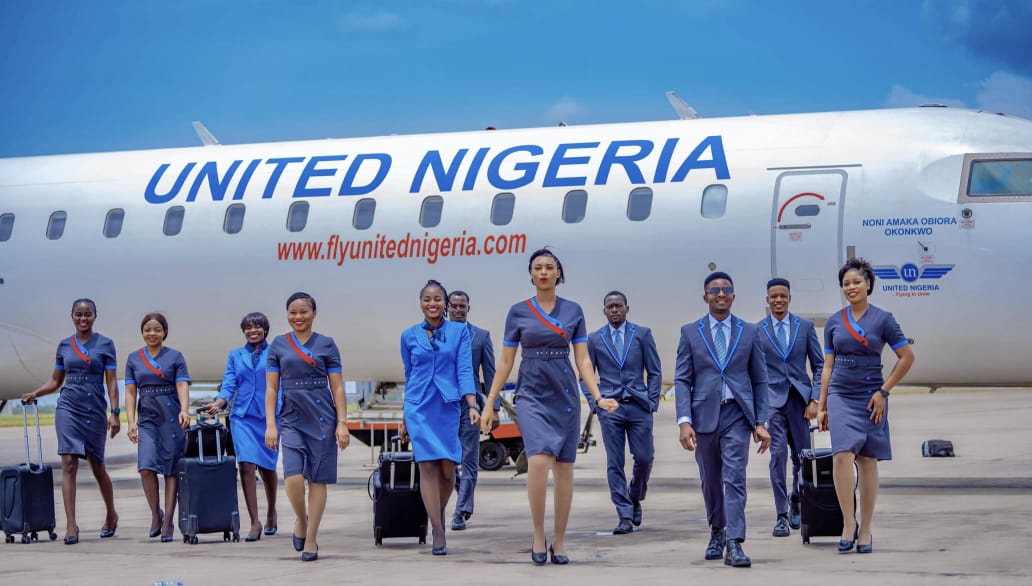 When United Nigeria Airlines commenced commercial operations on February 12, 2021, many aviation analysts gave the airline little chance of survival.
The timing appeared almost impossible.
The global aviation industry was still battling the devastating impact of COVID-19. Airlines across the world were grounding aircraft, laying off workers and struggling with massive financial losses.
Nigeria’s aviation industry was no exception.
Passenger traffic had collapsed, operating costs were rising, foreign exchange shortages were beginning to bite and airlines faced enormous uncertainty.
Yet, against those odds, United Nigeria Airlines chose to launch.
Five years later, that decision has become one of Nigeria’s most remarkable aviation success stories.
Today, the airline has established itself as a respected domestic carrier, expanded its fleet, increased destinations, invested in safety and maintenance, earned multiple industry recognitions and positioned itself as a serious competitor to some of Nigeria’s biggest airlines.
But the journey has been anything but smooth.
A Pandemic Launch Few Believed Would Succeed
Launching an airline is one of the most capital-intensive businesses anywhere in the world.
Launching one during a global pandemic was considered almost unthinkable.
Industry observers questioned whether there would be enough passengers.
Others doubted investors could sustain operations long enough to survive.
United Nigeria Airlines nevertheless proceeded with its carefully planned entry into the market.
Its inaugural commercial flight connected Lagos and Enugu, signalling a commitment to improving air connectivity between Nigeria’s commercial centres and the South-East.
That strategic positioning immediately differentiated the airline from several competitors.
Filling a Critical Gap
Before United Nigeria Airlines entered the market, many travellers in the South-East complained about limited flight options and expensive fares.
The airline targeted underserved routes while gradually expanding into major commercial destinations.
Over the years, its network grew to include key cities such as:
Lagos
Abuja
Enugu
Asaba
Owerri
Port Harcourt
Benin
Bayelsa
Kano
Sokoto
Maiduguri and others.
This expansion improved connectivity while increasing competition in Nigeria’s domestic aviation market.
Fleet Expansion Became the Backbone
One of the biggest indicators of airline growth is fleet development.
Rather than pursuing rapid but risky expansion, United Nigeria Airlines adopted a relatively measured approach.
The carrier steadily introduced Embraer regional jets and Airbus aircraft suited to Nigerian domestic operations.
The airline’s fleet strategy focused on balancing passenger demand, operational efficiency and maintenance requirements.
This cautious expansion helped avoid some of the financial pressures that have crippled other airlines.
Safety Before Speed
Perhaps one of the airline’s strongest selling points has been its emphasis on safety.
Management consistently invested in:
crew training
engineering capacity
regulatory compliance
operational oversight
maintenance partnerships
The airline also maintained close engagement with the Nigerian Civil Aviation Authority (NCAA), helping strengthen public confidence.
Industry observers frequently note that while passengers often focus on ticket prices and punctuality, long-term airline sustainability depends heavily on safety culture.
United Nigeria Airlines has repeatedly projected that philosophy.
Leadership That Defined the Brand
Behind the airline’s growth is Executive Chairman Prof. Obiora Okonkwo, whose leadership style has combined private-sector investment with long-term aviation ambition.
Unlike many airline promoters who focus solely on fleet acquisition, Okonkwo consistently emphasised institutional development.
His administration invested in:
human capital
engineering capability
staff development
customer service
long-term sustainability
That philosophy has helped shape the airline’s corporate identity.
Recognition Beyond Commercial Success
Within five years, United Nigeria Airlines accumulated several honours.
Among the most notable was recognition from the Institute of Nigerian Aeronautical Engineers, which conferred a Gold Medal Award on Prof. Okonkwo.
The institute cited:
safety culture
rapid growth
capacity building
resilience during COVID-19
engineering support
Such recognition reflects growing industry confidence in the airline’s operational standards.
Navigating Nigeria’s Tough Aviation Environment
No Nigerian airline operates under easy conditions.
Throughout the past five years, United Nigeria Airlines has faced challenges common across the industry, including:
Foreign Exchange Crisis
Aircraft leasing, insurance, maintenance and spare parts are largely denominated in foreign currencies.
With repeated naira depreciation, airline operating costs rose sharply.
Jet A1 Fuel Volatility
Aviation fuel prices reached historic highs during parts of the review period.
Fuel often accounted for more than 40 percent of airline operating expenses, squeezing profit margins.
Airport Infrastructure Constraints
Operators continued to grapple with limited airport operating hours, ageing facilities, inadequate navigation equipment at some locations and weather-related disruptions.
Multiple Taxes and Charges
Industry stakeholders have long argued that Nigerian airlines face one of Africa’s highest operating-cost environments due to multiple government levies.
Like its peers, United Nigeria Airlines has had to manage these pressures while remaining competitive.
Building Passenger Confidence
In aviation, reputation is earned flight by flight.
Over five years, the airline gradually built customer loyalty by focusing on:
schedule reliability
expanding destinations
customer engagement
improved digital booking
responsive passenger service
Although operational disruptions occasionally occurred—as with virtually every airline—the company’s ability to recover and maintain public communication helped strengthen customer trust.
Competition Intensified
United Nigeria Airlines entered a market already populated by established operators.
Competition has included major indigenous airlines serving Nigeria’s busiest routes.
 Instead of engaging in aggressive price wars, the airline sought differentiation through route development, service quality and operational discipline.
That strategy has enabled it to remain relevant in an increasingly competitive market.
Economic Impact Beyond Aviation
The airline’s contribution extends beyond transporting passengers.
Its operations support employment for:
pilots
engineers
cabin crew
dispatchers
customer service personnel
ground handlers
security providers
airport concessionaires
catering companies
logistics firms
Indirectly, tourism, commerce and regional business activities have also benefited from improved connectivity.
Looking Beyond Domestic Operations
Industry observers believe the next major phase of United Nigeria Airlines’ evolution could involve carefully selected regional and international routes.
Such expansion would require:
additional aircraft
stronger capital base
bilateral traffic rights
enhanced maintenance capability
robust foreign exchange planning
Management has consistently expressed interest in expanding beyond domestic services when market conditions permit.
Lessons from Five Years
United Nigeria Airlines’ first five years demonstrate several important lessons about Nigeria’s aviation industry.
First, disciplined growth often proves more sustainable than rapid expansion.
Second, safety investment remains the strongest foundation for long-term credibility.
Third, route selection matters as much as fleet size.
Finally, resilient leadership and prudent financial management can enable indigenous airlines to survive even under extremely difficult economic conditions.
Challenges That Still Lie Ahead
Despite notable progress, significant hurdles remain.
These include:
rising operating costs
foreign exchange instability
infrastructure deficiencies
aircraft financing constraints
evolving passenger expectations
increasing competition
regulatory changes
environmental sustainability requirements
How the airline responds to these challenges may determine whether the next five years become even more transformative than the first.
The Amrh News Analysis
Five years after its inaugural flight, United Nigeria Airlines has moved well beyond the uncertainty that surrounded its launch.
What began in February 2021 as a bold venture during one of aviation’s darkest periods has matured into a recognised indigenous carrier with an expanding footprint, a growing reputation for safety and an increasingly important role in Nigeria’s domestic air transport ecosystem.
Its story is one of resilience, strategic expansion and disciplined execution in one of the world’s most challenging aviation markets.
As Nigeria’s aviation sector continues to evolve, the next chapter for United Nigeria Airlines will likely be judged not merely by the number of aircraft it operates, but by how effectively it balances growth, profitability, safety and service quality in an increasingly competitive industry.
For an airline that many doubted would survive its early years, reaching the five-year milestone is itself a significant achievement. Whether it can transform that success into long-term regional prominence will be the defining question of its next decade.
Five years after launching in February 2021, United Nigeria Airlines has evolved from a bold startup into one of Nigeria’s fastest-growing domestic carriers. This special report examines its journey, achievements, challenges and what lies ahead.
Discover more from Ameh News
Subscribe to get the latest posts sent to your email.