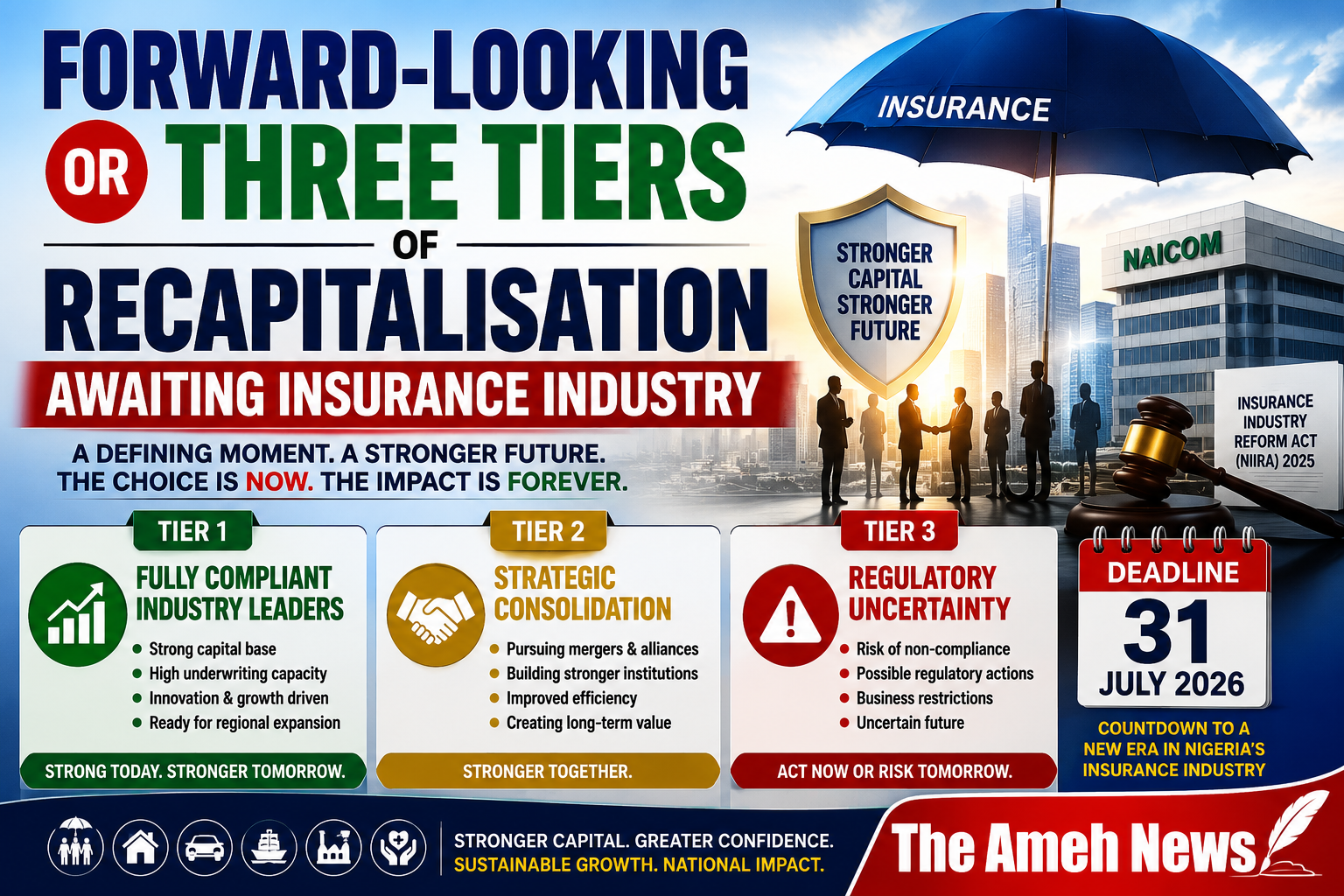
 Nigeria’s insurance industry is entering one of the most significant periods in its history as the 31 July 2026 recapitalisation deadline draws near. In just a few days, insurance companies will either emerge stronger, seek strategic partnerships, merge with competitors, or risk regulatory sanctions as the industry prepares for a new era of higher capitalisation and greater financial resilience.
The recapitalisation programme, driven by the National Insurance Commission (NAICOM), is designed to strengthen insurers’ financial capacity, improve claims-paying ability, deepen insurance penetration, and position Nigerian insurers to underwrite larger and more sophisticated risks within the country’s growing economy.
The deadline has sparked intense activity across the sector, with insurers accelerating capital raising, rights issues, private placements, mergers and acquisitions, strategic investments and corporate restructuring in a race to comply with the new minimum capital requirements.
A Defining Crossroads
Industry stakeholders describe the coming days as a defining moment that will determine the future structure of Nigeria’s insurance landscape.
Unlike previous recapitalisation exercises, the current programme is expected to reshape the market by producing fewer but stronger institutions capable of competing both locally and internationally.
Many analysts believe the exercise will improve investor confidence, enhance policyholders’ protection, and enable insurers to participate more effectively in financing Nigeria’s infrastructure, energy, aviation, marine, agriculture and other strategic sectors.
However, observers also warn that companies unable to meet the deadline may face difficult decisions, including mergers, acquisitions, portfolio transfers or possible regulatory intervention.
Major analysts are in line with Forward-looking recapitalisation which is a strategic capital enhancement approach that enables insurance companies to move beyond regulatory compliance and build stronger financial resilience, expand underwriting capacity, embrace innovation, and position themselves for sustainable long-term growth in an evolving insurance market.
While some analysts view the process as a Three Possible Tiers Emerging
As the countdown continues, analysts believe the industry could effectively evolve into three broad categories.
First Tier: Fully Compliant Industry Leaders
These insurers have successfully raised fresh capital well ahead of the deadline through public offers, rights issues, private placements or retained earnings.
They are expected to emerge as stronger institutions with enhanced underwriting capacity, improved solvency ratios and increased ability to compete for large-ticket risks that previously went to foreign insurers.
Many of these companies are also likely to pursue regional expansion and introduce more innovative insurance products supported by stronger balance sheets.
Second Tier: Companies Pursuing Strategic Consolidation
A number of insurers are expected to achieve compliance through mergers, acquisitions or strategic alliances.
For these firms, consolidation offers an opportunity not only to satisfy regulatory requirements but also to reduce operating costs, improve operational efficiency and build stronger brands capable of competing in a changing marketplace.
Experts believe the recapitalisation process could trigger a fresh wave of industry consolidation similar to previous reforms witnessed in Nigeria’s banking sector.
Third Tier: Firms Facing Regulatory Uncertainty
Companies unable to secure the required capital by the deadline may face significant regulatory challenges.
Depending on NAICOM’s final assessment, such insurers could be required to explore business combinations, restructure operations, transfer portfolios, restrict new business underwriting or face other regulatory actions aimed at protecting policyholders and maintaining market stability.
Industry watchers stress that policyholders’ interests remain the regulator’s primary concern throughout the transition process.
Why Recapitalisation Matters
The insurance sector has long struggled with low penetration, limited public confidence and insufficient underwriting capacity.
Many high-value risks in oil and gas, aviation, marine and infrastructure have historically been ceded abroad because of inadequate local capacity.
A stronger capital base is expected to enable Nigerian insurers to retain more premiums within the country, improve claims settlement, create employment opportunities, attract foreign investment and contribute more significantly to national economic development.
Recapitalisation is also expected to support Nigeria’s ambition of building a globally competitive insurance industry capable of supporting the country’s long-term economic growth agenda.
Investors Watching Closely
Capital market participants have equally maintained close watch on insurance stocks, as successful recapitalisation could unlock new investment opportunities and improve corporate governance across the sector.
Several insurance companies have already announced successful capital raising programmes, while others continue discussions with institutional investors and strategic partners.
Industry observers believe the outcome of the exercise could reshape competition, redefine market leadership and improve valuation across the insurance sector.
Expectations Beyond 31 July
While the deadline marks an important milestone, experts note that recapitalisation alone will not solve all the industry’s challenges.
Greater emphasis will still be required on digital transformation, product innovation, improved customer service, stronger risk management, effective claims settlement, financial inclusion and enforcement of compulsory insurance policies.
Stakeholders also expect NAICOM to maintain robust regulatory oversight to ensure that the gains of recapitalisation translate into stronger consumer confidence and sustainable industry growth.
Outlook
As the clock ticks towards 31 July 2026, Nigeria’s insurance industry stands at a historic crossroads. Whether viewed as a forward-looking reform or the emergence of a three-tier market structure, the recapitalisation exercise represents far more than a regulatory compliance deadline.
It is a transformative initiative that will determine which insurers possess the financial strength, strategic vision and operational resilience to thrive in an increasingly competitive environment.
The coming days are therefore expected to redefine the future of Nigeria’s insurance industry, setting the stage for a stronger, more resilient and globally competitive sector capable of supporting the nation’s economic aspirations.
Nigeria’s insurance industry faces a defining moment as the 31 July 2026 recapitalisation deadline approaches, with analysts projecting stronger insurers, industry consolidation and far-reaching market reforms.
Discover more from Ameh News
Subscribe to get the latest posts sent to your email.