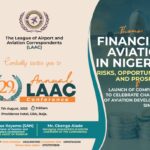
 The 30th Annual Conference of the League of Airport and Aviation Correspondents (LAAC) will bring Nigeria’s aviation industry together on September 10, 2026, for a critical debate on how government can increase revenue without undermining the growth, competitiveness and sustainability of the sector.
The landmark conference, themed “Towards a Sustainable Aviation Industry: Balancing Government Revenue Demands with Sector Growth,” is expected to attract the Minister of Aviation and Aerospace Development, Festus Keyamo, SAN; aviation regulators, government agencies, airline operators, airport managers, financial institutions, investors, aviation professionals, labour unions and other stakeholders across the industry.
The conference comes at a crucial period for Nigerian aviation, with the sector facing a combination of fiscal pressures, high operating costs, infrastructure challenges, foreign exchange constraints and the need for sustained investment.
Revenue versus sustainability
According to the conference committee, the choice of theme reflects growing concerns that government revenue policies, if not carefully designed, could place additional pressure on airlines and other aviation businesses already operating in a difficult economic environment.
The conference will therefore examine how government can meet its legitimate revenue objectives while creating an environment that allows airlines, airports and other aviation businesses to remain financially viable, invest in expansion and offer affordable services to consumers.
“At a time when the Nigerian aviation sector is undergoing significant reforms and infrastructure development, stakeholders believe that achieving a sustainable industry requires a careful balance between revenue generation by government and the creation of an enabling environment for investment, business growth and consumer affordability,” the committee said.
A major issue expected to dominate discussions is the burden of multiple charges imposed on airlines and other operators, alongside the rising cost of aviation fuel, foreign exchange challenges, aircraft acquisition and maintenance costs and infrastructure deficiencies.
Beyond taxation: unlocking aviation’s revenue potential
Rather than focusing solely on increasing existing charges, stakeholders are expected to explore alternative ways of expanding government and industry revenues through stronger passenger traffic, cargo development, tourism, airport commercialisation and other aviation-related economic activities.
The conference will also examine opportunities in aircraft leasing, maintenance, repair and overhaul (MRO), aviation logistics and other emerging segments capable of positioning Nigeria as a stronger aviation hub in Africa.
Stakeholders are expected to debate whether a larger and more efficient aviation ecosystem could ultimately generate greater government revenue than an approach heavily dependent on charges and levies imposed on existing operators.
Airline viability and passenger affordability
Another key concern will be the impact of rising operational costs on airlines and passengers.
The conference is expected to examine how regulatory charges, airport costs, fuel prices, maintenance expenses, financing costs and other overheads affect airline profitability and ultimately translate into higher airfares.
For operators, the challenge is to remain profitable enough to maintain fleets, acquire newer aircraft, employ skilled personnel and expand connectivity.
For government, the challenge is to generate sustainable revenue while avoiding policies that could weaken operators, discourage investment or reduce passenger traffic.
LAAC positions media as industry facilitator
The Chairman of LAAC, Suleiman Idris, said the 30th anniversary conference represents a significant milestone for the association and provides an opportunity for aviation journalists to facilitate constructive dialogue on issues shaping the industry’s future.
He stressed that the role of the aviation media goes beyond reporting events to creating platforms where policymakers and industry stakeholders can confront difficult issues and develop practical solutions.
“The aviation industry cannot grow sustainably if the operators are overburdened, just as government cannot abandon its legitimate responsibility to generate revenue. What is required is a balanced and sustainable framework that allows government to earn revenue while giving aviation businesses sufficient room to grow, invest and remain competitive,” Idris said.
From identifying problems to finding solutions
The Chairman of the conference committee, Wole Shadare, said the 30th edition would seek to move the conversation beyond identifying the industry’s problems to developing practical recommendations capable of influencing policy formulation and implementation.
He added that the conference would provide an opportunity to review the transformation of Nigeria’s aviation industry over the past three decades and examine the contribution of aviation correspondents to accountability, transparency and informed public debate.
The anniversary dimension is expected to give the conference a broader perspective, allowing stakeholders to assess the progress made in Nigerian aviation, persistent structural challenges and the reforms required to position the industry for long-term growth.
Infrastructure, regulation and investment
Discussions are also expected to focus on airport infrastructure, regulatory effectiveness and the role of government in creating an investment-friendly aviation environment.
Stakeholders will examine whether existing infrastructure can adequately support future passenger and cargo growth, while also considering the financing models required to modernise airports and develop aviation facilities.
Regulatory efficiency will equally come under scrutiny, particularly the need for predictable policies, effective oversight and a regulatory framework that protects passengers while allowing operators to compete and innovate.
A broader economic opportunity
Beyond its direct contribution to air transport, aviation supports tourism, trade, employment, logistics, hospitality and other segments of the economy.
The conference is therefore expected to examine how stronger aviation connectivity can contribute to Nigeria’s wider economic development and how policies designed for the sector can be aligned with national economic objectives.
A more competitive aviation industry, stakeholders argue, could increase passenger volumes, stimulate tourism, strengthen cargo movement, create jobs and attract new investments—ultimately expanding the industry’s overall contribution to government revenue.
Building a sustainable aviation future
LAAC said it remains committed to using its annual conference as a platform for bringing policymakers, regulators, operators, investors and other stakeholders together to address critical challenges facing Nigerian aviation.
The 30th Annual Conference is expected to produce recommendations around a more balanced revenue framework, improved infrastructure, regulatory efficiency, investment incentives and measures to strengthen the financial sustainability of aviation businesses.
At its core, the conference will confront a fundamental question: how can Nigeria generate more value and revenue from aviation without weakening the very businesses and investments needed to make the industry grow?
For LAAC, the 30th anniversary provides an opportunity not only to celebrate three decades of aviation journalism but also to deepen the industry’s policy conversation and help shape a more competitive, resilient and financially sustainable future for Nigerian aviation.
Discover more from Ameh News
Subscribe to get the latest posts sent to your email.