
By Benjamin A. Ameh | The Ameh News
The League of Airport and Aviation Correspondents (LAAC) has called for deeper consultation with airlines, airport operators, regulators, labour and investors before the Federal Government introduces or reviews major fiscal and regulatory policies in Nigeria’s aviation sector.
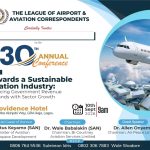
The Chairman of LAAC, Suleiman Idris, made the call while welcoming participants to the League’s 30th Annual Conference, held under the theme: “Towards a Sustainable Aviation Industry: Balancing Government Revenue Demands with Sector Growth.”
Idris said the aviation industry needed a policy environment that would enable government to generate legitimate revenue without placing excessive financial pressure on operators.
According to him, the critical question is not whether government should generate revenue from aviation, but how much the sector can reasonably bear without weakening its capacity to grow.
‘Industry Must Be Part of the Decision-Making’
The LAAC chairman said major decisions affecting aviation should not be presented to stakeholders after they have already been concluded.
He stressed that consultation must involve meaningful engagement before policies are finalised.
He said the Federal Government, aviation agencies, airlines, airport operators, labour, investors and other stakeholders should have the opportunity to present their concerns and expectations.
This, he argued, would help produce policies that are realistic, sustainable and beneficial to the entire aviation ecosystem.
5% TSC, CSC Debate Needs Wider Review
Idris said the ongoing debate over the five per cent Ticket Sales Charge (TSC) and Cargo Sales Charge (CSC) should not be reduced to arguments about which agency or institution receives a particular percentage.
He urged stakeholders to focus on what the revenues are intended to achieve.
He questioned how much aviation-generated revenue should support regulation, safety and security, airport infrastructure and the modernisation of air navigation systems.
He also called for greater accountability and transparency in the utilisation of aviation revenues.
LAAC Commends Government, Aviation Agencies
Despite its concerns, LAAC commended the Federal Government and aviation agencies for their efforts to improve the sector.
Idris praised President Bola Ahmed Tinubu and the Minister of Aviation and Aerospace Development, Festus Keyamo, SAN, for initiatives covering airport infrastructure, regulatory reforms, connectivity and other areas of aviation development.
He also commended the Nigerian Civil Aviation Authority (NCAA), Federal Airports Authority of Nigeria (FAAN) and Nigerian Airspace Management Agency (NAMA) for their roles in regulation, airport development, passenger experience and airspace safety.
However, he stressed that the work of repositioning Nigerian aviation was far from finished.
LAAC: Aviation Journalism Must Ask Difficult Questions
The chairman also used the occasion to redefine the responsibility of aviation correspondents.
He said aviation journalism must go beyond reporting press releases and official statements.
According to Idris, journalists must ask difficult questions, provide context, scrutinise policies, expose gaps and acknowledge genuine achievements.
He said LAAC would continue to report the industry fairly, supporting policies that advance aviation while raising concerns when government decisions threaten the sustainability of operators or the wider sector.
30 Years of Aviation Journalism
The conference also marked three decades of LAAC’s contribution to aviation journalism and industry discourse.
Idris paid tribute to the pioneers of aviation reporting in Nigeria, as well as successive LAAC leaderships, members, sponsors, advertisers and partners who have supported the League over the years.
He said the 30th conference was therefore not simply another annual gathering but an opportunity to reflect on the past three decades and determine the direction Nigerian aviation should take in the years ahead.
The Ameh News Perspective
The message from LAAC’s 30th conference is clear: aviation policy cannot be sustainable if those who operate the industry are excluded from the decisions that determine their costs.
Government needs revenue to fund national development and aviation institutions need adequate resources to perform their statutory functions.
But airlines and other operators also need financial room to survive, invest and expand.
The challenge, therefore, is to find a balance where government earns sustainable revenue while the aviation industry remains competitive, resilient and capable of growth.
That balance may ultimately determine whether Nigeria’s aviation sector becomes a stronger engine of economic development—or remains constrained by the financial pressures facing its operators.
Discover more from Ameh News
Subscribe to get the latest posts sent to your email.