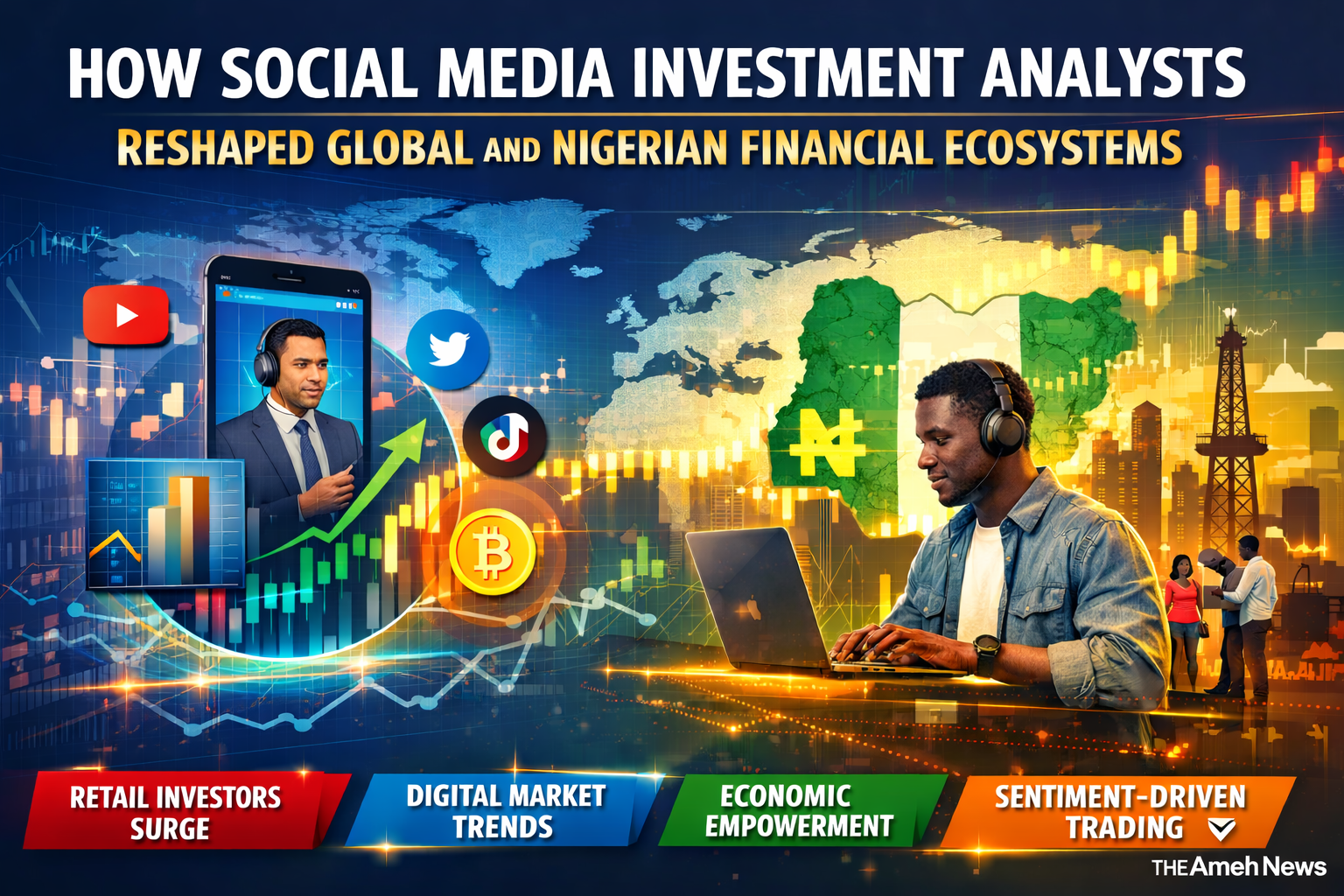
 The transformation of financial commentary from institutional research desks to social media platforms has triggered one of the most significant shifts in modern economic communication.
What was once the guarded domain of certified analysts, investment banks, and hedge funds is now openly debated across X (formerly Twitter), YouTube, TikTok, Instagram, and WhatsApp investment groups.
This evolution—driven by social media investment analysts—has democratized access to financial knowledge while also raising new questions about accuracy, influence, and market behaviour.
In response to questions from The Ameh News, a panel of experts offered insights into how this shift is reshaping financial ecosystems globally and in Nigeria.
The Digital Disruption of Financial Analysis
A decade ago, financial analysis was slow, structured, and institution-driven. Reports were published quarterly, often written in technical language and distributed within closed financial circles.
Today, a single viral post can influence investor sentiment within minutes.
The COVID-19 pandemic accelerated this shift, pushing millions of retail investors online and creating a demand for simplified, real-time financial interpretation.
As a result, social media investment analysts have emerged as influential intermediaries between markets and the public.
Expert Reactions: A Multi-Dimensional Perspective
Dr. Akin Olaniyan: Journalism, Leadership, and the Ethics of Financial Influence
Dr. Akin Olaniyan, a veteran journalist with over three decades of experience, lecturer at the Lagos Business School, and leadership coach, described the rise of social media analysts as both “a breakthrough and a responsibility test for modern communication.”
According to him:
“We are witnessing the democratisation of financial storytelling. Information is no longer locked in boardrooms. However, the challenge is that influence has outpaced verification.”
He noted that while digital platforms have expanded financial literacy, they have also blurred the line between professional analysis and personal opinion.
“In journalism and leadership, credibility is everything. The new financial influencers must understand that audiences are making real economic decisions based on their words.”
Dr. Olaniyan emphasized the need for ethical standards and media literacy to guide the rapidly expanding digital finance ecosystem.
Celestine Ukpong: Economist Perspective on Market Behaviour and Retail Psychology
Economist Celestine Ukpong highlighted the structural economic implications of social media-driven investing, noting that markets are increasingly influenced by sentiment rather than fundamentals.
“We are now operating in a hybrid market environment where economic data competes directly with viral narratives,” he explained.
He observed that retail investors, especially in emerging economies like Nigeria, are more reactive to online commentary than traditional financial reports.
“The speed of information has shortened decision cycles. Investors are no longer waiting for quarterly reports—they are reacting to tweets, videos, and threads in real time.”
Ukpong warned that while this increases participation, it also introduces volatility driven by emotion and herd behaviour.
“Markets are becoming more democratic, but also more psychologically sensitive.”
Dr. Ejike Nduilo: PR Strategy, Digital Influence, and Reputation Risk
Dr. Ejike Nduilo, PR expert and founder of Henryjvaleens, approached the phenomenon from a communications and reputation management angle.
He described social media investment analysts as “unregulated brand influencers of the financial world.”
“In public relations, perception often becomes reality. Financial influencers now shape market perception faster than institutions can respond,” he said.
He noted that while this creates opportunities for financial education, it also introduces reputational risks for companies and listed entities.
“A single misleading interpretation of earnings or policy changes can trigger market reactions before official clarifications are issued.”
Dr. Nduilo stressed the importance of crisis communication readiness among financial institutions.
Peter Adebayo (FCA): Financial Accountability and Market Discipline
Chartered accountant Peter Adebayo (FCA) focused on accountability, investor protection, and market discipline.
He acknowledged the positive role of social media analysts in increasing financial awareness but cautioned against unverified financial advice.
“Financial markets depend on trust, structure, and regulation. When unqualified voices dominate investment narratives, the risk of misinformation increases significantly,” he stated.
Adebayo pointed out that retail investors often lack the technical capacity to validate complex financial claims shared online.
“We are seeing a shift where entertainment and finance are merging. That is powerful—but also dangerous if not properly guided.”
He called for stronger investor education frameworks and clearer regulatory oversight of financial content creators.
The Bigger Picture: A Hybrid Financial Information System
Across all expert perspectives, one theme remains consistent: the financial information ecosystem has fundamentally changed.
Markets are no longer shaped solely by institutional research but by a hybrid mix of:
Professional analysts
Social media influencers
Retail investor communities
Algorithm-driven content distribution
Real-time sentiment cycles
In Nigeria and other emerging markets, this shift has significantly increased participation in financial systems, but also introduced new layers of risk and unpredictability.
Conclusion: Between Access and Accuracy
The rise of social media investment analysts represents one of the most transformative developments in modern financial communication.
As Dr. Olaniyan noted, it is a “breakthrough in access,” but as all experts agree, it is also a “test of responsibility.”
Between Celestine Ukpong’s concerns on market psychology, Dr. Nduilo’s warnings on reputational risk, and Peter Adebayo’s call for financial discipline, a clear consensus emerges:
The future of investing will not only be defined by capital—but by credibility.
And in this new digital financial era, the most valuable currency may no longer be information itself, but the trust behind it.
Experts including Dr. Akin Olaniyan, economist Celestine Ukpong, PR strategist Dr. Ejike Nduilo, and chartered accountant Peter Adebayo (FCA) weigh in on how social media investment analysts are reshaping global and Nigerian financial ecosystems, increasing market participation while raising concerns about misinformation, sentiment-driven trading, and financial accountability.
Financial experts discuss the rise of social media investment analysts and their impact on global and Nigerian markets, highlighting increased financial access, retail investor growth, and rising concerns over misinformation, market volatility, and regulatory gaps in the digital financial ecosystem.
Discover more from Ameh News
Subscribe to get the latest posts sent to your email.