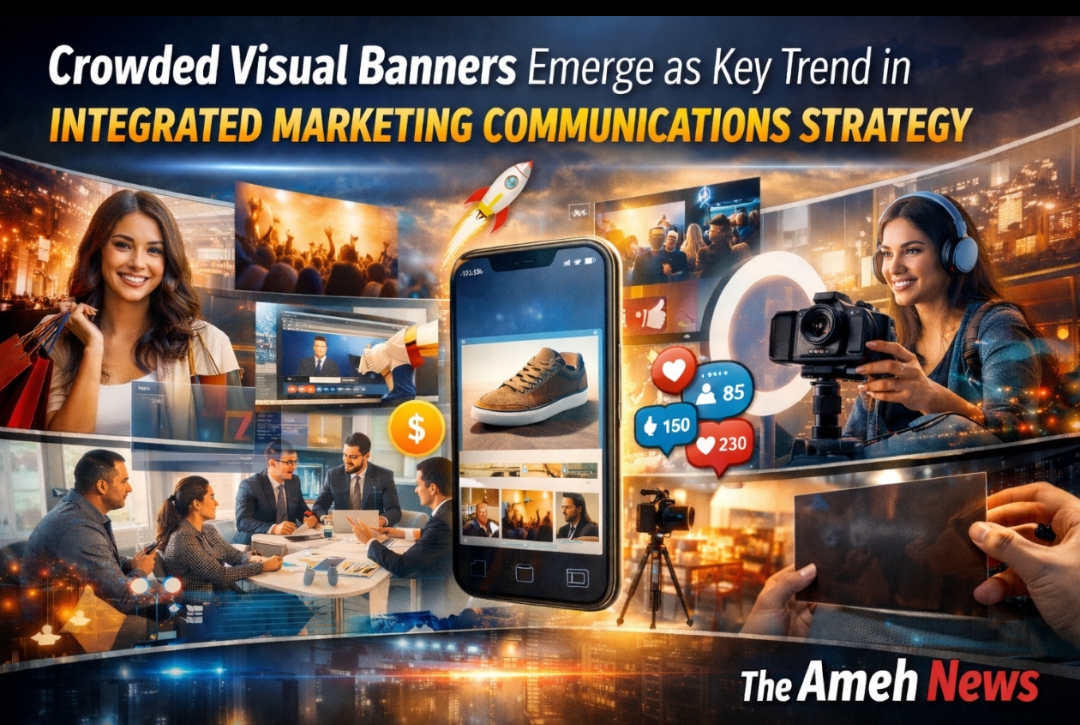
 In the evolving landscape of digital communication, visual storytelling has become both an art and a strategic instrument. One of the most striking developments in recent years is the increasing adoption of crowded visual banners within integrated marketing communications (IMC) strategies—a design shift that continues to redefine how brands and media outlets engage audiences.
What was once a domain dominated by minimalism and single-image clarity is now being reshaped by multi-layered visual compositions. These banners, filled with multiple images, attempt to compress entire narratives into a single frame—blending emotion, product identity, and storytelling context in one glance.
Yet, as this trend gains momentum, it has also sparked intellectual debate among professionals in economics, finance, and communication strategy.
During a recent interaction with The Ameh News, The Ameh News posed a critical question around whether crowded visual banners represent strategic innovation or visual overload in modern IMC systems.
Responding to the inquiry, economist Celestine Ukpong observed that the shift reflects broader behavioral changes in information consumption rather than a mere design preference.
According to Ukpong, today’s digital audiences are operating in “compressed attention cycles,” where information is processed rapidly and often non-linearly. In his reflection, he noted that crowded visual banners are an economic response to scarcity—specifically, the scarcity of attention. By packing multiple visual cues into a single frame, marketers are effectively attempting to maximize informational yield per second of viewer engagement.
However, he also cautioned that efficiency does not always guarantee effectiveness. “When too many signals compete at once, the cost of interpretation rises,” he implied, suggesting that poorly structured visuals may reduce cognitive clarity and weaken message retention.
From a financial and compliance perspective, chartered accountant Peter Adebayo offered a different but complementary viewpoint. He linked the trend to accountability in marketing expenditure and return on investment (ROI) optimization within corporate communication budgets.
Adebayo noted that organizations are increasingly under pressure to justify marketing spend with measurable engagement outcomes. In this context, crowded visual banners become a strategic attempt to consolidate messaging—reducing the need for multiple campaigns while increasing exposure within a single asset.
However, he emphasized discipline in execution. “The problem is not the use of multiple images,” he suggested, “but the absence of hierarchy and structure in how they are deployed.” Without clear visual prioritization, he warned, brands risk communicating noise instead of narrative.
 From a broader industry perspective, integrated marketing communications specialists argue that this evolution represents a convergence of storytelling formats. Rather than separating brand messaging across print, digital, and social platforms, crowded visual banners allow for synchronized storytelling within one visual environment.
Still, the tension remains unresolved.
Design experts continue to debate whether this approach enhances or undermines clarity. Advocates see it as a necessary adaptation to fragmented attention economies. Critics see it as a shortcut that risks eroding visual discipline.
What is clear, however, is that the modern banner is no longer a passive design element. It has become a contested space where psychology, economics, and communication strategy intersect.
As brands continue to navigate this terrain, the success of crowded visual banners will depend less on how much they show—and more on how intelligently they organize what is shown.
In that balance between density and clarity lies the next phase of integrated marketing communications evolution.
Economist Celestine Ukpong and FCA expert Peter Adebayo weigh in on the growing use of crowded visual banners in integrated marketing communications, highlighting benefits, risks, and evolving audience behavior in digital storytelling.
Discover more from Ameh News
Subscribe to get the latest posts sent to your email.