…..Nigeria’s flagship LNG expansion project edges toward completion, with experts projecting major foreign exchange inflows, expanded export capacity, and thousands of jobs as global gas demand strengthens into 2026.
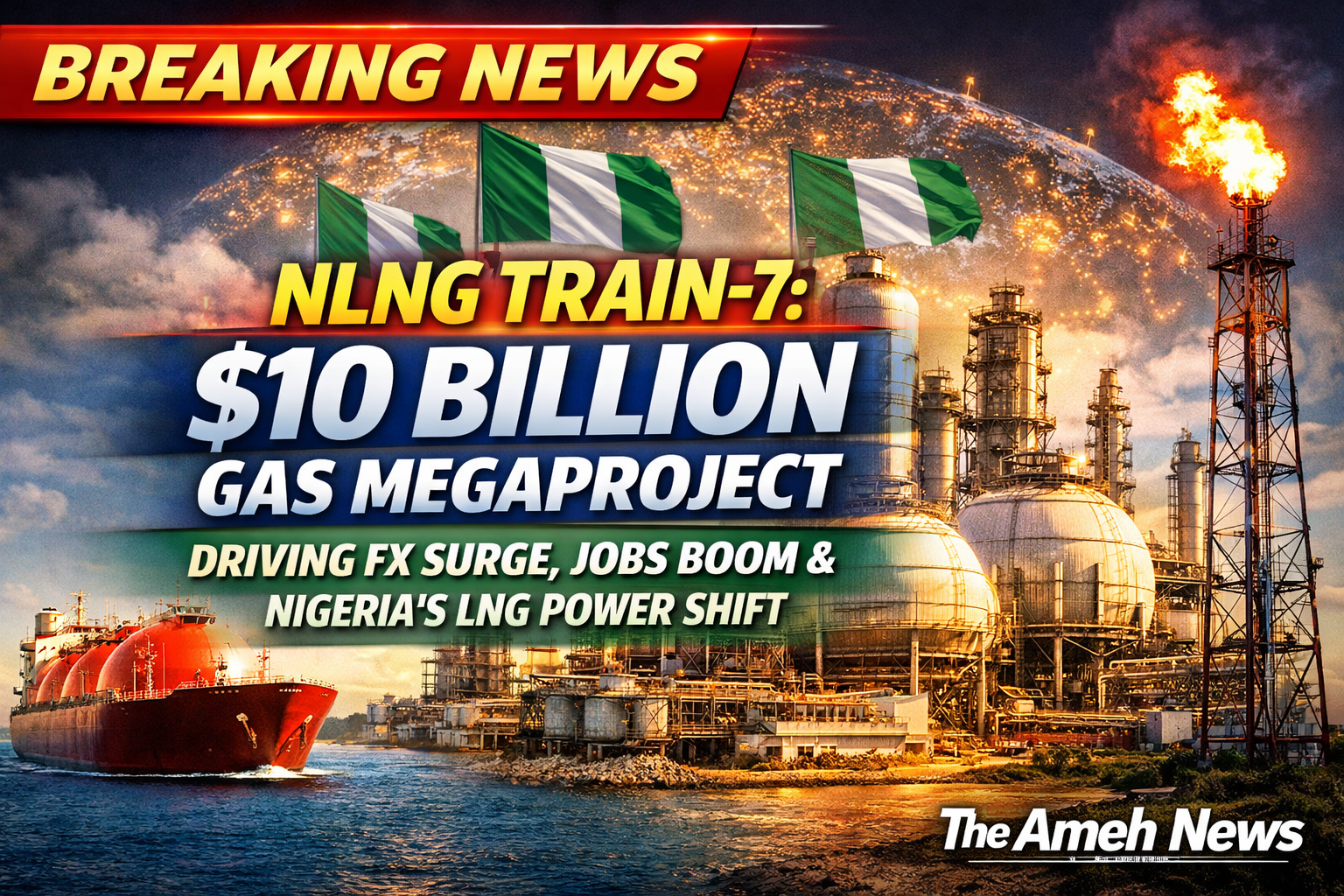 Nigeria’s energy sector is once again at the centre of global attention as the NLNG Train-7 project advances toward completion, with analysts projecting it as one of the most significant foreign exchange (FX) catalysts in the country’s modern economic history.
Fresh data from industry disclosures, engineering consortium updates, and energy market trackers show that the project is not only expanding Nigeria’s LNG capacity by 35% (from 22 MTPA to 30 MTPA), but also positioning the country to benefit from a tightening global gas market expected to intensify into 2026.
According to operational and project documentation from Nigeria LNG Limited and its engineering partners, Train-7 is already more than 80–92% complete, with commissioning phases approaching final stages after years of construction cycles and investment structuring, according to Punch Newspapers.
$10bn Investment Signal and Global Confidence Index
Credible project financing records show that Train-7 is backed by an investment envelope of over $7bn–$10bn, structured through NLNG shareholders including NNPC Ltd, Shell, TotalEnergies, and Eni, alongside international financing arrangements stressed Nigerian Investment Promotion Commission.
Economists describe this as one of the clearest recent signals of sustained investor confidence in Nigeria’s upstream and midstream gas economy.
The significance is not only in scale, but in structure:
Zero direct government capital outlay
Fully investor-driven financing model
Long-term FX repatriation through LNG exports
In macroeconomic terms, this represents a shift from fiscal dependency to export-led FX accumulation.
FX Impact Pathways: How Train-7 Changes Nigeria’s Dollar Flow
1. Export Capacity Expansion
NLNG’s output jump to 30 MTPA creates immediate export leverage into Europe and Asia LNG markets.
This matters because global LNG demand is projected to rise sharply through 2026 as energy security realignments continue after geopolitical disruptions.
2. FX Earnings Multiplier Effect
Industry projections suggest Train-7 will significantly increase Nigeria’s LNG export receipts through:
Higher cargo volumes
Premium winter-season pricing cycles
Long-term supply contracts
3. Investment Inflow Stabilisation
The project continues to attract ancillary investments in:
Engineering services
Marine logistics
Industrial fabrication
Insurance and energy finance
These secondary inflows deepen Nigeria’s FX ecosystem beyond crude oil dependency.
4. Employment & Domestic Value Chain Expansion
At peak construction:
10,000+ direct jobs
40,000+ indirect jobs
According to the Nigeria LNG, Local content participation exceeds 50% in procurement and engineering, strengthening domestic capacity in industrial services.
Economic Flashback: Why Train-7 Matters Now
A decade ago, Nigeria’s gas monetisation was constrained by infrastructure bottlenecks and export limitations.
Despite holding over 200 trillion cubic feet of proven gas reserves, the country relied heavily on crude oil for FX stability, exposing the economy to price shocks.
Train-7 marks a structural correction:
From crude dependency → diversified hydrocarbon exports
From idle reserves → monetised LNG streams
From volatility → contract-based FX inflows
Expert Reactions (Ameh News Roundtable)
Celestine Ukpong, Economist described Train-7 as a “macro-stabilisation asset disguised as an energy project.”
“What Nigeria is building is not just LNG capacity—it is a foreign exchange buffer system. The real value is in predictable export inflows that can support reserves and reduce FX shocks.”
He added that the timing aligns with global LNG supply tightening, making Nigeria a “strategic swing supplier in the emerging energy order.”
Dr. Ejike Nduilo, a PR Strategist & Founder, Henryjanleens focused on perception and investor confidence:
“Train-7 is also a reputational asset. International capital reads infrastructure completion as governance credibility. This project strengthens Nigeria’s brand in global energy diplomacy.”
He noted that media visibility and transparent reporting on mega-projects directly influence sovereign risk perception.
While Peter Adebayo, FCA , a Financial Analyst emphasized fiscal implications:
“The FX inflow structure from LNG exports provides a more stable revenue stream compared to crude oil. It improves planning for reserves, debt servicing, and external balance management.”
He highlighted that diversified export receipts could ease pressure on the naira over the medium term.
Strategic Context: Global Gas Shift
Data from energy market trackers show that global LNG demand is expected to grow significantly as countries diversify away from single-source dependence.
Nigeria’s positioning as one of the world’s top LNG exporters becomes more relevant in this environment, especially as new global capacity additions reshape supply chains.
Policy Reflection
Officials in Nigeria’s energy ecosystem, including leadership at NNPC Ltd, have repeatedly described Train-7 as a cornerstone of the country’s gas expansion strategy—linking it to:
Export growth
Domestic gas development
Industrialisation strategy
FX diversification
A Turning Point in FX Architecture
Train-7 is increasingly being viewed not just as an industrial expansion project, but as a foreign exchange architecture shift.
If projections hold, Nigeria could see:
Higher LNG-driven FX inflows post-2026
Improved external reserves stability
Reduced dependence on crude oil earnings
Expanded industrial job creation
In reflection, what began as an engineering project on Bonny Island is now evolving into a national macroeconomic instrument—one that could quietly redefine Nigeria’s foreign exchange future.
Nigeria’s NLNG Train-7 project is projected to boost FX inflows through a $10bn investment, 35% LNG capacity expansion, and global export growth, with economists and experts highlighting its impact on jobs, reserves, and economic stability.
Discover more from Ameh News
Subscribe to get the latest posts sent to your email.