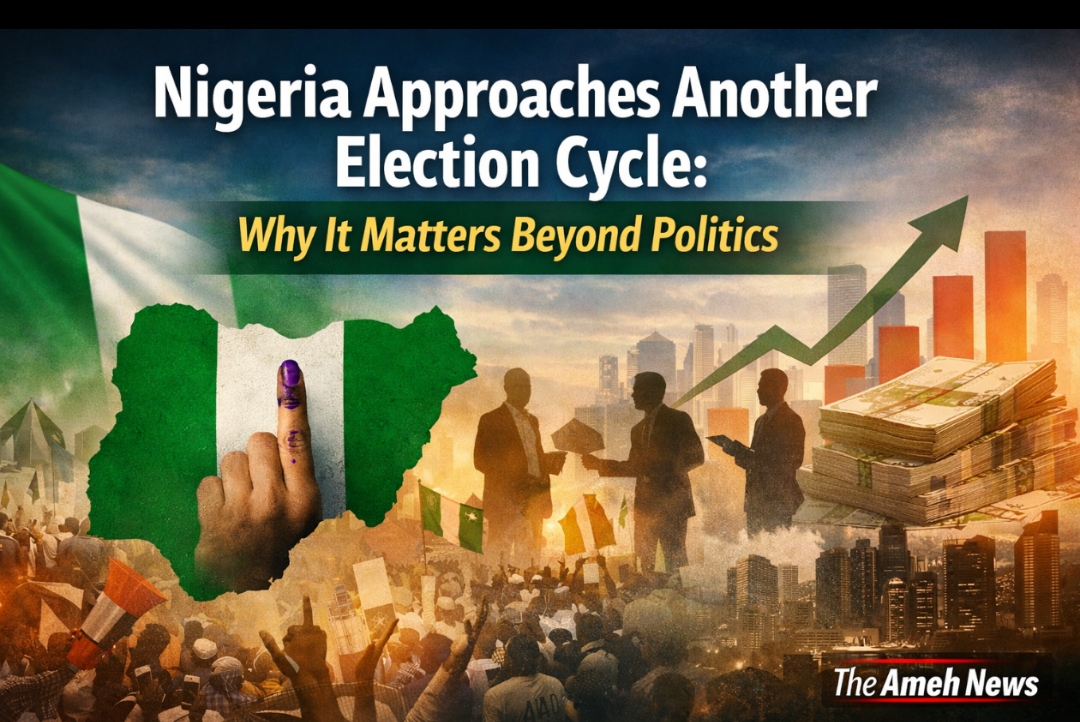
 As Nigeria approaches another election cycle, the conversation around the Election Economy is gaining renewed attention among economists, communication experts, and business leaders. What is often seen as a purely political season is increasingly being reframed as a short, intense commercial cycle — one that temporarily reshapes demand patterns across media, logistics, advertising, branding, and digital services.
Questions posed by The Ameh News on how businesses should interpret and position themselves within this cycle drew reactions from industry experts, who agreed on one key point: the election period is economically active, but strategically unforgiving.
A Short-Term Economic Surge, Not Structural Growth
Speaking on the trend, Dr Akin Olaniyan, a veteran journalist with over three decades of experience, a leadership coach, and Lagos Business School lecturer, described the Election Economy as a “high-intensity but short-lived business surge that rewards preparation over improvisation.”
According to him, while the cycle generates visible economic activity, it rarely translates into long-term structural business expansion for unprepared operators.
“Election seasons amplify demand, especially in media and communications, but they also expose operational weakness. Businesses that lack systems tend to collapse after the cycle ends,” he said.
He added that sustainable gains come from treating election-driven contracts as part of a broader portfolio strategy rather than a standalone income source.
Economy of Speed, Liquidity and Opportunistic Demand
For Celestine Ukpong, an economist, the Election Economy is best understood as a “liquidity injection cycle” driven by political urgency rather than productive economic expansion.
“It is a demand shock economy. Money circulates quickly, but it is concentrated in services that can deliver speed — media buying, logistics, branding, and campaign infrastructure,” he explained.
He cautioned that SMEs often misread the cycle as sustainable growth, when in reality it is time-bound consumption spending.
“The danger is over-expansion. Many businesses hire aggressively or scale equipment for a cycle that lasts only months,” he added.
Communication, Influence and Reputation Markets Expand
From a communications perspective, Dr Ejike Nduilo, a public relations strategist and founder of Henryjvaleens, said the election season creates a “reputation economy” where perception management becomes as valuable as physical goods.
“Every election cycle expands the demand for narrative control. Political actors, brands, and institutions all compete for attention, credibility, and influence,” he said.
He noted that digital platforms have intensified the competition, making speed and content precision critical.
“Today, social media strategy is not optional — it is central. Those who understand audience sentiment in real time will dominate the space,” he added.
Financial Discipline and Cash Flow Reality
Also reacting, Peter Adebayo, a Fellow of the Institute of Chartered Accountants (FCA), emphasised the financial implications of operating within a volatile, short-cycle economy.
“The Election Economy is profitable on the surface, but it is a cash flow-sensitive environment. Payment delays, contract uncertainties, and political risk are real,” he warned.
He advised businesses to maintain strict financial discipline, especially in managing receivables and avoiding over-leverage during peak demand.
“Treat election income as seasonal revenue, not recurring income. That distinction determines whether a business survives after the cycle,” he said.
Where the Opportunity Lies
Despite differing perspectives, all experts agreed on one point: the Election Economy rewards preparedness.
Key opportunity zones identified include:
Media production and advertising services
Event management and political logistics
Printing, branding, and campaign materials
Digital media and social engagement services
Security and protocol coordination
However, they emphasised that the real differentiator is not sector entry — but execution speed, credibility, and operational readiness.
Positioning for the Cycle
The consensus from expert responses suggests a clear framework for businesses:
Build capacity before demand peaks
Strengthen networks across political and private sectors
Prioritise cash flow management over expansion
Focus on execution speed and reliability
Treat contracts as portfolio opportunities, not long-term anchors
The Election Economy remains one of Nigeria’s most intense but misunderstood business cycles. It compresses opportunity, accelerates spending, and rewards agility — but it also exposes weak structures and short-term thinking.
As Nigeria moves closer to the next election season, the message from experts is consistent: opportunity is real, but sustainability depends entirely on discipline, timing, and strategy.
Experts Warn Nigeria’s Election Economy Is a Short-Term Boom With High Opportunity and High Risk for Businesses
Nigeria’s Election Economy is creating a short-term business surge across media, branding, logistics, and PR services. Experts Dr Akin Olaniyan, Celestine Ukpong, Dr Ejike Nduilo, and Peter Adebayo explain opportunities, risks, and how SMEs can position strategically for the election cycle.
Discover more from Ameh News
Subscribe to get the latest posts sent to your email.